
The (Un)Certainty of (Be)Longing in Peishen Liang’s Threshold
I find that like me, many people like to begin by defining things. Not out of an obsession for labelling them, but in hope to understand them beyond what one may already know. If in luck, one may find some sort of clarity or even resolution to wonder.
This is how I feel about most photographs. I enter them from a place of curiosity, sometimes wonder, sometimes revulsion, and sometimes relatability. Peishen Liang’s Threshold compels a combination of some of these feelings from me. However, in a way that is paced, controlled, and gently brings to the fore of my memory different times where I found myself in one threshold or the other.
What does threshold even mean?
Threshold /θrɛʃ(h)əʊld/
1. The strip of floor or ground at the bottom of a doorway that you step over when
entering a room or building.
2. The specific point, level, or value at which an effect, reaction, or rule begins.
3. Being on the verge or brink of a major change, new phase, or important event.
While all three definitions may seem—no, are—different, what they all share are the feelings associated with being in those positions, chief among them being (un)certainty, no matter how brief. In Liang’s work, however, what stands out is that third definition: the verge of a major change tied to dislocation, to having to move places for a time, whether within a country or between them. Here, the vulnerability of leaving is almost always promised. One work in the series that immediately reflects this is Sixty Seconds.
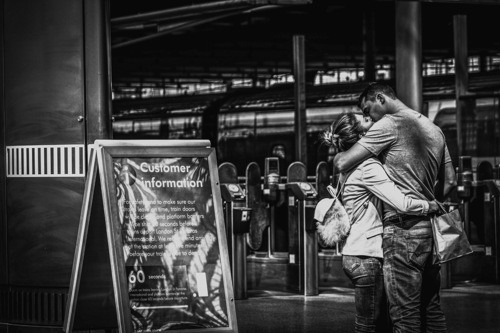
Peishen Liang, Threshold, Sixty Seconds © Peishen Liang
In Sixty Seconds, we see two people—a man and a woman—locked in an intimate embrace beside a train platform's information board. It is unclear who is leaving, but one of them is undoubtedly being left behind. The board speaks to the cold, methodical precision of transit. Still, one may pose a quiet question: why sixty seconds, and not one minute? The language itself insists on an unforgiving urgency—one Liang captures alongside a couple who seemingly refuse to be threatened or pressured by it. Also striking is the way the artist has managed to place something so impersonal in close proximity with something so intimate, offering at once a seamless way of seeing two distinct realities. By holding these two truths in the same frame, Liang portrays the quiet, nuanced tension that defines Threshold.
In contrast, The Lucky Ones presents a man and woman amidst children whose complete
presence is discernible only on close scrutiny. One child is clearly noticeable, while another and maybe a third are partly obscured by the woman. The visible child, a girl, has a hand on a suitcase, while the man and woman each have on one hand, a take-away cup of coffee, or tea, or something else. At a glance, one may presume them to be travelling as a family. And this may be why Liang has called them “The Lucky Ones”. Or could it be for other reasons? Like having the means to travel or possessing the freedom to choose where to build a life, even temporarily. Or perhaps, it highlights the sheer privilege of being able to move freely across borders—a possibility that remains out of reach for many people from certain continents. While a single photograph cannot factually reveal this family’s economic reality or emotional closeness, the work invites us to consider parallel realities and conversations around the unequal systems of passports, visas and access that shape international mobility cross-border travel, even if these concerns would most likely remain unresolved for years to come.
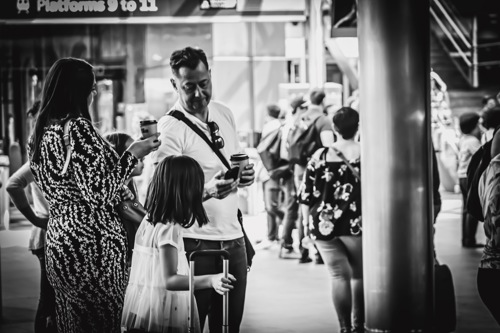
Peishen Liang, Threshold, The Lucky Ones © Peishen Liang
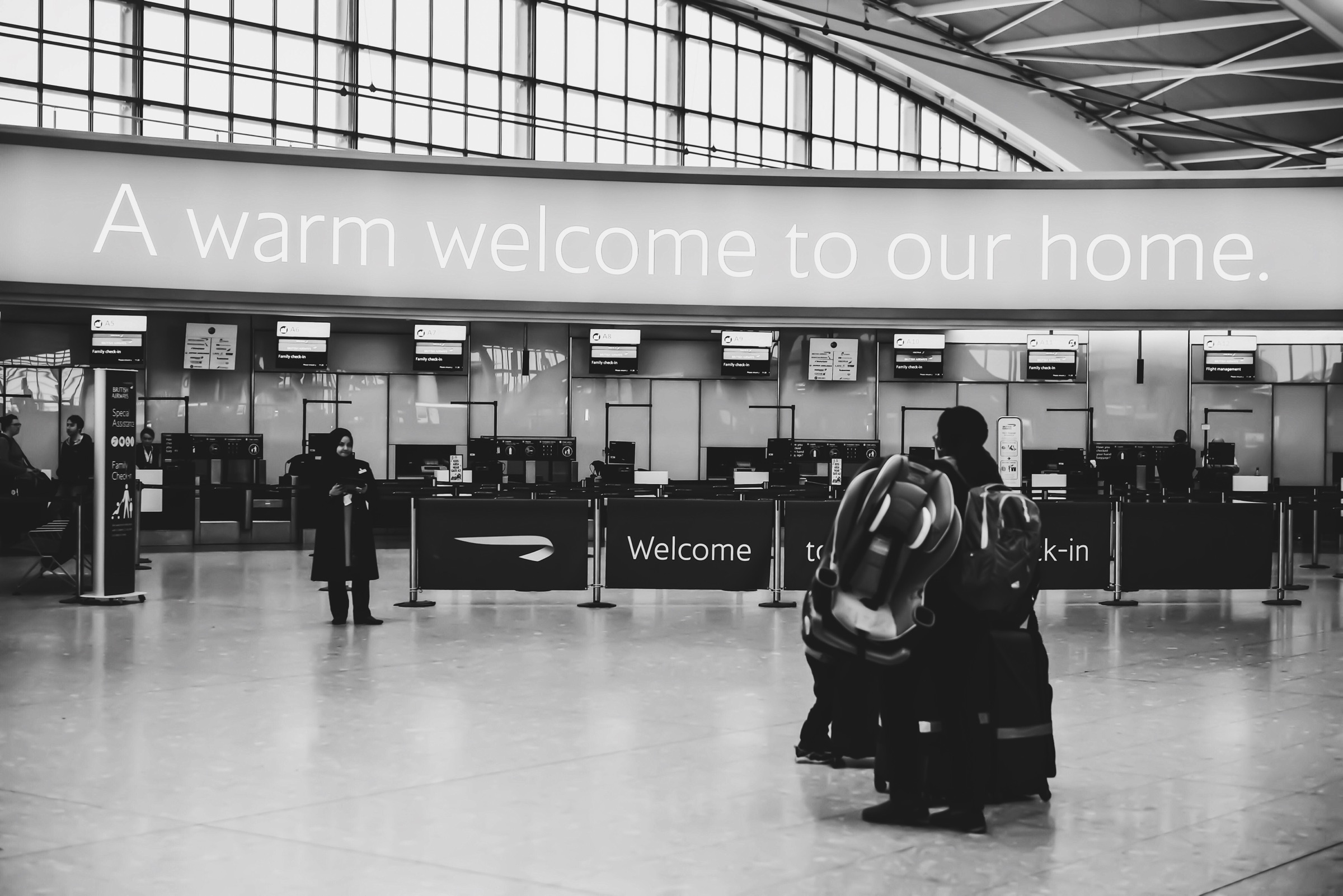
Their Home further complicates the idea that home is a fixed location. In this photograph set at London’s Heathrow Airport, we see a woman with her back to the camera, balancing a backpack and a child’s car seat on her shoulder. She stands a short distance from a check-in counter, but the intent of her direction is obvious. The counter bears the familiar logo of British Airways. Across from her, another woman, presumed to be an airline employee, stands facing the oncoming passenger—and, by extension, the camera. Below the car seat on the passenger’s shoulder, the small feet of a child peek out, partially obscured—a recurring visual tactic Liang utilises to test the limits of what a photograph can truly reveal. Above them, a prominent horizontal sign bears the words “Welcome to our home”. Looking at this image, one has to wonder what the idea of home is, and who gets to call a place home. The word ‘home’ shifts depending on who is speaking. Whose home is being offered, and what does it mean to be welcomed into someone else's? For the passenger, we cannot tell what or where she considers home, and if she is travelling towards or away from it. This nuanced complication is one of the intrigues Liang offers curious audiences who encounter works in this series.
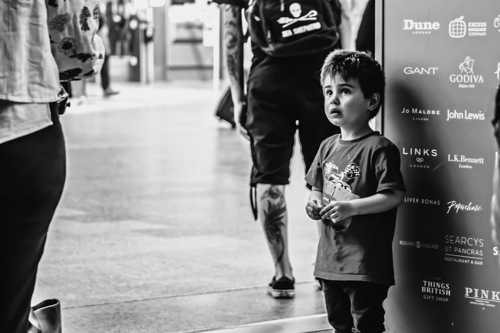
Peishen Liang, Threshold, Someone © Peishen Liang
There is another photograph of a child—this time the sole subject—in the work titled
Someone. No more than three years old, the boy tilts his gaze upward, directed at a figure or object far beyond the frame. The tentative meeting of his small fingers and the rapt attention across his face only intensify the (un)certainty of what he may or may not be longing for. Here again, the viewer is left to negotiate the space between what is visible and what must be imagined, confronting in the process the quiet peculiarities of looking at photographs of a stranger.
Across Threshold, Liang’s decision to work in monochrome is clearly intentional. In the
accompanying artist statement, he explains that colour can distract from the emotional and gestural narratives he seeks to emphasize. Departure points are almost always chaotic, overstimulated spaces; stripping away color allows the viewer to absorb micro-details that might otherwise go unnoticed—details essential to interpreting the core thesis of Threshold.
Yet, The Hope presents a striking exception. It breaks from this visual strategy, carrying faint, atmospheric hues of blue, purple, and yellow. Does this subtle tint lend itself to the promise "hope" beyond the subjects themselves, who all stand with their backs turned to the camera? Or was it a visual pull—a form of hope—that drew their collective gaze in one direction? The nature of hope, however, is that while it foregrounds optimism, it guarantees no certainty—just as the absence of color does not inherently imply gloom.
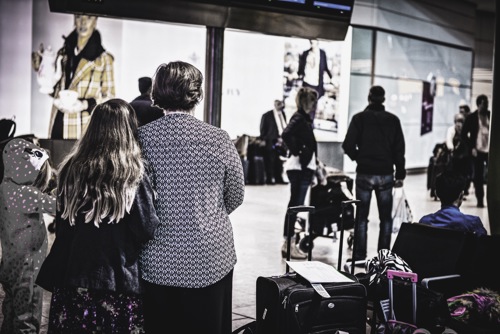
Peishen Liang, Threshold, The Hope © Peishen Liang
With Threshold, Liang brings the impersonal machinery of transit into observable proximity with the personal experiences of those who move through it. Through his lens, one may feel all the more the various feelings and layered vulnerabilities that come with departures and arrivals. The lure of this body of work is not necessarily its newness. We know these feelings, and we are familiar with them, especially if one is a frequent traveller. However, being an actor in a movie offers a different view from being a spectator. Liang offers his audience the opportunity to be on the other side for once, without the pressure of thinking about excess luggage, delayed departure times, or even the uncertainty of stepping onto new ground. Here, he offers us the opportunity to be a different kind of traveller through his images.
This brings us back to that initial impulse to define things in the hope of reaching a deeper
understanding. Looking closely at Threshold, however, underscores the profound limitations of expecting a photograph to reveal everything. What Threshold offers instead is a simultaneous reality: a realm where the vulnerabilities of longing and belonging, leaving and staying, welcome and goodbye, remain in constant negotiation with movement—whether one is travelling for a brief season or migrating towards a new life far from where or what was once home. Perhaps this is where the photographs find their meaning, not necessarily in only what they reveal, but also, in all that remains unresolved.
Main Image: Peishen Liang, Threshold, Their Home © Peishen Liang