
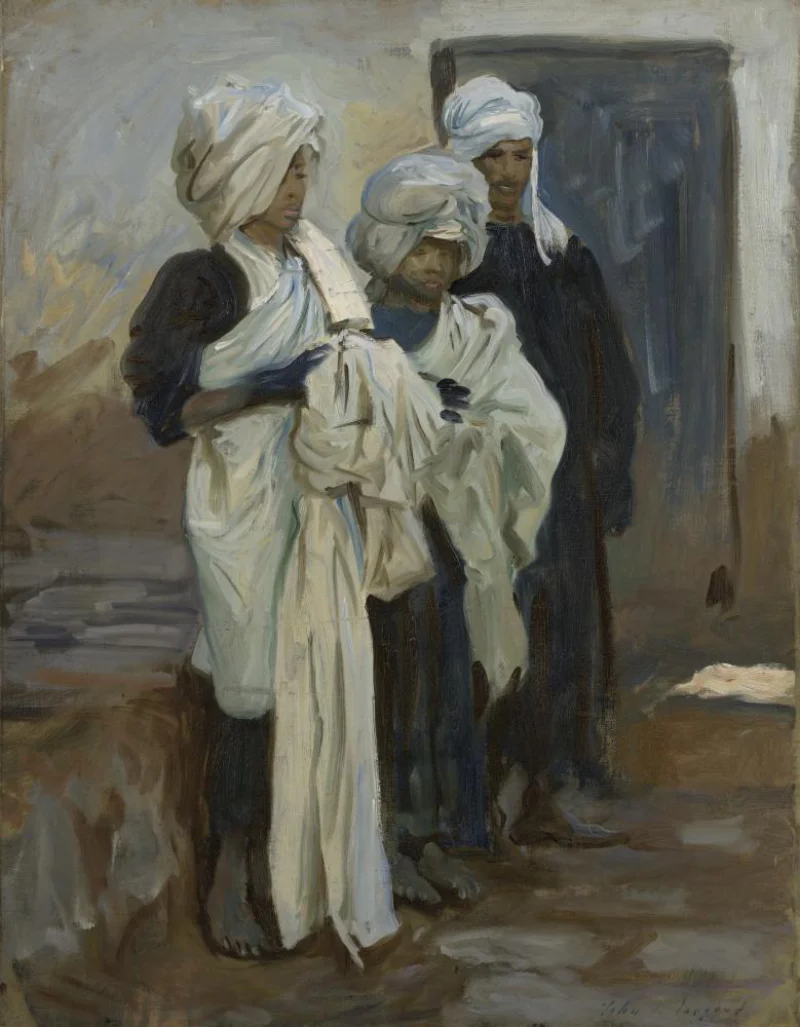
Following extensive conservation treatment, Egyptian Indigo Dyers by John Singer Sargent is once again on display at The Mesdag Collection. The painting is the only work by Sargent in a Dutch public collection. Technical examination carried out during conservation revealed new details, including an underlying composition and fingerprints along the edge of the painting.
Sargent painted Egyptian Indigo Dyers after travelling through Western Asia and North Africa in 1890 and 1891 in search of inspiration for murals in the Boston Public Library. In Egypt, his subjects included indigo dyers: craftspeople who practised a dyeing technique that was increasingly under pressure during the period of British colonial rule.
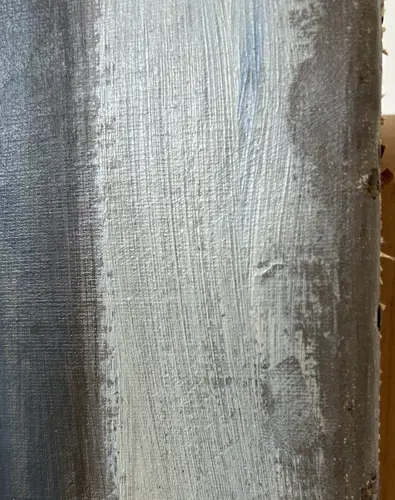
Fingerprints along the right-hand edge of the painting
Hendrik Willem Mesdag and Sientje Mesdag-van Houten were particularly drawn to works with a sketch-like quality that reveal the artist’s working process, as in this painting by Sargent. They acquired the work between 1899 and 1902, possibly with the assistance of the Italian artist Antonio Mancini. Mancini was a friend of Sargent’s and also sold several works to the Mesdags.
The painting was in need of conservation treatment. The yellowed varnish layer has been removed, making the colours more visible once again. In particular, the figures’ white garments now appear fresher and lighter. Where possible, old retouches and overpaintings that had discoloured over time were removed, and new retouches were applied. The painting was then given a new varnish layer.
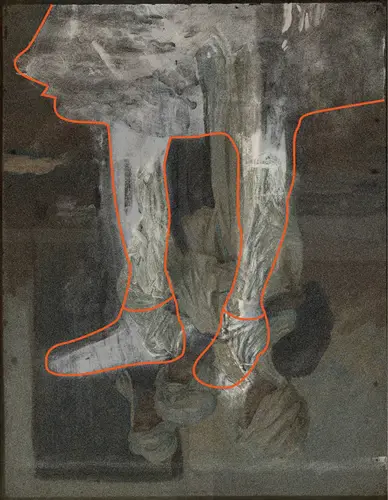 Beneath the current composition lies an earlier image: a cropped pair of legs
During conservation, the work was examined using techniques including Macro X-Ray Fluorescence (MA-XRF). This method makes it possible to identify a number of chemical elements present in the paint. Analysis revealed an underlying composition containing mercury beneath the image of the indigo dyers. Mercury is the principal component of the red pigment vermilion. Analysis also identified cobalt and ultramarine in the blue areas of the painting. Whether Sargent used genuine indigo remains unknown.
The research also led to a surprising discovery. Beneath the current composition lies an earlier image: a cropped pair of legs. These closely resemble the legs of a figure in a work by the 17th-century painter Diego Velázquez, whose paintings Sargent studied and copied while in Spain. Part of the red ground layer remains visible to the naked eye in the lower left corner of Egyptian Indigo Dyers.
It is possible that Sargent cut up an earlier copy after Velázquez in order to take the canvas with him to Egypt. The removal of the varnish layer also made fingerprints along the right-hand edge of the painting more visible. Sargent likely handled the painting there while the paint was still wet.