
The Painted Language of Tarot: From Renaissance Courts to Contemporary Art
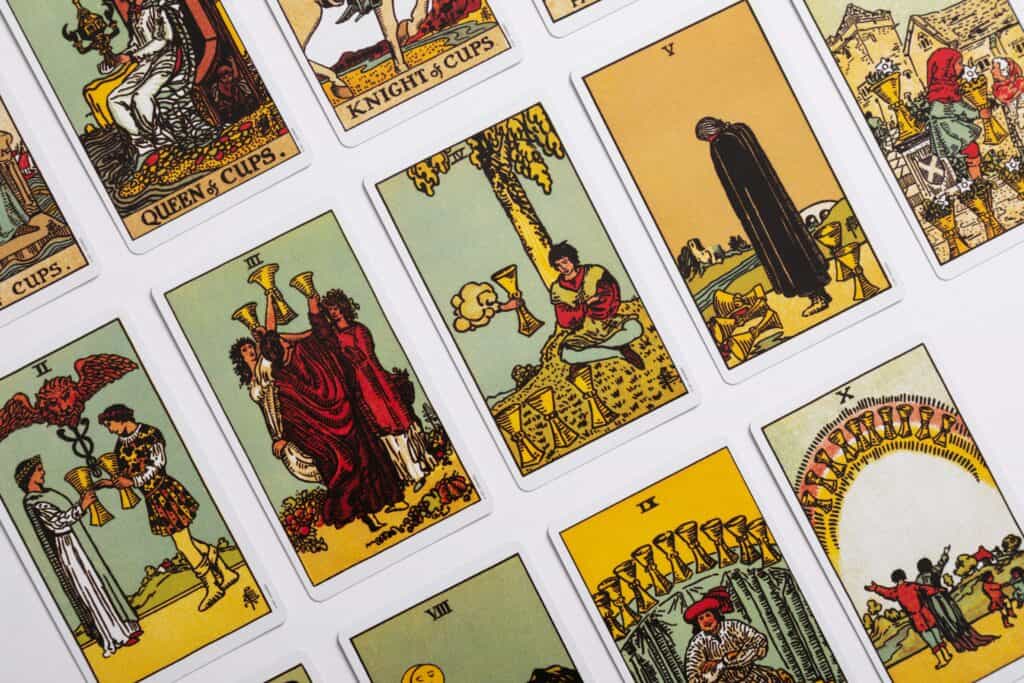
Long before tarot became shorthand for fortune-telling, it was a painter's commission. The earliest surviving decks, produced for the Visconti and Sforza families of Milan around the 1440s, were luxury objects: hand-painted, gilded, and burnished by court artists for an aristocratic clientele.
They were made not for divination but for play — a trick-taking game known as tarocchi, whose trump cards, the trionfi or "triumphs," borrowed the allegorical pageantry of the era's triumphal processions and of Petrarch's poetry. Divinatory readings came centuries later, an eighteenth-century overlay on what began as an aristocratic pastime rendered in gold leaf.
The surviving cards are now scattered across collections — a significant group resides at the Morgan Library & Museum in New York — where they are studied less as occult instruments than as exquisite examples of International Gothic painting. Their figures, set against tooled gold grounds and dressed in the mineral blues and reds of contemporary panel painting, belong to the same visual world as the era's altarpieces and illuminated manuscripts. To look closely at a Visconti card is to see the hand of a court miniaturist: the same patience with brocade, the same idealized faces, the same gilding techniques used on devotional images of the period.
What makes tarot endure as a subject for art history is that each card is a deliberate act of composition. Nothing in the better decks is incidental. Gesture, color, the direction of a gaze, the objects placed in a figure's hands, the landscape glimpsed behind them — all are arranged to carry meaning. The deck is, in effect, a portable picture gallery governed by a consistent visual grammar, one the viewer is meant to read rather than merely admire.
Pamela Colman Smith and the modern icon
The deck most people picture today is the work of an artist long denied her name. When the occultist A.E. Waite set out to design a new tarot in 1909, he commissioned Pamela Colman Smith (1878–1951), a London-born illustrator and stage designer trained at the Pratt Institute in Brooklyn. Smith's imagination had been shaped by an unusually transatlantic life — childhood years spent between England, Jamaica, and the United States — and by a deep immersion in theatre and music. She designed for the stage, produced striking poster work, and was said to paint in response to music, translating sound into image. Moving in Symbolist and esoteric circles, she counted W.B. Yeats among her acquaintances and shared the period's appetite for allegory, myth, and the decorative line of Art Nouveau.
Her great contribution to tarot was pictorial. Earlier decks had left the minor suits as plain heraldic arrangements — four cups, seven swords — like oversized playing cards, abstract and inert. Smith populated every one of those cards with a fully drawn human scene: a figure walking away from a row of cups under a clouded sky, a man burdened beneath ten staves, three craftsmen conferring in a cathedral. In doing so she turned a numerical system into a sequence of small narrative tableaux, each legible at a glance. This is the principal reason her designs have been copied, adapted, and reinterpreted more than any others in the medium's history: she gave tarot a complete vocabulary of images.
That pictorial richness is also what allows the cards to be interpreted at all. Because Smith encoded specific symbols into each composition — a falling tower struck by lightning, a figure suspended serenely upside down, a sunlit child on a white horse — readers parse them much as one reads any allegorical painting, attending to attribute and gesture. A modern reference for tarot card meanings essentially functions as an iconographic glossary, decoding the same kinds of motifs an art historian would catalogue in a Renaissance panel: who holds what, who looks where, and what each emblem traditionally signifies.
And yet, for the better part of a century, the deck was sold simply as the "Rider-Waite" — named for its publisher and its commissioning author, erasing the woman who actually drew all seventy-eight cards. Smith was paid a modest flat fee, received no royalties as the deck became one of the best-selling artworks of the twentieth century, and died in relative obscurity. Only in recent decades has "Rider-Waite-Smith" become the standard credit, a small act of art-historical justice restoring her to the line where she always belonged.
Into the museum and the garden
Tarot's imagery proved irresistible to twentieth-century artists, who recognized in it a ready-made lexicon of dream symbols. The Surrealists were especially drawn to its logic of chance and association; stranded in Marseille in 1940–41 while awaiting escape from occupied France, a group of them designed their own deck, reinventing the traditional suits around emblems of love, dream, revolution, and knowledge. Salvador Dalí, ever alert to a potent visual tradition, later produced an elaborate tarot of his own, collaging himself and his wife Gala into the major arcana.
The most ambitious translation, though, is sculptural. Niki de Saint Phalle's Tarot Garden (Il Giardino dei Tarocchi) in Garavicchio, Tuscany, took shape over nearly two decades before opening to the public in 1998. There she built monumental walk-in sculptures of the twenty-two Major Arcana — the Empress, the Tower, the Sun — encrusted with mirror, glass, and ceramic mosaic in her signature exuberant palette. Visitors do not contemplate these cards so much as inhabit them, climbing inside figures that tower over the Tuscan landscape. It is perhaps the most vivid demonstration ever made that tarot's figures were always, at heart, works of art: not predictions but pictures, built to be entered and read.
Seen this way, the deck belongs on the wall as much as on the table — a thread of symbolism running unbroken from gilded Renaissance courts to contemporary installation, its painted figures waiting, as they always have, to be read.