
The Other Worlds We Inherit in Yaroslava Murashko’s Art
Yaroslava Murashko's images are often populated by characters who appear to have
arrived from somewhere else: another century, another mythology, another novel,
another imagined world.
Yet what gives them their particular force is not the strangeness of these worlds, but the intimacy with which she constructs them. A room, a garment, a landscape, a face, a shaft of light or an object placed at the edge of a composition can make an invented world feel uncannily close. Her images are attentive to the moment when fiction acquires physical presence.
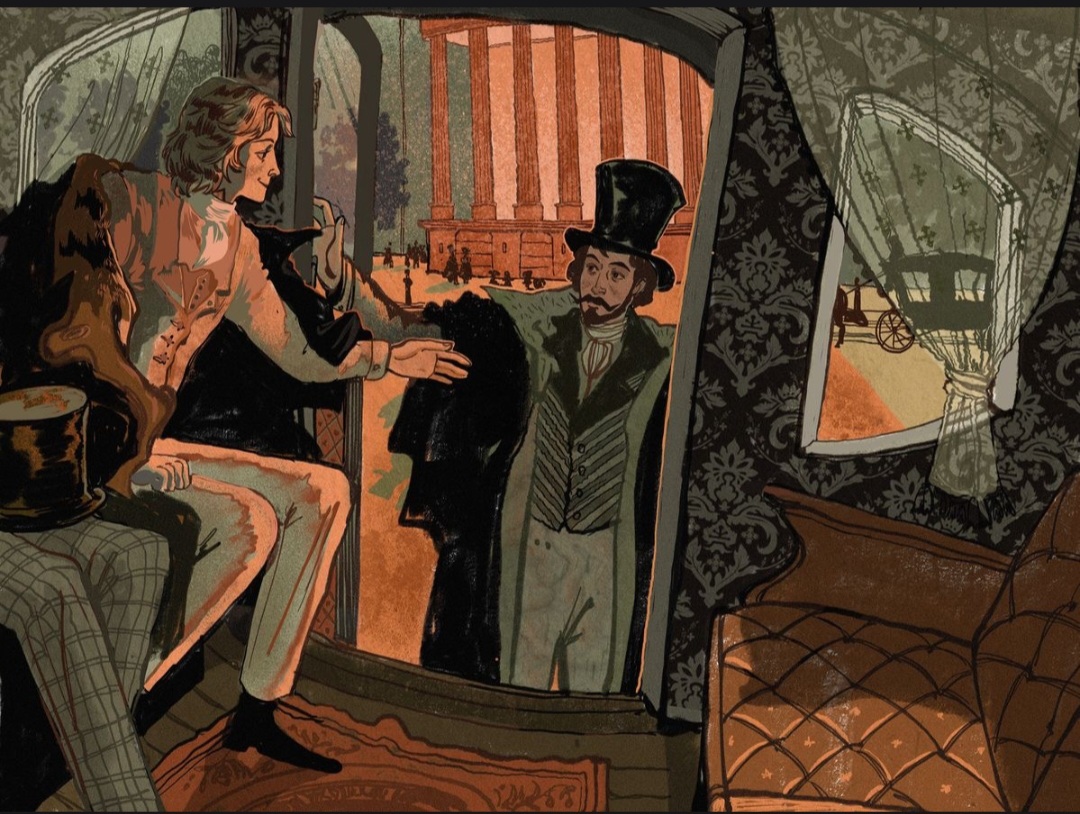
Working across literary illustration, comics, bookmaking and independent image-making, Murashko approaches an existing story not as something to reproduce but as something to enter. Her training in production design is significant here, although the influence of cinema on her work is less about cinematic spectacle than about the construction of space. Her characters are rarely isolated from their surroundings, as their environments seem to carry their own memories, histories and emotional temperatures. And this is quite evident in her illustrations for Oscar Wilde's The Picture of Dorian Gray. Created for the 2021 Chinese edition of the novel, the series belongs to an early stage of Murashko's professional practice.
The images have a distinctly enclosed quality. Rather than relying on dramatic gestures or exaggerated expressions to communicate Wilde's atmosphere of beauty and corruption, Murashko allows interiors with a hint of surrealism to do much of the psychological work. The eye moves across rooms crowded with architectural and domestic details: furniture, books, paintings, windows, lamps and other objects are arranged with the deliberateness of a stage set, but without becoming theatrical in the conventional sense. There is a stillness to these spaces, a sense that something has happened just before we arrive or is about to happen after we leave.
Heaven Official's Blessing
Her composition frequently places the human figure within, rather than in front of, the space. This distinction is important. The character does not dominate the image, but is absorbed into a larger arrangement of space, light and objects. In one of the studio scenes, for instance, the portrait itself becomes a second presence within the room, creating a visual tension between the living body and its painted double. The architecture, furniture and objects around them extend the psychological drama beyond the figures.
There is also something almost tactile about the atmosphere. Murashko's palette avoids the easy seduction of saturated colour. Instead, muted tones and controlled contrasts create an old-world richness, allowing the occasional stronger colour to acquire greater weight. The effect is neither simply dark nor gothic. It is atmospheric in the more literal sense, in that the colour seems to belong to the air of the room. This attention to atmosphere is one of Murashko's strengths. She understands that mood does not have to be represented through an expression on a face. It can be built into the temperature of an image.
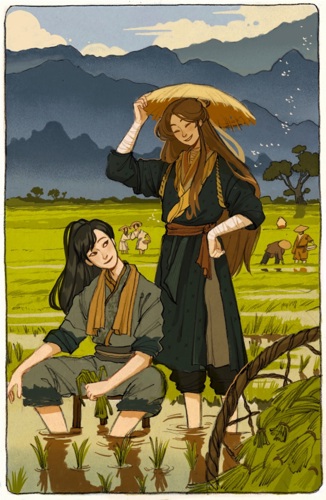
The same principle becomes more expansive in Heaven Official's Blessing, where Murashko was required to inhabit a fantasy universe already familiar to a large readership. Across six volumes, she produced six covers and approximately fifty interior illustrations, combining pencil drawing with digital colour and post-production. The visual language here is markedly different from Dorian Gray. With Heaven Official’s Blessing, the compositions become more ornamental and the figures more prominent. Bodies are elongated and carefully posed, garments fall in elaborate layers, and decorative details create a sense of abundance. Colour becomes more expressive, working not only to distinguish characters and settings but to intensify the emotional register of the scenes. Where Dorian Gray often feels enclosed, Heaven Official's Blessing tends towards movement and theatrical expansion.
Murashko's use of illustrative tools does not produce the anonymous smoothness that can sometimes characterise digital fantasy illustration, and pencil remains an important structural element. Lines retain the slight irregularity of drawing, while digital colour allows her to build atmospheric depth and ornamental complexity. The resulting surface sits somewhere between the intimacy of a sketch and the polish of a finished cinematic image. This hybridity is important to her practice. The digital image is not created as immaterial; it becomes a way of layering surfaces, preserving the tactile suggestion of the drawn line while extending the possibilities of colour and composition. There is also an interesting tension between figure and ornament in the works from Heaven Official's Blessing. One may find that characters often appear surrounded by elaborate clothing, architecture, vegetation or decorative motifs, establishing the emotional and cultural world in which the figures exist. This was also the project in which Murashko's interpretation encountered resistance from parts of the existing fan community, particularly around her stylised approach to the novel's ancient-Chinese-inspired setting. But what is more interesting than the disagreement itself is the question it raises about visual authorship. A literary character may exist differently in the imagination of every reader, and the illustrator makes one of those possibilities visible. By doing this, she necessitates the need to transform this overlooked relationship between reader and text, serving as an act of interpretation. This becomes particularly clear when she turns towards Russian folklore.
Russian Folk Tales with Female Archetypes
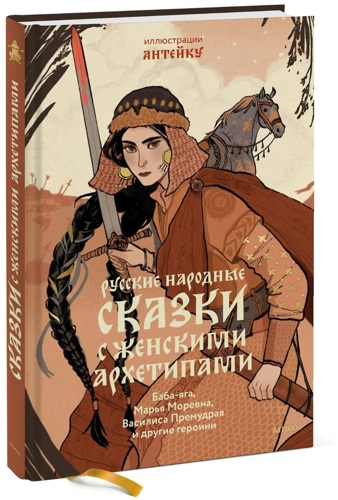
In Russian Folk Tales with Female Archetypes, Murashko works with characters whose visual identities have already been shaped by generations of retelling. Baba Yaga, Marya Morevna, Vasilisa the Wise, and the other women in the collection arrive with cultural associations already attached to them. Her approach to this work could be seen as not simply inventing their appearance, but determining what can still be made visible in
characters that feel almost archetypal.
Again, with this work, the palette is deliberately subdued, a decision she herself associates with the archaic. Rather than covering the page in competing colours, she frequently places the figures against large, relatively flat areas of colour. These fields create a calm visual ground against which the characters become sharply articulated. The effect is almost icon-like, where the figure is given enough space to be contemplated
rather than consumed by a densely descriptive background. This restraint also changes the relationship between the character and the page. The figures feel almost suspended, as though they have been lifted from the narrative and placed before us for examination. Yet, they are remarkably detailed. Faces, hair, embroidery, jewellery, sleeves and layers of clothing receive close attention. Against the simplified backgrounds, these details become more visible. A fold in a garment can suddenly carry as much visual weight as an entire landscape.
Across these projects, Murashko repeatedly takes things that have already acquired cultural meaning and subjects them to another act of looking. Wilde's decadent interior. A fantasy character already beloved by thousands of readers. A Russian folk heroine shaped by generations of collective memory. Tolkien's invented mythology and its European sources. This is perhaps the most exciting way to understand Murashko's position as an artist. Her work is concerned with inherited images, but not with inheritance as something
passive. She treats inherited narratives as active materials that can be opened, researched, rearranged and embodied differently. This temporal quality is particularly evident in her use of costume. Historical dresses
become a way of locating a body within an imagined social world. Likewise, architecture does not simply tell us where a story occurs; it establishes what kind of life might occur there. Colour does not merely beautify an image. It alters its temperature and determines how we move through it. These decisions give Murashko's work its particularly compelling effect.
Even when her subjects are fantastical, her images are rarely chaotic. There is control in the way she distributes visual information. Some things remain sharply visible while others recede into atmosphere. Murashko's images often work similarly: a face is precise, while the landscape behind it becomes diffuse; a costume is meticulously constructed, while the surrounding space is reduced to a field of colour; an architectural detail is rendered with care, while the larger world remains partially withheld.
The withheld becomes as important as the depicted. This is where her work moves beyond the simple act of illustrating a text. Murashko is interested in what an image can suggest that a narrative does not explicitly state. Her pictures are full of spaces for projection, and they invite the viewer to complete the world. It is tempting to describe this simply as world-building, particularly because fantasy and mythology recur throughout her practice. This is why the four projects, despite their different sources, belong together. They reveal an artist whose real subject is not Dorian Gray, or Xie Lian and Hua Cheng, or Baba Yaga, or Middle-earth. Her deeper subject is the relationship between people and the worlds they inherit, imagine and inhabit. While the stories provide the architecture, Murashko changes the light.
Main Image: The Picture of Dorian Gray