
The Metropolitan Museum of Art repatriates Two Sculptures to Republic of Türkiye
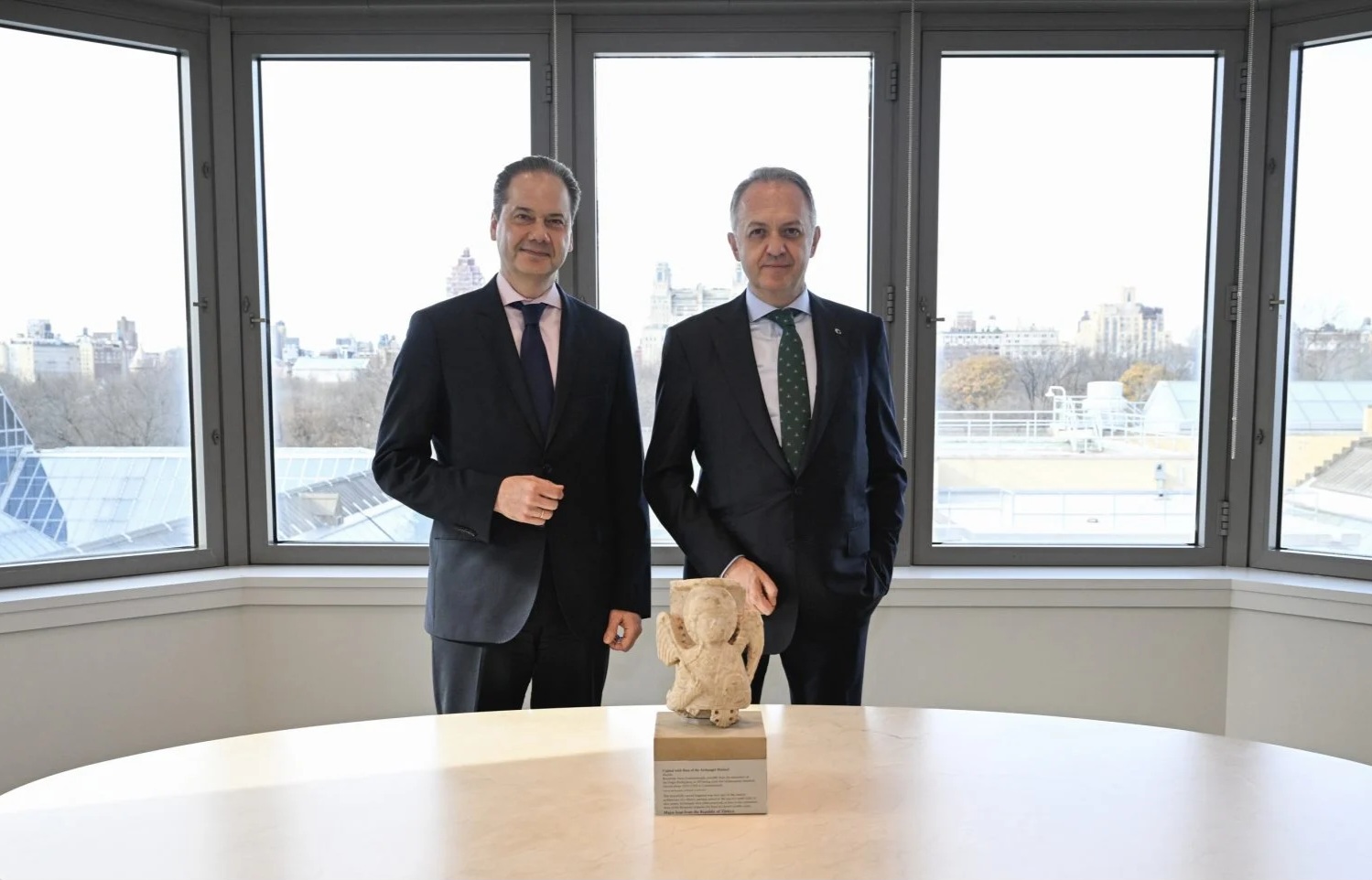
One of the two works—a Byzantine sculpture Capital with Bust of the Archangel Michael—was generously lent back to The Met for three months, marking the first loan from Türkiye to The Met in over two decades
The Metropolitan Museum of Art announced today the repatriation of two sculptures, the Capital with Bust of the Archangel Michael and the Marble Head of Demosthenes, to the Republic of Türkiye. The Met transferred title of the two works to Türkiye this fall, in cooperation with the Manhattan DA’s investigation of Robin Symes and Fortuna Fine Arts Gallery, respectively. Türkiye, in turn, generously lent the Capital with Bust of Archangel Michael back to The Met where it was displayed for three months. It was the first artwork to be loaned directly from the country to The Met in over two decades, marking an important collaboration between the Museum and Türkiye. The loan was celebrated with a ceremony at The Met, attended by: Max Hollein, Director and CEO of The Met; Gökhan Yazgı, Deputy Minister, Ministry of Culture and Tourism, Türkiye; and Zeynep Boz, Head of Department, Ministry of Culture and Tourism, Türkiye.
“The Met greatly values our open and ongoing dialogue with the Republic of Türkiye, and we were honored to collaborate together on these repatriations and on the historic loan,” said Max Hollein, Director and CEO of The Metropolitan Museum of Art. “This partnership underscores our commitment to the responsible stewardship of cultural heritage, and we look forward to continuing our collaborative efforts to enhance the world's understanding and appreciation of the arts of Türkiye.”
Deputy Minister Gökhan Yazgı emphasized the collaborative nature of the process, noting: “This repatriation, carried out in close cooperation with the MDA and HSI, reflects our shared commitment to justice, scientific clarity and the responsible stewardship of cultural heritage. We appreciate the steps The Met has taken to strengthen provenance research and the constructive cooperation developed throughout this process. The presentation of the Archangel Michael capital prior to its return was a meaningful gesture and may provide a solid foundation for further collaboration as this positive spirit continues.”
Carved in marble in late thirteenth-century Constantinople, the Capital with Bust of the Archangel Michael is an exceptional example of late Byzantine sculpture and architectural design. Said to have been discovered in the vicinity of the Monastery of the Virgin Peribleptos complex in Psamathia (modern Samatya), the work offers a rare material link to one of the capital’s most important religious foundations. Once part of the Byzantine church’s interior—perhaps crowning a column or framing a sacred niche—the capital reflects the sophistication of Byzantine carving at the twilight of empire. The Archangel Michael, rendered in imperial regalia and holding an orb and scepter, embodies the fusion of divine and earthly authority central to Byzantine visual culture. Its refined modeling and inscription attest to the artistry of Constantinople’s workshops during a period of renewal. The Met transferred title of the Archangel Michael to Türkiye this summer, in cooperation with the Manhattan DA’s investigation of Robin Symes. Türkiye, in turn, generously lent the work back to the Met, where it has been an attraction in its Byzantine galleries for 42 years. The Museum is grateful for this constructive resolution.
Demosthenes (ca. 384–322 b.c.) of Athens is widely considered the greatest orator of ancient Greece. More than fifty Roman portraits of Demosthenes are known, an eloquent testimony to his continued popularity in Roman times. All the existing portraits appear to reflect a single Greek original, most likely the posthumous portrait statue by the sculptor Polyeuktos erected in the agora (marketplace) of Athens in 280 B.C. The fine head captures the orator in a characteristically harsh, unhappy yet determined expression—the countenance of a noble fanatic, great mind, and passionate patriot.
The Met Collection includes over 1,700 Turkish works, represented across many of the Museum’s curatorial departments including Medieval Art, Ancient West Asian Art, Islamic Art, and more. Recent exhibitions and special installations at the Museum highlighting arts of Türkiye include Dialogues: Modern Artists and the Ottoman Past (2023), renovated galleries for the art of the Arab Lands, Turkey, Iran, Central Asia, and Later South Asia (2011), and The Making of a Collection: Islamic Art at the Metropolitan (2011).
Main Image: (L-R) Max Hollein, The Met's Director and CEO, and Gökhan Yazgı, Deputy Minister of Culture and Tourism of Türkiye, at a ceremony at The Met celebrating the loan of the Capital with Bust of the Archangel Michael.