
The Met to acquire Renaissance Artist Rosso Fiorentino’s rediscovered Seminal Painting
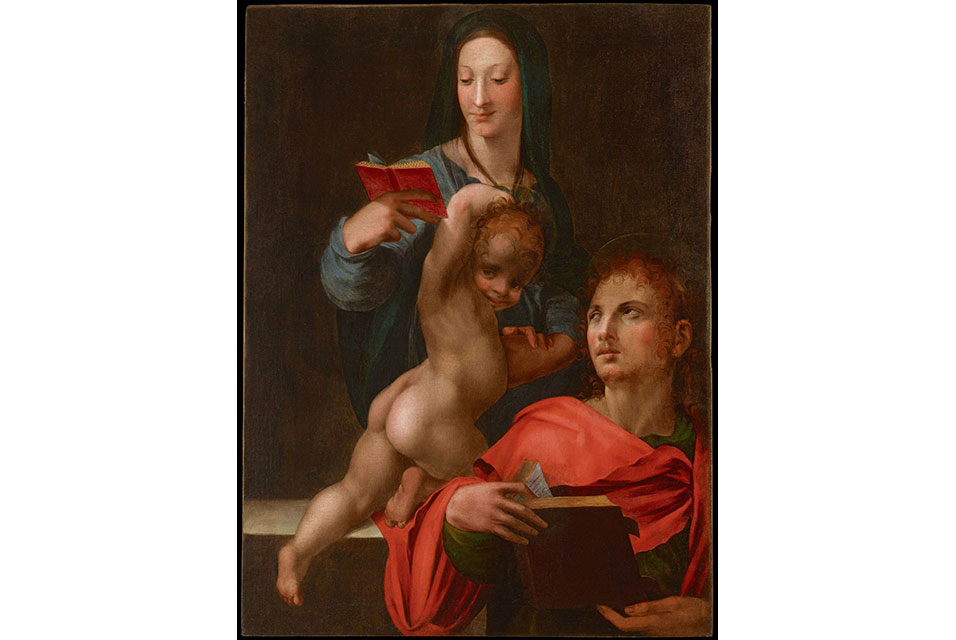
The Metropolitan Museum of Art will acquire a newly rediscovered painting by Renaissance artist Rosso Fiorentino (1494–1540), one of the great masters of the maniera moderna, known today as Mannerism.
Madonna and Child with Saint John the Evangelist, thought to be lost for centuries, was newly identified during a recent conservation treatment that removed a layer of overpaint on the canvas, revealing the remarkable figure of Saint John the Evangelist in the foreground of the picture plane. The reemergence of the figure—after perhaps centuries of being overpainted—made clear that this is the seminal painting described in Giorgio Vasari’s Lives of the Artists as the work that launched the young Florentine artist’s career.
"This painting is a rare and pivotal early work by one of the most important painters of the 16th century, striking in its experimental ambition and psychological intensity,” said Max Hollein, The Met’s Marina Kellen French Director and Chief Executive Officer. “With his unusual placement of the figures and daring postures, Rosso transforms a familiar devotional type into a charged encounter that draws the beholder into a complex interplay of seeing, feeling, and believing. The rediscovery of this work reshapes our understanding of Rosso’s early oeuvre and the emergence of more expressive and dynamic compositions in 16th-century Florentine painting.”
Stephan Wolohojian, John Pope-Hennessy Curator in Charge of the Department of European Paintings, added: “Paintings by Rosso are exceedingly rare, numbering only about two dozen, and many of his most celebrated works remain undocumented or unfinished. The discussion of this painting in Vasari’s Lives of the Artists, often described as the first book of art history, gives the work the added distinction of having been part of art-historical discourse since the discipline’s inception. Executed on canvas and preserved in remarkably good condition, it is the artist’s earliest recorded painting to survive. This work will anchor The Met’s collection of 16th-century religious paintings, an exceptional and complementary group that elucidates key developments in painting for private devotion during the first quarter of the 16th century in Italy.”
A major protagonist of early Mannerism, Rosso Fiorentino ranks among the most important Italian artists of the 16th century, influential both as a print designer and as a painter of arresting portraits and radically expressive religious works. Alongside near-contemporaries such as Pontormo and Parmigianino, Rosso pioneered a style that recast the ordered harmony of High Renaissance compositions into more dynamic and expressive configurations, engaging the viewer through sophisticated explorations of color, form, and pictorial tension.
Primarily active in Florence during the first decade of his career, Rosso traveled to Rome in 1523 but fled the city following the Sack of 1527, eventually arriving in France, where he secured a position at the court of Francis I. Working alongside Francesco Primaticcio, he became one of the leading artists at the royal château of Fontainebleau and helped establish what is now known as the First School of Fontainebleau. Rosso remained in France until his death in 1540.
Rosso’s early life remains poorly documented. Beyond a limited number of archival references—his birth on March 8, 1494; his enrollment at age 23 in the Arte degli Speziali in 1517; and scattered family records—little is known of his training. Art historians have suggested that he may have studied with Andrea del Sarto, who was only seven years his senior, though evidence for that is inconclusive. Vasari instead emphasized Rosso’s independence from formal apprenticeship, noting that in his youth he "drew from the cartoons of Michelangelo" and studied "with but few masters, having a certain opinion of his own that conflicted with their manner of painting."
Shortly after enrolling in the painter’s guild, Rosso undertook his first altarpiece commission, the Santa Maria Nuova Altarpiece (1518), a breakthrough work that rejects the balanced chromatic and compositional harmonies of the High Renaissance in favor of tension, asymmetry, and expressive intensity. The only securely dated work preceding that altarpiece is the fresco of the Assumption of the Virgin in the Chiostrino dei Voti at Santissima Annunziata, commissioned in November 1513. This fresco shows that, by this early date, Rosso had already developed a strikingly independent visual language, compressing pictorial space through a complex figural arrangement set in an environment devoid of landscape or architectural setting.
Vasari records that Rosso secured the important Annunziata commission by presenting Fra Jacopo of the Servite Order with "a painting of the Madonna and Child with a half-length figure of Saint John the Evangelist.” The recently revealed figure of Saint John in the painting currently displayed at The Met confirms its identification with this pivotal work, presented by the teenage artist to demonstrate his readiness for such an important commission. The painting can therefore be situated immediately before the Annunziata fresco of 1513, thus reframing scholarly understanding of this important moment at the start of the 16th century in Florence.
Stylistically, the work already displays the defining tensions of Rosso’s early manner. The Virgin’s hieratic stillness and Raphael-like grace contrast with the energetic Christ Child, whose exaggerated musculature and unstable pose recall both Donatello’s experimental reliefs and Michelangelo’s heroic nudes. Rosso heightens this interplay of balance and imbalance through the unusual inclusion of Saint John the Evangelist on the threshold between the devotional image of the Madonna and Child and the viewer. The saint is depicted in a state of prophetic vision that mirrors the viewer’s own heightened engagement with this subject.
Main Image: