
The Met New York Acquires Important Paintings by Chinese Ink Painter Chang Dai-chien
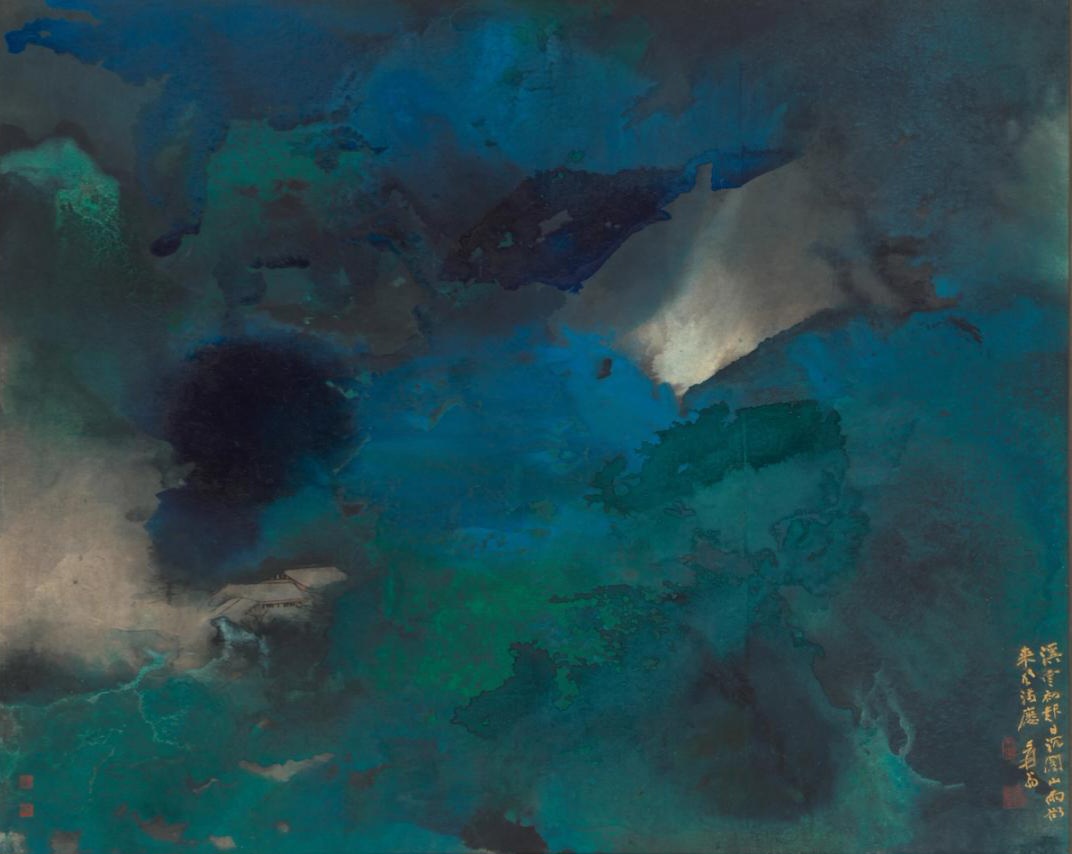
The Metropolitan Museum of Art announced an acquisition of 38 paintings by preeminent Chinese ink painter Chang Dai-chien (Zhang Daqian; 1899–1983) from the collection of the artist’s daughter, Sing Sheng Chang.
Chang Dai-chien left China in 1949 and spent the following decades moving between Hong Kong, Japan, India, Argentina, Brazil, California, Europe, and Taiwan, crafting along the way a transnational style that combined his early training with ideas and currents encountered along the way. The landmark acquisition spans all phases of the artist’s career, from his early works of the 1930s–40s to his breakthrough abstract paintings of 1965–68 to a selection of unfinished works, providing a deep and concentrated view of his singular career as an essential figure of modern art. A selection of works from the acquisition will be on view later this year, and further works will be included in a forthcoming 2028 exhibition on 20th century Chinese ink painting.
This acquisition is made possible by Sing Sheng Chang Gift, in memory of Chang Hsu Wen-po, with additional major gifts in support of the acquisition from Oscar L. Tang and H.M. Agnes Hsu-Tang, The Vincent Astor Foundation, Mary and James G. Wallach Foundation, Kristine Johnson and Timothy Dattels, Eugenia Ames, Jane DeBevoise and the Calello Family, Friends of Asian Art, The Hao Family, and Andrew Solomon and John Habich Gifts; Florence and Herbert Irving Acquisitions, Douglas Dillon, Rogers, Denise and Andrew Saul, The Miriam and Ira D. Wallach Foundation, and Philippe de Montebello Funds; Robert Hatfield Ellsworth and Brooke Russell Astor Bequests; and allocations from the Museum’s general art acquisitions funds.
“Chang Dai-chien stands as one of the most important painters of the modern era. He combined a deep knowledge of classical Chinese culture with a transnational perspective to fashion a style of ink painting that was both locally rooted and connected to a wider global outlook,” said Max Hollein, The Met’s Marina Kellen French Director and Chief Executive Officer. “This major acquisition will allow for a thorough understanding of Chang Dai-chien through career-defining works that span the range of his creativity, presenting a panoramic view of the artist’s life. We are grateful to Sing Sheng Chang for entrusting The Met with her father’s legacy, making The Met a leading center for the study of this important artist.”
The paintings span Chang’s career from the 1930s to the 1980s, covering the artist’s exceptionally broad range of styles and genres, from the classicist experiments of his youth to his abstract breakthrough of the 1960s to his later works that synthesize both currents. Each phase is represented by major works, such as the “splashed-color” and “splashed-ink” breakthrough period of 1965–68. Other periods and categories of painting in Chang Dai-chien’s career—figure painting, gestural lotus painting, meticulous flower painting, and even self-portraiture—are represented by examples of high quality. Taken as a group, these works represent 20th-century ink painting—its dynamism and modernity—at the highest level and through the story of its most celebrated practitioner.
The Sing Sheng Chang Collection provides an unusually intimate look into the home and heart of Chang Dai-chien. It contains eye-opening gems from the artist’s early period, including several works made at the Buddhist cave temple site of Dunhuang in the 1940s, very few of which exist outside of museum collections in Asia. Unfinished works, semi-completed experiments, and paintings lovingly inscribed to his daughter all make this collection unique. This allows for a richness in narrating the artist’s story that will present him in dynamic dimensionality. All the paintings in the collection were passed down to Sing Sheng Chang by her father and her mother, Chang Hsu Wen-po, the artist’s wife.
In the 1960s, Chang’s interest in abstraction blossomed in his “splashed-color” and “splashed-ink” works, which sought to locate the roots of modern abstraction within the theory and practice of Chinese ink painting.
Main Image: Chang Dai-chien (Zhang Daqian), Approach of the Storm, 1967. Purchase, Sing Sheng Chang Gift, in memory of Chang Hsu Wen-po, 2024 and 2025 Benefit Funds, and funds from various donors, 2026