
The Discovery of -0 Painting - From Natural Flow Color to -0 Painting
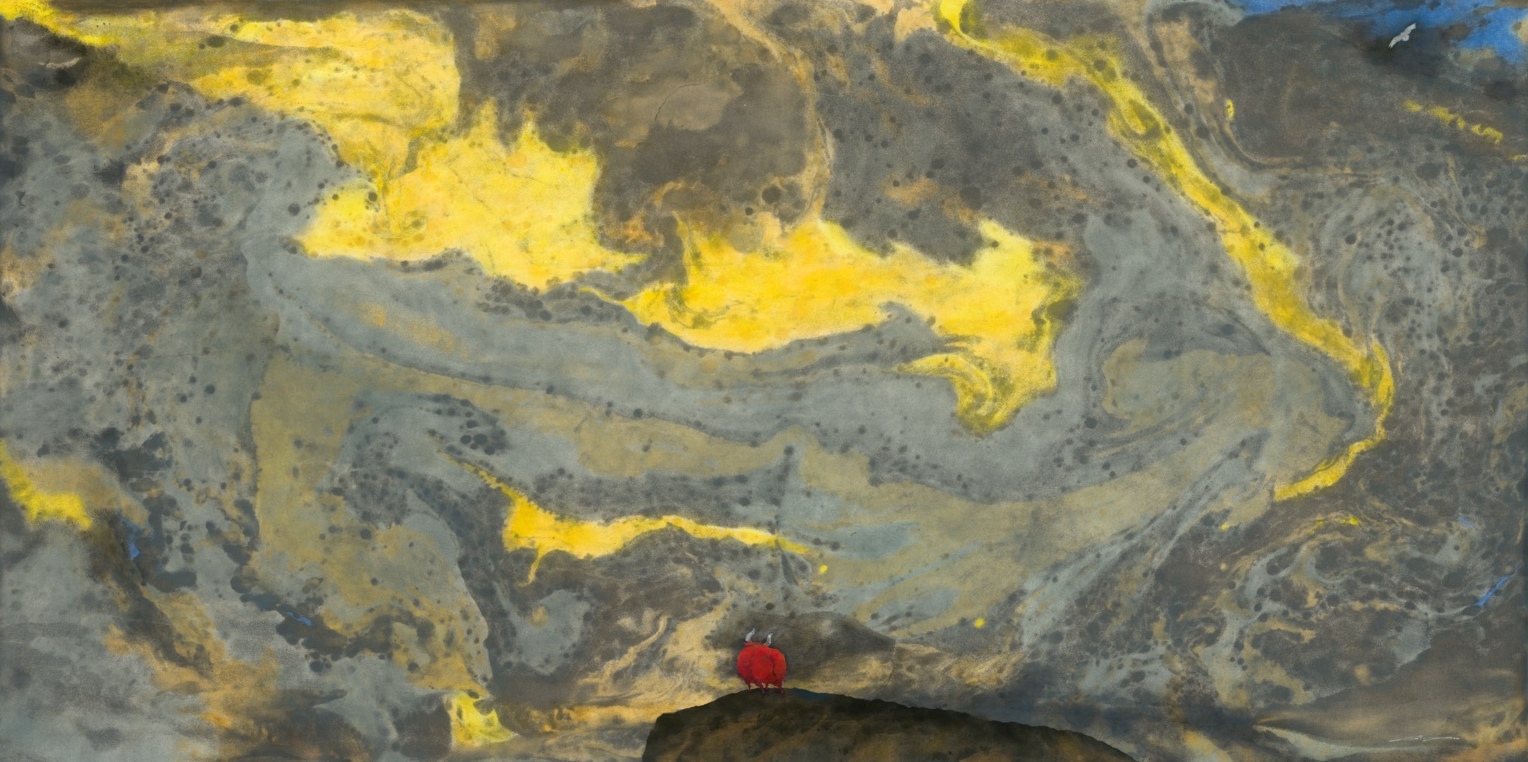
For decades, I have often been asked the same question: How did -0 Painting come into being? The answer did not begin with a theory. Nor did it begin with a style of painting. It began with an accident.
The Sound of Waves
While working on the print The Sound of Waves, I used a ground material that developed naturally cracked textures as the print was being completed. These cracks were neither drawn nor carved by me, nor were they designed in advance. They emerged naturally through changes within the material itself. Yet when I looked at them, I saw more than damage or irregular texture. I saw movement, rhythm, structure, and an unexpected expressive power.
This experience changed my understanding of artistic creation. Until then, I had mainly regarded nature as something to be observed and represented. But the naturally cracked surface revealed another possibility: nature was not only an object to be depicted. Under certain conditions, it could participate directly in the creation of an image.
Looking back today, I recognise this as the true beginning of everything that followed.
Natural Flow Color
From that point onward, I began to pay closer attention to marks, textures, flows, deposits, cracks, and transformations that arose without being directly designed by the artist. I experimented with different materials and methods, seeking to understand how naturally generated forms might enter painting and printmaking without losing their spontaneity.
I experimented with flowing colour, flowing ink, and other related processes. Later, I brought these experiments together under the name Natural Flow Color. The term refers to colours, ink traces, and other visual forms generated through the physical movement of materials and natural processes, rather than through direct manual depiction.
The name came only after the experiments. What mattered at the beginning was the discovery that the forces and properties of materials could themselves possess a creative capacity.
As the experiments continued, I gradually realised that colours formed through natural flow behaved in a fundamentally different way from colour in conventional painting. The artist could establish the initial conditions, but once the flow began, the colours developed according to the inherent properties of the materials and the physical forces governing their interaction.
Repairing the Sky
The expressive potential revealed by Natural Flow Color gradually led me to a new question: Could it cease to function merely as a supporting effect in painting and instead become a principal language of painting itself?
This question eventually led to the creation of Repairing the Sky.
At that time, Natural Flow Color presented a practical limitation. Once the flowing state had settled and become fixed on the surface, the process was essentially complete, leaving little room for the artist to continue working within it. For this reason, it could not yet be used extensively or controllably in painting.
Through repeated and unconventional experimentation, I found a way to use flowing ink controllably across a larger area. This made it possible for freely moving ink to become part of the overall pictorial structure while still remaining available for purposeful artistic use.
For the first time, naturally generated ink flow became the principal element of the image. The work was no longer organised solely around conventional modelling. Instead, the movement of ink itself became a major source of visual formation.
The resulting image was neither made solely by the artist nor produced solely by chance. It arose through an interaction between human agency and the formative powers of nature.
Although I had not yet developed a complete theoretical framework, I already sensed that I was moving beyond the original expressive limits of Natural Flow Color.
Eastward Flow
With Eastward Flow, this method entered thematic printmaking. The work was no longer merely an experiment in the behaviour of materials. Natural Flow Color began to function as part of a complete artistic expression.
Eastward Flow later received the Award for Excellence in Creative Work at the Ninth National Print Exhibition—the only category of award presented at that exhibition. For me, however, the work’s importance did not lie primarily in the award. Its deeper significance was that it demonstrated how this experimental method could accommodate both naturally generated transformation and thematic expression.
Dynamic Form Flow Color
These early works led me to a new question: Although nature could participate in the formation of an image, was it limited to flat textures lacking spatial depth and other essential pictorial elements—remaining merely a special surface effect? Could it move beyond these limitations, acquire a fuller capacity for pictorial expression, and communicate insights beyond the reach of conventional representation?
That question became increasingly urgent when I tried to give visual form to my memories of first setting foot in Beidahuang. What remained most vividly within me was never a particular landscape, object, or event. It was something far more difficult to define—a profound sense of cangmang: vastness, remoteness, emptiness, uncertainty, silence, movement, and a force that seemed almost primordial.
I could depict the visible appearance of Beidahuang, yet appearance alone could never convey that experience. The more faithfully I represented what could be seen, the more I felt that its essential reality remained outside the image.
I therefore entered another stage of experimentation. I explored different materials, states of pigment, and methods of intervention, transforming the forms generated by Natural Flow Color in search of a visual language capable of expressing cangmang—something conventional representation could not fully contain.
During these experiments, flowing colour began naturally to generate a far stronger sense of depth, movement, atmosphere, and spatial transformation. The image was no longer merely a collection of traces spreading across a flat surface. Forms appeared to advance and recede, overlap and dissolve, emerge and pass through one another.
This marked a decisive transformation. Natural processes were no longer producing texture alone. They had begun to generate the essential elements of painting itself—space, rhythm, movement, tension, relationships, and visual transformations.
As the experiments continued, I realised that something fundamental had changed. Flowing colour was no longer functioning simply as a natural phenomenon. It had acquired the essential qualities required of painting itself.
Unlike Natural Flow Color, these flowing forms no longer served merely to enrich an existing image. They had begun to generate the image itself. Space, rhythm, movement, structure, atmosphere, and expressive force now emerged directly from the flowing process.
At that moment, I realised that this could no longer be described simply as Natural Flow Color. A new artistic form had come into being. I named it Dynamic Form Flow Color.
The term Dynamic Form Flow Color does not simply refer to movement. It refers to imagery coming into being through movement.
“Dynamic” refers to movement and continuing transformation. The forms generated through this process never appear completely fixed; they seem to be forming, changing, combining, dissolving, or transforming into something else.
“Form” does not refer to a predetermined object. It refers to forms generated through movement and capable of being perceived in many different ways. They may evoke landscapes, living organisms, spaces, figures, energies, or structures, yet they remain open to multiple interpretations rather than a single fixed identity.
Dynamic Form Flow Color grew out of the experiments of Natural Flow Color. Yet once naturally generated flow had acquired the essential elements of painting, it had become a new artistic form in its own right.
Looking back today, I regard this as the first truly decisive turning point in my artistic exploration.
Years
One of the representative works of this period was Years.
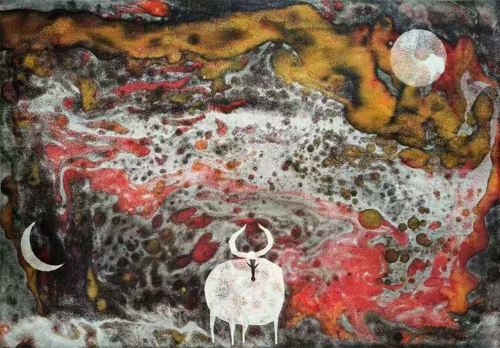
Li Pu, Years, 1987. Oil colour on paper, 90 × 60 cm.
In Years, this development reached a crucial stage. The chaotic yet ordered, multidimensional, uncertain, mysterious, and dreamlike forms generated through Dynamic Form Flow Color finally gave visual expression to the sense of cangmang that Beidahuang had left within me.
This mattered not simply because the painting expressed a personal memory. More importantly, it showed me that Dynamic Form Flow Color could give perceptible form to something that did not exist as a directly visible object.
Cangmang cannot be copied from nature in the way one copies a tree, a river, or a human figure. It is not a fixed object. It is an invisible condition of experience.
This painting confirmed something of lasting importance for me: Dynamic Form Flow Color possessed the ability to express invisible existence.
In this painting, naturally flowing forms acquired an unprecedented sense of space. They no longer resembled ordinary textures. Instead, they evoked landscapes, geological formations, the cosmos, living forms, and space-time, while never fully becoming any one of them.
The image seemed to exist somewhere between recognition and non-recognition. Viewers could sense countless possibilities, yet no single interpretation could claim absolute certainty.
This phenomenon would later become one of the most important foundations of -0 Painting.
But this confirmation did not end the exploration. It opened another question: If invisible perceptions could be revealed through these processes, what else might appear?
I continued experimenting. Works such as Splendor, The Sound of Wind, The Vast Sky, Heavenly Script, and Variations revealed different possibilities of movement, density, spatial depth, atmosphere, and naturally generated structure.
In some works, the flowing forms suggested vast natural spaces. In others, they resembled forces, traces, living organisms, or signs belonging to an unknown order. The image often seemed to contain several possible states at once, while these naturally generated forms could also interweave and merge seamlessly with diverse forms of deliberate artistic shaping and pictorial language.
Among these works, White Eagle received an International Award at the 24th Asia International Art Exhibition, while Kindred Spirit was selected for the 11th National Exhibition of Fine Arts in China.
The Human Profile in Somewhere in the Universe
As the experiments continued, another important work emerged: Somewhere in the Universe. During one of these experiments, something unprecedented appeared—a remarkably realistic human profile formed naturally within the image.
I did not draw it in advance. Nor did I intentionally guide the flowing colour toward the structure of a human face. Yet the resulting form possessed recognisable facial proportions, volume, direction, and expression.
Throughout all my experiments, this remained the only naturally formed realistic human portrait.
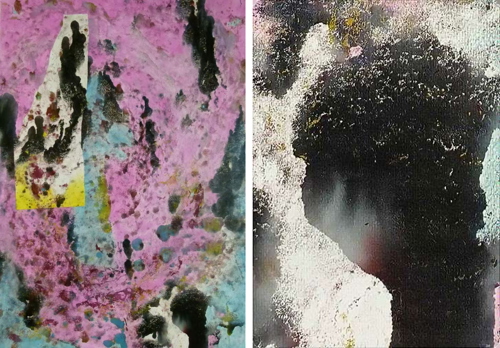
Li Pu, Somewhere in the Universe, 2018. Oil colour on paper, 69 × 99 cm. Full work and detail.
Unlike conventional portraiture, the human image was not constructed through deliberate depiction. It emerged naturally from the flowing process itself.
This discovery profoundly changed my understanding of artistic creation. I began to realise that pictorial forms need not arise solely from the artist’s conscious design. Even without deliberate human shaping, they could, under certain conditions, emerge naturally through the interaction of materials, process, and time.
This did not diminish the role of the artist. Rather, it transformed the artist’s role. The artist no longer determines every visible form directly. Instead, the artist establishes the conditions under which forms may emerge.
Naming -0 Painting
For many years, I continued creating without giving this new artistic direction a name. Although the works continued to evolve, I could not yet find a term capable of expressing precisely what I had discovered.
The name came only after the discoveries. It was never the beginning. It was the result.
As my understanding deepened, I gradually realised that these works could no longer be explained simply as Dynamic Form Flow Color. The flowing process itself was only one part of a much broader artistic understanding.
Only then did I give this understanding a name: -0 Painting.
Many people have asked why I chose the name -0 Painting.
The name did not arise from mathematics or abstract philosophical speculation. It emerged from decades of artistic experimentation and from the gradual recognition of what those experiments had revealed.
The symbol “-0” does not represent subtraction in the mathematical sense, nor does it signify negation. Instead, it points to a generative state not yet fixed into a determinate form, one in which multiple possibilities remain open. It is not a completed form of existence, but a threshold of continual becoming, rich in latent possibilities and spiritual vitality.
“0” may be understood as an origin, a point of potential, or an undivided state.
For me, the sign “-” points toward what precedes visible definition: the unknown, the latent, the invisible, and the not-yet-formed.
In Chinese, I have also associated “-0” with the homophonic expressions fù líng (负零) and fù líng (富灵): a state rich in latent possibilities and spiritual vitality.
From this perspective, -0 Painting does not merely create images. It creates conditions in which possible existence may reveal itself.
This is the meaning that -0 gradually came to represent in my artistic practice.
Within this theoretical framework, relative to -0 Painting, I regarded other forms of painting—including my own printmaking—as +0 Painting.
-0 Painting supplements, rather than replaces, the expressive capacities of existing painting. Viewed through the traditional Chinese concept of yin and yang, +0 corresponds to yang and the manifest, pointing toward visible existence, whereas -0 corresponds to yin and the latent, pointing toward invisible existence. Only through the union of yin and yang can painting encompass a complete world composed of both the visible and the invisible—like the unity embodied in the Taiji diagram.
Gradually, I realised that what these works revealed might not belong entirely to the world of known existence. Instead, they seemed to point toward another domain that had not yet been fully recognised.
Many human-like forms appeared in later works, but they were not realistic portraits. They were often ambiguous, transformed, fragmented, symbolic, or open to multiple interpretations. More unexpectedly, recognisable forms also lay concealed within the textures of the image. Interwoven with the surrounding naturally generated textures, these forms constituted a kind of primordial texture fundamentally different from the deliberately constructed textures of +0 Painting, and further gave rise to a distinctive textural
dimension in -0 Painting—one that seemed to contain stories of its own.
As the experiments developed, increasingly unfamiliar forms began to appear. They did not reproduce known objects, yet neither were they empty nor meaningless. They seemed to possess internal relationships, spatial structures, movements, and identities that remained beyond ordinary classification.
These experiences eventually led to the creation of Unknown Realm.
In Unknown Realm, numerous unknown forms appear together. Some suggest living organisms; others resemble human or nonhuman figures. Still others appear architectural, cosmic, microscopic, or dreamlike. Yet none can be conclusively identified.
The works do not present a single imaginary world consciously constructed by the artist. They present afield in which many possible forms appear to emerge, coexist, overlap, and transform.
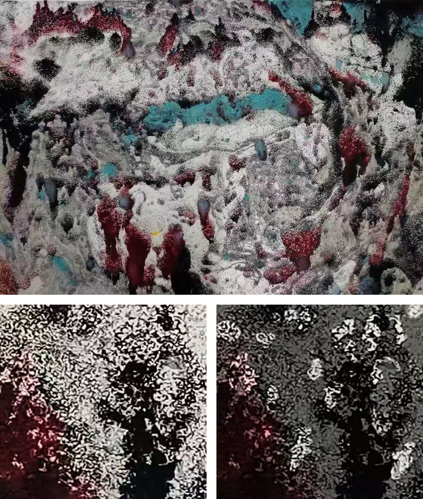
Li Pu, Legend, 2024. Oil colour on paper, 100 × 70 cm. Top: full work. Bottom: Unique Textural Dimensions and Stories of Concealed Faces—left, an enlarged detail; right, an interpretive illustration highlighting human faces concealed within the same detail.
By this stage, I had begun to reduce my control over the formation of the image. I still selected the materials, established the experimental conditions, and initiated the process. But once the interaction had begun, I increasingly allowed the materials and natural forces to continue developing on their own.
Among all the works created during this period of exploration, one became a decisive turning point. It fundamentally transformed my understanding of artistic creation.
That work was Dream Without Title.
Dream Without Title
Unlike my previous works, this painting was not completed through continuous artistic intervention. Once the experimental conditions had been established, the detailed formation of the image unfolded without my direct participation.
I established the conditions under which creation could occur, but I did not determine the image that ultimately emerged.
This distinction is essential. It reveals the difference between initiating a creative process and controlling its outcome.
The creation of Dream Without Title did not entirely exclude human involvement. The experimental conditions did not establish themselves. I remained responsible for selecting the materials, establishing the conditions, and initiating and stopping the process.
Yet once those conditions had been established, the specific image was no longer consciously designed. It emerged naturally through the interaction of materials, physical processes, time, and conditions.
This work compelled me to ask an entirely new question: If I had not consciously designed the final image, what, then, had actually completed the work?
For me, simply attributing it to chance was not sufficient to explain the experience. Chance might account for why the result could not be predicted, but it did not fully account for the coherence, internal relationships, spatial depth, and expressive force that emerged in the final image.
Nor could I honestly claim that I had consciously created the final image. Its specific forms had neither been conceived in advance nor individually constructed by my hands.
The work seemed to exist somewhere between intention and non-intention, authorship and non-authorship, control and spontaneous emergence.
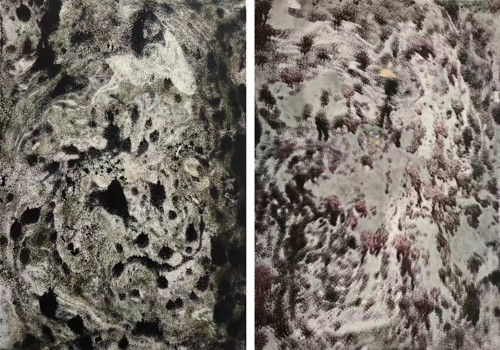
Left: Li Pu, Dream Without Title, 2024. Oil colour on paper, 70 × 100 cm. Right: Li Pu, Myriad Faces of the Human World No. 16, 2026. Oil colour on paper, 70 × 100 cm.
All photographs by the artist. The interpretive illustration was supplied by the artist.
Heart-Perception
As I observed the responses of different viewers encountering these works, another phenomenon increasingly drew my attention: they often perceived entirely different images within the same painting.
One person might recognise a landscape. Another might discover a human figure, an animal, architecture, cosmic space, or a form beyond ordinary description. Even the same viewer might perceive different images when returning to the work at another time.
At first, I regarded these differences simply as variations of imagination. But after years of observation, I gradually realised that something far more profound was taking place.
Through prolonged observation, I gradually came to realise that these different perceptions were not merely arbitrary inventions. They were often grounded in genuine visual relationships already present within the painting—direction, rhythm, density, boundaries, spatial depth, resemblance, fragmentation, and transformation. Yet none of these relationships compelled every viewer to recognise exactly the same object.
The image seemed to contain far more possibilities than ordinary visual recognition could ever stabilise.
Gradually, I became aware that another mode of perception might exist—one that did not rely solely upon recognising visible objects.
Sometimes viewers could not clearly explain what they had perceived. Yet they still experienced an unmistakable sense of presence, movement, depth, atmosphere, or meaning.
This experience was closer to an intuitive awakening than to recognition achieved through the identification of visible objects. It could be experienced directly, yet often resisted complete expression in language.
Only much later did I give this mode of perception a name: Heart-Perception. Heart-Perception does not reject vision. It begins with vision, yet is not confined to the recognition of visible objects. It emerges when ordinary visual recognition reaches its limit while perception itself continues. In Myriad Faces of the Human World No. 16, for example, a face may seem recognisable at first, yet its features and expression remain open to different readings as the viewer continues looking.
Unknown Existence
If Heart-Perception describes how perception continues when ordinary visual recognition reaches its limit, another question follows: what, exactly, is being perceived?
At first, I regarded each unexpectedly generated image as an isolated phenomenon. Yet over many years of experimentation, similar phenomena continued to recur across different works. Something seemed to reveal itself again and again through the interaction of materials, natural processes, artistic conditions, and perception.
It could not be fully contained within the category of known visible objects, because the forms that appeared could not always be identified as familiar things. Yet neither could they simply be dismissed as illusion, because they emerged through objectively occurring material processes and gave rise to genuine perceptual experience.
Gradually, I came to understand that visible existence might represent only one dimension of reality. There may also be forms, relationships, forces, states, and possibilities that cannot be directly seen, yet under particular conditions become perceptible.
I came to describe this repeatedly recurring phenomenon, which I could not yet fully explain within my existing understanding, as “Unknown Existence.” The name came later. Discovery always came first.
My understanding of these recurring phenomena did not begin with philosophical speculation; it developed gradually through artistic practice. The forms that emerged in these works were neither conventional representations of familiar objects nor merely abstract arrangements of colour and shape detached from reality. Rather, they appeared as manifestations of possible existence—forms whose identities had not yet become fixed within what was already known. They could therefore not be adequately explained within the traditional binary framework of representation and abstraction.
The Reality of the Unreal, the Certainty of Uncertainty
Chaos also appears within Dynamic Form Flow Color, but it is not absolute disorder.
The flowing forms may seem unpredictable, yet they remain subject to the properties of the materials, concentration, flow rate, gravity, force, absorption, time, and the conditions established by the artist.
What emerges is therefore a form of order within chaos: a structure that cannot be fully predetermined, yet is not without governing principles.
This is also one reason I later came to recognise a natural resonance between Dynamic Form Flow Color and the quantum age.
This understanding also led me to the expression: the reality of the unreal, and the certainty of uncertainty.
The naturally generated forms in these paintings are “unreal” in the conventional sense because they do not necessarily reproduce known objects from the external world.
A landscape-like form may not correspond to any actual landscape. A figure-like presence may not represent any existing person. A space may possess convincing depth without belonging to any physically identifiable location.
Yet these forms are also real.
They arise from real materials, forces, movement, and time, through a generative process that objectively takes place. They are not merely products of the artist’s imagination; once formed, they acquire a visible existence within the work.
Their reality does not lie in the imitation of any known object. It lies both in the objective truth of the process through which they emerge and in the possibility that they reveal a reality beyond direct visibility.
This is what I mean by the reality of the unreal.
The second expression—the certainty of uncertainty—concerns the definite existence of forms whose identities remain uncertain. Once a painting has formed, its colours, textures, and material presence are physically real and definite. Yet the forms it presents may remain unfamiliar, overlapping, and open to multiple interpretations.
Myriad Faces of the Human World No. 16 offers a visible example. Its face-like forms exist within the painting, but their identities and expressions cannot be settled by a single reading. What is certain is their presence; what remains uncertain is what they are and what they may reveal. This is what I mean by the
certainty of uncertainty.
Painting Becomes a Medium
After decades of practice, I gradually came to understand that Natural Flow Color, Dynamic Form Flow Color, Heart-Perception, Unknown Existence, and the relationship between visible and invisible reality were not isolated discoveries, but interconnected aspects of a larger whole. Together, they gradually converged into an integrated artistic understanding.
-0 Painting is neither merely a painting technique based on the flow of colour nor a fixed visual style.
-0 Painting is also not confined by the distinction between abstraction and figuration, because naturally generated forms may appear abstract or figurative, embody qualities of both, or resist being fully defined by either category.
Nor does it seek to remove the artist entirely from creation.
The artist still establishes conditions, selects materials, initiates processes, observes transformations, and makes necessary decisions.
But the artist no longer assumes that conscious intention is the only source of form.
In -0 Painting, the emergence of the work is understood as the result of an interaction among human consciousness, material properties, natural forces, chance, time, environment, and unknown processes.
Within this interaction, painting becomes a medium.
It mediates between human intention and natural creation.
It mediates between the visible and the invisible.
It mediates between known forms and Unknown Existence.
It also mediates between conscious recognition and Heart-Perception.
Multidimensional Superposition Constitutes the Real World
The visible image that has emerged does not necessarily represent the full reality contained within the work. It may be only one temporary formation emerging from a broader field of possibilities.
Visible existence and invisible existence are therefore not two completely separate worlds.
Within my artistic understanding, reality consists not only of what has already become visible and identifiable, but also of what remains invisible, potential, uncertain, unformed, and unknown.
Visible existence and invisible existence, superimposed across multiple dimensions, together constitute the real world.
This is the central understanding that gradually emerged through decades of experimentation.
-0 Painting was not first invented as a theory and then demonstrated through artworks.
The works came first.
The experiments came first.
The questions came first.
The discoveries came first.
Only later, in retrospect, did I come to recognise the connections among these discoveries, give them names, establish a corresponding theoretical framework, and continue to develop and refine it.
For this reason, -0 Painting should not be understood as a closed doctrine.
It is a theoretical understanding formed through practice, and it must continue to be tested through practice.
I believe that Dynamic Form Flow Color and the concept of -0 Painting together present an artistic possibility that has not previously taken this form.
But I do not ask others to accept this statement simply because it is mine.
Resonating with the Quantum Age
Looking back from the present, I have gradually come to recognise that these discoveries also resonate with the age in which they took shape.
In many traditional conceptions of reality, stability, continuity, relatively fixed identity, and intelligible causality long held an important place. Many traditions of classical painting likewise tended to establish a relatively stable visual order: the artist organised the image, forms occupied comparatively defined positions, and the completed work presented a more determinate structure.
Contemporary understandings of reality have become far more complex. Uncertainty, probability, superposition, discontinuity, observer participation, emergence, and the transformation of multiple possibilities into a realised outcome have become important reference points in contemporary thinking about reality.
Dynamic Form Flow Color was never created to illustrate quantum physics. My experiments did not begin with scientific theory, nor should these paintings be understood as visual diagrams of physics. Only much later did I come to recognise that the generative process of Dynamic Form Flow Color naturally resonated with several characteristics associated with the quantum age.
The flow begins from conditions that have already been established, yet its final outcome cannot be predicted. Throughout this generative process, multiple possible forms coexist. Different movements overlap and interact, continually altering one another’s course. Subtle variations in material, time, direction, temperature, concentration, or intervention may produce entirely different results. Eventually, the overall dynamic state stabilises, and one particular image takes form. Among countless possibilities, this form becomes visible reality.
Metaphorically, this process resembles a movement from possibility toward manifestation, or from a state of superposition through a visual “collapse” into one particular outcome. This resemblance does not imply that painting and quantum mechanics describe the same phenomenon. Rather, they offer comparable ways of understanding how uncertainty, multiple possibilities, interaction, and emergence participate in the formation of reality.
The Conception of Space in -0 Painting
From this understanding, I gradually came to realise that the “space” explored in -0 Painting could not be understood solely in terms of ordinary physical space, nor merely as psychological or symbolic space.
It is a pictorial space in which visible existence and invisible existence continually interact, overlap, and reveal one another.
This multidimensional superposition is one of the defining characteristics of -0 Painting.
Within such a space, forms need not possess fixed identities. They may remain in continual transformation, existing simultaneously among multiple possibilities.
For this reason, viewers often perceive different images within the same work. These different perceptions do not necessarily exclude one another; they may simply reveal different aspects of the same multidimensional reality.
Conclusion
My artistic exploration did not begin with theory; it began with practice.
Natural Flow Color came first, followed by Dynamic Form Flow Color. Only afterwards did the concept of -0 Painting gradually emerge.
Theory did not create the works; rather, the works gradually gave rise to the theory.
Throughout this process, I did not seek to prove any pre-existing concept. Instead, I sought to understand what artistic practice itself was revealing.
It is in this sense that artistic practice, for me, is not only a means of creating works, but also a way of continually coming to understand reality.
From the initial realisation that “nature was not only an object to be depicted; under certain conditions, it could participate directly in the creation of an image,” through the decades of practice that followed, my understanding of artistic creation also changed. The formation of a painting need not arise entirely from the artist’s conscious design. Under certain conditions, natural processes themselves can participate in the generation of the image, bringing forth visible forms that were not consciously predetermined and need not correspond to any already known object in reality. For me, this is one of the most fundamental discoveries of -0 Painting.
If there is originality in -0 Painting, it lies not merely in the creation of a new form of painting. More importantly, it opens another possible way of understanding art, perception, and reality.
I do not claim that these conclusions are final. On the contrary, I welcome dialogue, questioning, and even refutation. Only through sustained dialogue can new understanding continue to emerge.
Li Pu
About the Artist
Li Pu is a Chinese artist with more than five decades of practice in printmaking and painting. He is a member of the China Artists Association, a National First-Class Artist, and a member of the Japan Artists Association, Inc. (JAA). His awards include an International Award at the 24th Asia International Art Exhibition and an Award for Excellence at the Fourth National Exhibition of Fine Arts in China. His works are held in collections including the National Art Museum of China, China’s Ministry of Foreign Affairs,
and the World Trade Center in Japan.
Main Image: Li Pu, Kindred Spirits, 2009. Oil colour on paper, 200 × 100 cm.