
Sotheby’s to Offer Exceptionally Rare Nanotyrannus “Jodi”
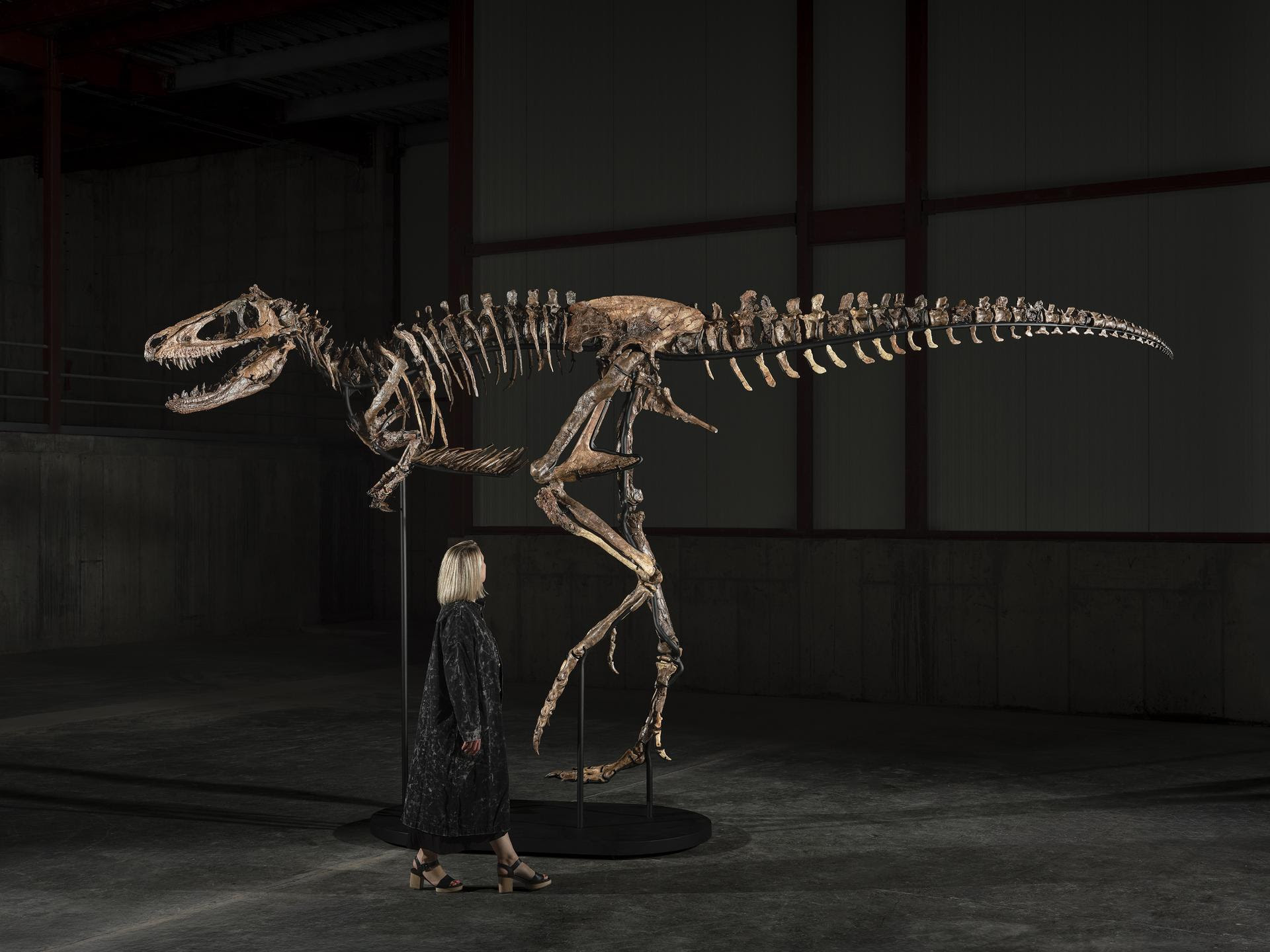
Nearly three months after the record-breaking sale of “Gus” – which sold for $50.1 million at Sotheby’s New York earlier this year, becoming the most valuable dinosaur ever sold at auction – Sotheby’s is set to bring another remarkable dinosaur to market.
“Jodi” is an exceptionally rare mounted skeleton of Nanotyrannus and one of only three such skeletons known to science. Its emergence follows the long-awaited confirmation of Nanotyrannus as a distinct genus (now split into two species, N. lancensis and N. lethaeus), challenging long-held assumptions that Tyrannosaurus rex was the sole large predator of the Cretaceous. Measuring approximately 6.5 feet tall and 19.6 feet long, “Jodi” is the first Nanotyrannus to come to market following the confirmation of the genus’s validity last year.
The finest and most complete Nanotyrannus available, “Jodi” is an exceptional example of this elusive predator, boasting a virtually complete skull, and is second only to “Bloody Mary,” the Nanotyrannus that forms one half of the celebrated “Dueling Dinosaurs.” Estimated at $6–9 million, “Jodi” will be the star of a dedicated live auction at Sotheby’s New York on 27 October. Ahead of the sale, “Jodi” will be installed at Sotheby’s galleries in New York at the Breuer, with a public exhibition opening on 13 October.
Nanotyrannus was a fast, highly specialized carnivorous tyrannosaurid that lived alongside Tyrannosaurus rex at the end of the Cretaceous, about 67 million years ago. Previously hypothesized by some to be adolescent T. rex, Nanotyrannus has been shown to have over 150 morphological differences that distinguish it from its much larger cousin. Some of the more obvious traits include: body length: adult Nanotyrannus measured approximately 18 feet in length, compared to the behemoth 40-foot length of a T. rex; Nanotyrannus had proportionally and absolutely longer forelimbs in comparison to T. rex, as well as larger hand claws; Nanotyrannus boasted a greater number of teeth, with up to 17 tooth sockets in the dentary vs 12–13 in T. rex; and among many other distinguishing features, Nanotyrannus had fewer tail vertebrae, with 35 in Nanotyrannus vs 40-45 in T. rex.
For more than 80 years, since the discovery of the “Cleveland Skull” (CMNH 7541) – a nearly complete, articulated skull now recognized as the type specimen for Nanotyrannus lancensis – paleontologists have debated whether small tyrannosaurid skeletons like “Jodi” were juvenile T. rex or a totally new and distinct genus of theropod. Last fall, that debate was resolved with the publication of a groundbreaking paper demonstrating that Nanotyrannus was in fact a valid genus of dinosaur that co-existed with T. rex at the end of the Cretaceous, occupying its own distinct niche in the ecosystem. The paper, published by Drs. Lindsay Zanno and James Napoli, is based on their exhaustive research of over 200 tyrannosaur fossils, including the Nanotyrannus “Bloody Mary.”
Eighty‑four years on from the discovery of the type specimen, the conversation around Nanotyrannus has shifted. A field that once pushed back against the idea of a separate genus now recognizes it, placing the research on Nanotyrannus among the most significant and exciting paleontological developments in recent decades.
|
|
|
|