|
In the early 1960s, London's rhythm and blues scene was led by musicians including Alexis Korner and Cyril Davies, whose group Blues Incorporated became an important meeting ground for many of the musicians who would go on to shape British rock music. Among them was Charlie Watts, a talented jazz drummer who balanced performances with the group alongside his day job in advertising.
Meanwhile, Brian Jones, Mick Jagger and Keith Richards were developing their own sound, drawing heavily on the Chicago blues tradition and the music of artists such as Muddy Waters. Jones, a passionate advocate for the blues, played a central role in the group's earliest formation.
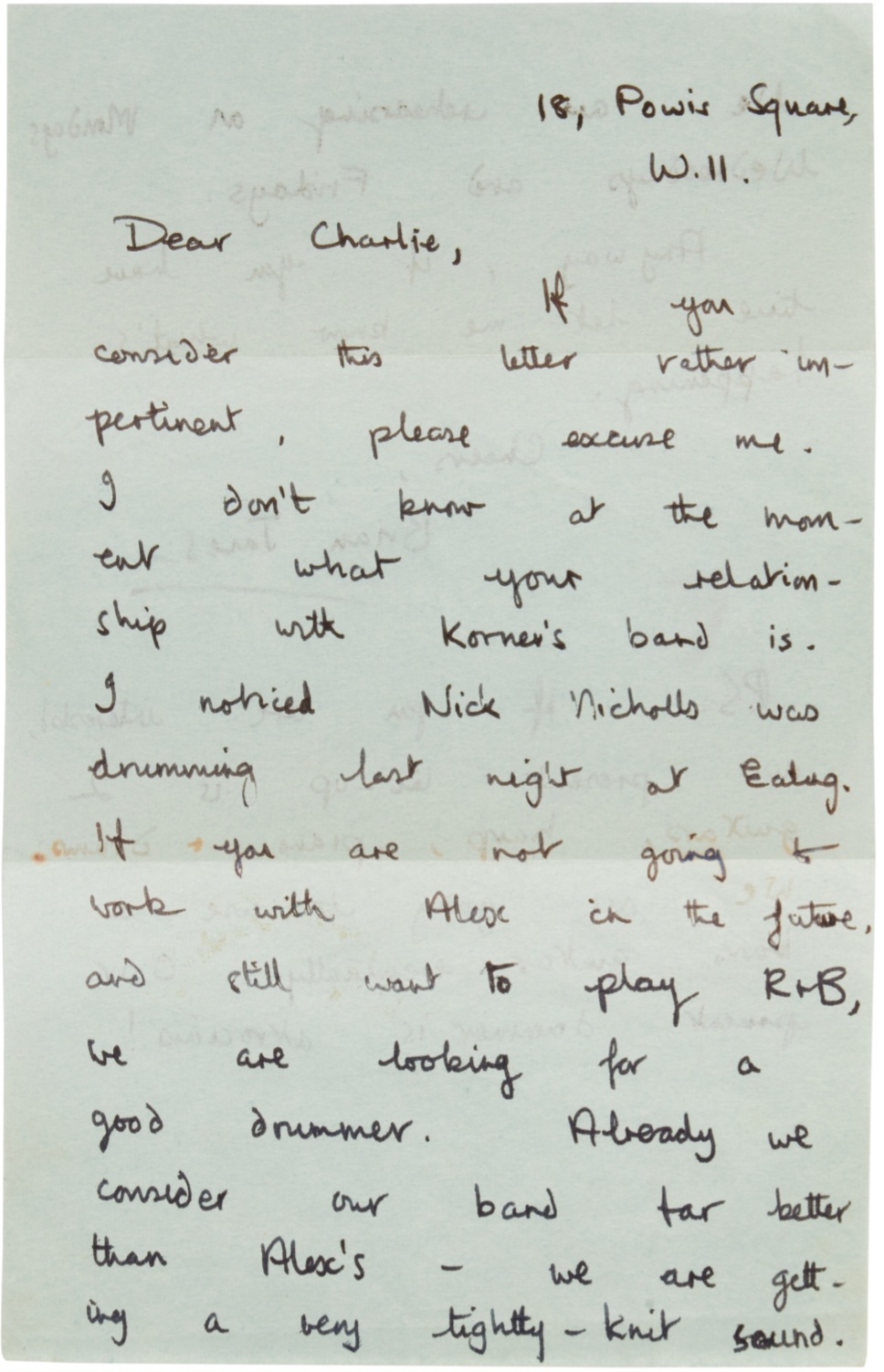
Watts, whose background lay primarily in jazz, was already highly regarded on London's music scene. Yet he was initially reluctant to leave Blues Incorporated and the security of his work in advertising for an uncertain future with the emerging band.
As Bill Wyman later recalled in his autobiography Stone Alone, Watts initially remained loyal to Korner and preoccupied with his day job. The June 1962 letter provides a rare surviving record of Jones's early efforts to bring him into the fold. The band's determination to recruit Watts was also recalled by Keith Richards in his autobiography Life, in which he described the lengths to which the musicians were prepared to go to secure the drummer. Richards remembered that they had even cut back on food to afford him, declaring: “We starved ourselves to pay for him!”
Despite Jones's early overtures, it would take another seven months before Watts officially joined The Rolling Stones in January 1963. By then, bassist Bill Wyman had also joined the group, completing the rhythm section that would become central to the band's distinctive sound. On 2 February 1963, The Rolling Stones performed with their early six-member lineup of Watts, Wyman, Jones, Richards, Jagger and pianist Ian Stewart.
Watts would remain the band's drummer until his death in August 2021, providing the steady, understated rhythmic foundation behind some of the most recognizable songs in rock history. His distinctive style, rooted in jazz but perfectly suited to the group's blues-driven sound, became an essential part of The Rolling Stones' musical identity.
|