
Silvio Zangarini: Assembling Space through Perception
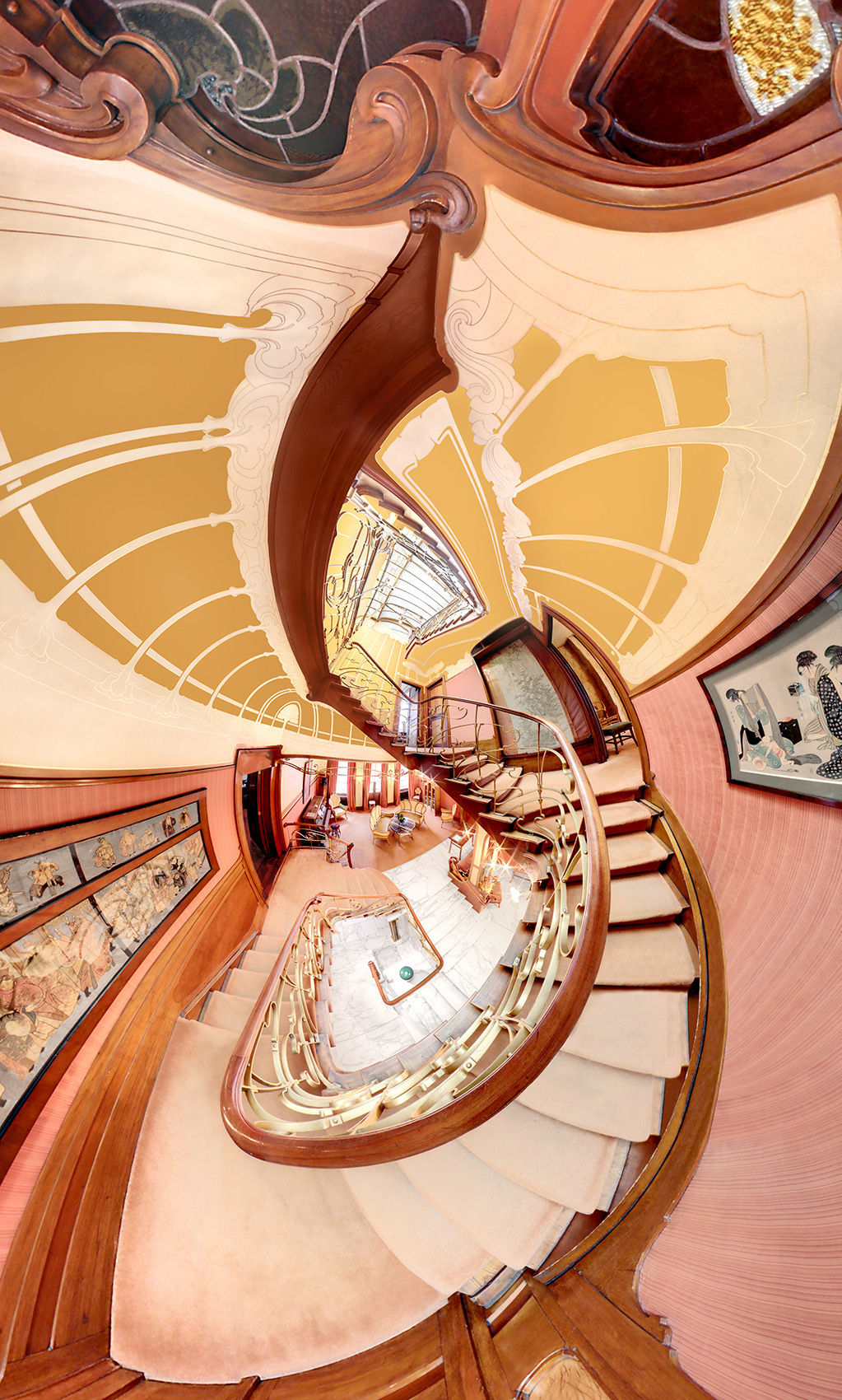
In his photographic practice, Silvio Zangarini approaches space not as a stable object to be represented, but as a lived, perceptual construction shaped by movement, memory, and attention.
His images do not seek to reproduce reality as it appears, but to translate the temporal and bodily processes through which we come to know a place. Moving between photography, research, and material experimentation, Zangarini treats the image as a trace of experience—one that crystallises time, scanning, and encounter rather than offering a fixed point of view. In this conversation, he reflects on perception as an embodied act, on the tension between practice and visibility, and on photography’s potential to function as a device for generating meaning in an increasingly unstable visual landscape.
ArtDependence (AD): How do you understand your role as an artist at this moment in your life?
Silvio Zangarini (SZ): I have been engaged in my artistic path for about fifteen years now, and during this time my position toward what I do has gradually shifted, both in terms of awareness and structure. From the beginning, my practice has been conceived as a long-term research rather than a succession of isolated works. Many of my projects take the form of series that unfold over several years, and their meaning is not fixed from the outset. It is something that constantly redefines itself, accumulates new layers, and at times becomes something other than what I initially imagined.
At the start, my work functioned mainly as a way of understanding my own position in relation to the world. Coming from a background in philosophy, I used images almost as a mirror, a tool to bring into focus a set of questions that were still unclear and to better understand where my interests were located. Over time, this process led to a growing awareness of both the conceptual and formal dimensions of my practice.
These two aspects began to inform each other more directly. Rather than analysis following intuition, the theoretical questions I was developing started to actively shape the way I worked. This shift coincided with a change in my relation to the viewer. What began as a largely self-reflective process progressively opened up, involving the observer more directly. The work no longer served only as a means of personal clarification, but increasingly as a space in which the viewer’s perception and experience became part of the work itself.
At this stage of my practice, I see my role as holding all these elements together: exploration and intention, making and understanding, personal research and its broader theoretical implications. My work unfolds as a dialogue between what I try to articulate through images and what the images themselves gradually disclose. It is a position that continues to shift as the work develops. In this sense, I consider my practice a form of research, encompassing self-reflection and an ongoing experimentation with the photographic medium and its possible extensions, with the hope that this process can also resonate beyond my own experience.
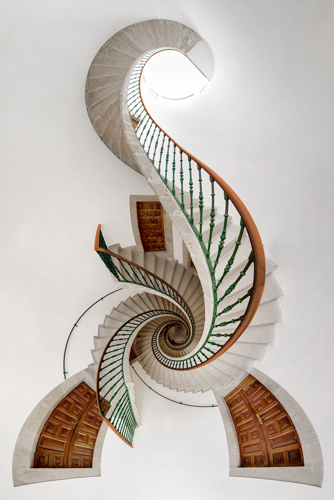
Silvio Zangarini, Convento de Santo Domingo de Bonaval, Santiago de Compostela. Domingo de Andrade’s triple staircase, 2022 Inkjet print on dibond with plexi
AD: What kind of attention do you bring to the world when you are working?
SZ: When I work, my attention is not directed toward capturing what is simply given, but
toward inhabiting a place. I try to let a space enter me, to measure it through my body, my gaze, and an active form of perception. What interests me is understanding how a relationship with space can take shape, rather than recording it from a distance.
I am aware that I am not only absorbing what presents itself to my senses, but actively reorganising it. While I try to remain open to what surrounds me, I cannot avoid filtering and reshaping space through my own way of thinking and perceiving. The work takes place precisely in this tension.
I often think of this condition as being on a threshold. Not only in a conceptual sense, but as a bodily and temporal experience. It means not being fully inside, but no longer outside either. It involves pausing, holding back, and allowing things to remain unresolved for a moment. This is what I mean by inhabiting a space: entering it, being affected by it, and letting perception filter and reshape what I encounter. It is a moment of suspension that holds the conditions for something new to emerge.
The images that emerge from this process are not representations of space as it is, but traces of this state of being in-between. They ask the viewer to enter a similar condition. Rather than observing from the outside, the viewer is invited to linger, to move mentally within the image, to lose and regain orientation, and to negotiate their own way of seeing.
In this sense, the photograph becomes a metaphor for a mental image. It does not
correspond directly to the world, but offers an interpretation of it. An interpretation that remains fluid, and that continues to shift as the relationship between perception, space, and the observer evolves.
AD: Why do you think certain forms or spaces continue to return in your work?
SZ: I know that my work might appear as a form of obsession with certain themes:
staircases, squares, urban spaces. It is not unusual for friends to contact me after a trip to tell me about a remarkable staircase I absolutely should photograph. I do not exclude that a certain familiarity with recurring forms can be reassuring. But I prefer to think of this repetition as a necessity rather than an obsession.
What returns in my work is not so much a form, but a question that never fully settles. I come back to the same themes because their meaning is never fixed. It keeps shifting, accumulating new layers, sometimes even becoming something else altogether. In this sense, repetition becomes a method of reconstruction rather than a loop.
This is particularly evident in Staircases to Elsewhere, which I conceive as a variation
on a theme. My interest is stylistic and structural, but above all symbolic. The staircase carries a dense symbolic charge, and when a symbol is reworked, especially through deformation and fragmentation of the image, its meanings begin to multiply. Like a set of tarot cards, the same structure can generate very different readings depending on how it is approached.
The same logic extends to other series, where the return of certain forms gives way to a reflection on how meaning is constructed rather than what is represented. In my series on public squares, repetition does not introduce new meanings, but intensifies those already present. The gesture becomes almost ritualistic, allowing the symbolic and social charge of these spaces to resonate more strongly. With Eutopia, this logic shifts further: the fluidity I am interested in does not reside only in the imagery itself, but also in the structure of the work. The work unfolds on a three-dimensional support that forces perception to shift continuously, making meaning dependent on movement, position, and the viewer’s active engagement.
This approach also extends beyond individual images. The book I am about to publish, which shares its title with the staircase series, Staircases to Elsewhere, is conceived as a spatial structure in itself. Its design requires the reader to navigate, unfold, and reconfigure the book physically, mirroring the same processes of passage, interruption, and reorientation that run through the photographic work.
Even the project I am currently conceiving follows this logic, focusing on the idea of the threshold: on crossing, transition, and changes of state. Here, repetition operates both technically and thematically, not as redundancy, but as a way of staying with questions that continue to unfold over time.
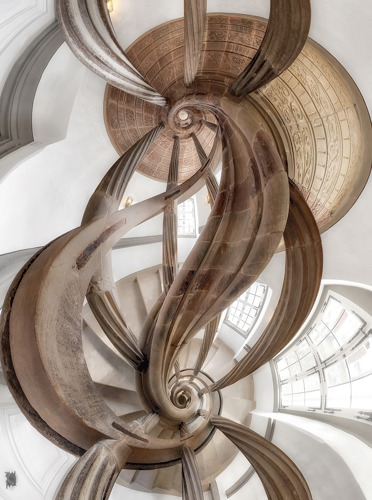
Silvio Zangaria, Mergentheim Schloss. Blasius Berwart staircase, 2022
Inkjet print on dibond with plexi
AD: As a central strand within your broader research, how did Staircases to
Elsewhere gradually take shape, and how has its meaning evolved over time?
SZ: This series has become a central axis in my practice, and it is also a clear example of how my way of working has evolved over time. It reflects a shift in which my visual research initially generated theoretical questions, and was later reshaped and enriched by them in return.
The project didn't begin with a strong conceptual agenda. It started as a technical and perceptual experiment. I was trying to free photography from the constraint of the single frame, from the obligation to compress space into a static rectangle. That limitation made me uncomfortable. I wanted to find a way to construct images that could accommodate a more fluid and spatial experience.
This led me to start assembling spaces specifically to be photographed, allowing for a greater freedom of movement and composition. Almost by accident, I arrived at staircases, because they allowed me to explore not only horizontal space, but also
vertical movement, which is often absent in architectural photography. My interest in architectural space was already present, but the staircase suddenly offered a structure that could hold multiple directions, and viewpoints at once.
A decisive moment came when I first assembled the multiple photographs needed to
reconstruct a staircase. It was the monumental staircase of the Vatican Museums in Rome, and the experience felt like a genuine epiphany. I immediately sensed that this
approach was fertile, and I began to reflect on why it affected me so strongly. From that point on, conceptual reflection became an integral part of my practice. My background in philosophy started to intertwine more explicitly with my visual work.
Themes such as lived experience, phenomenology, the fluidity of interpretation, the
symbolic density of forms, and the generative power of ambiguity gradually came to the forefront. Seriality also became central, as a way of working through variation, insistence, and repetition, not to exhaust meaning, but to keep it open, much like in
Calvino’s Invisible Cities or Queneau’s Exercises in Style.
So what do my staircases mean? For me, they are not illustrations of a concept, but
devices that put vision into crisis. They destabilise the idea of a single, fixed point of view and transform the image into a space of interpretation. The staircase becomes a
threshold, a place of passage where perception, memory, and imagination intersect, and where meaning is never fully settled.
This logic extends into the book I am currently preparing, which shares the same title as the series. The book is not meant to explain the project, but to extend it: it becomes another spatial and interpretative device, one that challenges how images are navigated , read, and understood. In this sense, interpretation is not something that happens after the work, but something the work actively generates.
Over time, conceptualisation itself has become part of my artistic practice, rather than a commentary added from the outside. I am not interested in reducing ambiguity by explaining less. On the contrary, I believe that clarity and reflection can create better conditions for uncertainty, multiplicity, and critical engagement. In this sense, putting things into question, rather than providing definitive answers, has become one of the most important driving forces behind my work.
AD: Can you describe what happens between encountering a place and making an image of it?
SZ: What happens is a transfiguration of space: a spatialisation of time and movement,
and the visualisation of a lived experience. My technical process and artistic intervention try to mimic what occurs when entering a place. Rather than focusing solely on my personal experience of a place, my interest lies in a process that anyone goes through when encountering a space.
In order to understand a place, we need to move within it, look in different directions, grasp how those directions relate to each other, and connect what we perceive to memories or forms of knowledge we already possess. Through this process, we construct a mental space: a mental image of that place. What we retain is never the space in itself, but the space as it is experienced, interpreted, and internalised.
The transfiguration I am interested in happens precisely on this level. The image I
produce is closer to this mental construction than to a faithful representation of reality. It does not aim to reproduce the space as it appears, but to translate the way space is gradually assembled through perception.
Another crucial aspect is that the final image crystallises the movement required to
observe the surrounding space. In this sense, the image functions as a scanning of
space, a scanning that unfolds over time rather than in a single instant. What becomes visible in the image is therefore a spatialized version of the time and movement necessary to experience that environment.
Ultimately, the photograph is a visual reduction of a much broader experience, one that involves the whole body. Perception is never purely optical, but always grounded in movement, orientation, and embodied presence. The image carries the trace of this process, rather than the illusion of a stable or complete view.
Common Ground places the emphasis on practice, materiality, and artistic intent, rather than on visibility or circulation. How does the work you present at Larry Gallery relate to this perspective, especially in a moment when visibility often seems to dominate artistic discourse?
I recognise myself quite naturally in this position. My work has always developed in the long term, often outside the rhythms of visibility that the art world tends to privilege. What interests me most is not where an image circulates, but what it does, and how it continues to operate over time.
I have consciously chosen to engage with social media as a way of testing another medium. I became curious about what would happen if I treated those platforms not as neutral channels, but as spaces with their own grammar, tempo and expectations. Rather than adapting my work to them, I tried to let the medium and the message negotiate with each other.
My use of social media is closer to a form of research than to a pursuit of visibility. It is an attempt to understand how meaning shifts when an image enters a different ecosystem, and how attention can be shaped without being reduced to spectacle. What matters to me remains the same: the practice itself, the questions it generates, and the possibility that the work points somewhere beyond its current form.
AD: What directions are you interested in exploring next and what remains
unresolved for you?
SZ: I remain deeply engaged with a number of conceptual cores that have already
emerged in earlier series and that, over time, have become more conscious and complex within my practice. I am interested in presenting reality not as something self-evident or transparent, but as a place that is mysterious, layered, and open to fluid interpretation.
What particularly interests me is the transformative dimension of encounter. To come into contact with something, to know it, always implies a passage, a change of state, a threshold that affects both the observer and what is being observed. This is why I keep returning to questions of space: to the way personal and public spaces shape our perception, and to how they act upon us as embodied observers.
Formally, this has led me to work with approaches that keep photography at the core,
while at the same time extending and transforming it. Rather than treating the photograph as a direct extraction from reality, I am interested in it as a trace that has been altered through the act of perception, a trace shaped by the way reality is experienced and interpreted by us as human beings.
These questions inevitably collide with broader contemporary issues, such as post-truth, the proliferation of simulacra, and the fragility of shared narratives. I am increasingly interested in how meaning is constructed in a context where media can both distort and reconfigure reality, and I do not exclude that these concerns will take on a more explicit role in my future work.
What matters to me is that my works do not offer conclusive interpretations. I see them instead as perceptual devices, or as machines for generating meaning, in which the viewer is invited to participate actively in the construction of sense. This approach is central to the book I am about to publish, which is the most significant project I am currently working on, and it also informs a new series that is beginning to take shape, focused on visual instability, thresholds, and the fluidity of meaning.
Ultimately, what remains unresolved is precisely what I want to preserve: an openness of meaning. I am drawn to the idea that sense does not reside in the work itself, but comes into being through an act of interpretation. Reality, like an immense library, already contains every possible configuration, but without a reader, without an active engagement, it remains inert.
Meaning, for me, is not a property of the world, but a human act. It is something that
happens through attention, movement, and interpretation, and that is never completed once and for all. This is the space in which I feel my work truly operates.
Main Image: Silvio Zangarini, Victor Horta Museum, Brussel, 2022 Inkjet print on dibond with plexi
Common Ground exhibits works by Silvio Zangarini
Exhibition Dates : January 29 - March 15
Locations: Groeningestraat 26, Kortrijk
Koning Leopold I Straat 26, Kortrijk