
Rubens’ adorned Ceiling in Banqueting House, London, to reopen after Major Restoration
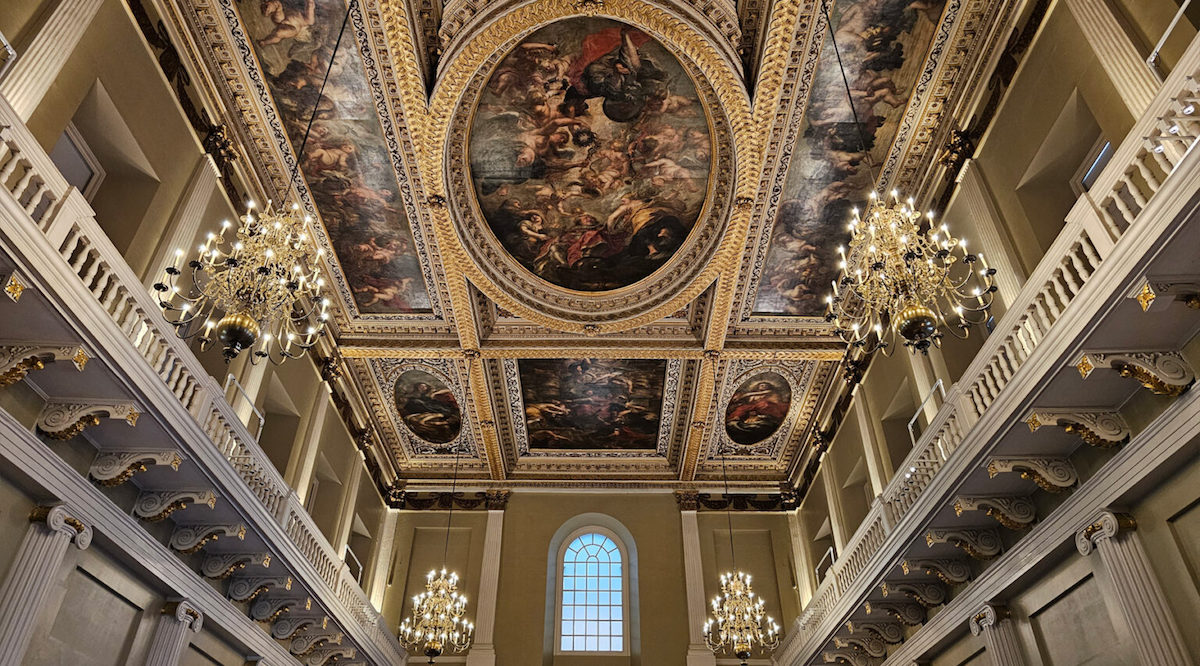
A passenger lift installed into the 400-year-old Banqueting House in Whitehall will offer visitors step-free access to Peter Paul Rubens’ masterpiece ceiling for the first time.
Built for King James I in 1622, the Banqueting House is last complete piece of the lost royal Palace of Whitehall, most of which perished to fire in 1698. It has recently reopened following a major project by Historic Royal Palaces, the independent charity that cares for the Banqueting House, to upgrade the building’s facilities and carry out essential improvement works, preserving this historic building for years to come.
The brand-new lift enables guests visiting the Banqueting House to have step-free access to the Main Hall, a grand space housing the only artwork by Rubens to still be displayed in the original space for which it was created: “The Glorification of King James I”, also known as the dazzling “Rubens ceiling”.
Starting in May 2024, Historic Royal Palaces has undertaken a major project to transform the Banqueting House. A new passenger lift has been installed in the North Annex, enabling step-free access to the main hall. The installation follows years of planning from expert conservators, historic buildings curators and other specialists, enabling the integration of modern accessibility into a Grade-I listed building at the heart of Whitehall.
To help preserve the condition of the historic Rubens ceiling for future generations, new air-source heat pumps installed onto the roof, combined with a re-routing onto the Whitehall District Heating System, will significantly improve the temperature and humidity control of the building. The building has been re-serviced to be net-zero ready, ensuring that the Banqueting House is more resilient to climate change and working towards Historic Royal Palaces’ long-term sustainability goals.
A new sustainably sourced English Oak floor has been installed, following the removal of the old floor for an essential upgrade to heating pipes and other services. This provided a chance archaeologists to look beneath the floorboards for the first time since 1964, leading to discoveries of items left behind by previous workers that provided insights into historic workmanship. The new floor reflects the history of the Banqueting House, and architecturally unites the space.
The Banqueting House has witnessed dramatic moments in history, including the execution of King Charles I. Originally created as a space in which to stage entertainments and completed in 1622 as part of the Palace of Whitehall, the Banqueting House is a masterpiece of classical architecture designed by Inigo Jones for James I. It was intended to host extravagant performances known as ‘masques’, but was later used for diplomatic meetings and to stage the ritual touching carried out by historic English monarchs to heal ‘the King’s Evil’.
In 1630, King Charles I commissioned Flemish artist Peter Paul Rubens to create a painting on the ceiling. This magnificent artwork is a collection of nine paintings glorifying the achievements of Charles I’s father, King James I, a testament to royal power and the divine right of kings. The painting was installed in 1636, and just 13 years later, Charles I was led beneath the very ceiling he had commissioned to his execution on a scaffold outside the Banqueting House.
Most of the Palace of Whitehall, the principal residence for the Tudor and Stuart monarchies, perished to a fire in 1698, leaving the Banqueting House as the sole complete survivor of the lost royal palace. Over the centuries, the building served a number of different purposes, from a chapel to a museum, and now stands as an events venue and visitor attraction.