
Qatar Museums unveils Programme for Rubaiya Qatar, a New Contemporary Art Quadrennial
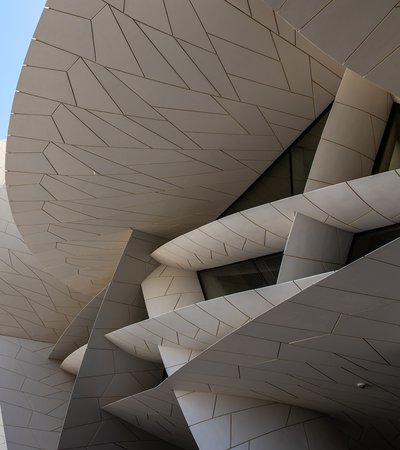
Qatar Museums (QM) announced the programme for Rubaiya Qatar, a new nationwide multidisciplinary contemporary art quadrennial developed under the auspices of ALRIWAQ Art + Architecture, the contemporary art and architecture institution of Qatar Museums dedicated to research, exhibitions, and public art.
Conceived to elevate Qatar's international presence and empower new generations of artists and thinkers, Rubaiya Qatar will present a dynamic programme of exhibitions, commissions, public art projects, residencies, publications, and more, organised every four years under a single theme.
As part of this inaugural programme, Qatar Museums also announced further details of Unruly Waters, the flagship and largest exhibition of Rubaiya Qatar. Referencing the book of the same title by environmental historian Sunil Amrith, Unruly Waters features works by more than 50 contemporary artists, many of whom have been commissioned to create new work for the project. The exhibition explores how both humans and nature have shaped today's realities across a region spanning from the Gulf to East Asia, while also examining Qatar's place within that region.
Sheikha Reem Al-Thani, Qatar Museums Deputy CEO of ALRIWAQ Art + Architecture, Public Art, and Rubaiya Qatar, said, "Rubaiya Qatar builds on the growth of Qatar Museums over the past two decades, aiming to reflect the country's aspirations by positioning Doha as a hub for global art practice. This inaugural edition of Rubaiya Qatar will foster new creative networks, support emerging artists who are pushing the boundaries of innovation, and showcase Doha as a platform for the exchange of cutting-edge ideas."
Sheikha Alanood Al-Thani, Director, Rubaiya Qatar, said, "Unruly Waters locates Qatar as a meeting point for different cultures and traditions, underscoring the nation's past and present role as a geopolitical hub. Alongside works by major contemporary artists, the exhibition will present artefacts from Qatar Museums' extensive collections to propose new artistic and historical connections, shining a light on how the wider Gulf region has been shaped by nature and global weather systems as much as by commerce, trade, and culture."
Rubaiya Qatar will include multiple exhibitions, public artworks and activations across Qatar.
Its largest exhibition, Unruly Waters, will be on view at ALRIWAQ Arts + Architecture and part of Rubaiya Qatar's multi-site activations across Qatar. Curated by Tom Eccles (Executive Director, Center for Curatorial Studies and the Hessel Museum of Art, Bard College), Ruba Katrib (Chief Curator and Director of Curatorial Affairs, MoMA PS1), Mark Rappolt (Editor-in-Chief of ArtReview and ArtReview Asia), and Shabbir Hussain Mustafa (Chief Curator, Singapore Art Museum).
Tom Eccles said, "The quadrennial exhibition introduces a new type of transnational, transdisciplinary program to Doha, rooted in issues that affect both Qatar and the wider region. The artists exhibiting broadly represent the diverse nationalities that live in Qatar, while their work reflects the shared geographical, environmental and social realities of today. The program builds upon the ambitious expansion of the arts in Doha over the past decade and represents another milestone in the evolution of Qatar's commitment to dialogue within the international arts community."
The more than 50 artists invited to participate in Unruly Waters come from a region informed by both the ancient Maritime Silk Road and Qatar's present demographics. A region that is locally rooted but often diasporic, and a site of artistic innovation and research and a region. Their works are engaged with the urgencies of ecologic transformation and geopolitical reality, and reflect the migratory patterns that have shaped the Gulf for more than a thousand years, continuing to today. Artists participating include Lawrence Abu Hamdan, Sophia Al Maria, Mohamed Bourouissa, Ade Darmawan, Alia Farid, Naiza Khan, Dala Nassar, Lydia Ourahmane, Marina Tabassum, and Rirkrit Tiravanija.
Exhibition themes will focus on the circulation and transport of people, goods, and ideas embedded histories and memories infrastructure, and speculative futurism. The works on show span a range of media, from painting and sculpture, to moving image, storytelling, sound and performance. In all of this, art functions as a cross-border medium drawing up new solidarities and new connections.
Unruly Waters will also present artefacts held by Qatar Museums, including objects from the Cirebon shipwreck, a late-9th- to 10th-century merchant vessel salvaged in 2003 in Indonesia's Java Sea. The wreck's cargo provides significant evidence of a Maritime Silk Road, early forms of globalisation, and trade across the Indian Ocean, suggesting a shared cultural history predating European colonialism, governed not by national borders, but by winds, tides, and rains. The wreck's artefacts allow the exhibition to speculate on entanglements that resist conventional geographic frameworks and the separate histories of West, South, and East Asia. By presenting these objects alongside contemporary artworks, Unruly Waters aims to shine a light on a vast, interconnected Asia.
Unruly Waters builds on years of research, including the 2022 exhibition One Tiger or Another, presented at Mathaf: Arab Museum of Modern Art and curated by Eccles and Rappolt, and "Water Ways: Epistemologies and Aesthetics," a three-day academic conference organised in February 2024 by Qatar Museums, Rubaiya Qatar, and Doha Institute for Graduate Studies.
In addition, Rubaiya Qatar will also present Our Common Currents curated by Lina Patmali, Acting Head of Curatorial Affairs, Rubaiya Qatar, at the QM Katara Gallery. The exhibition is anchored in Qatar, where water is a defining element of both the cultural and natural landscapes, including pearling and maritime trade heritage, nomadic traditions, and their environmental counterparts: the sea, the coast, and the deserts. Expanding to other contexts, the exhibition traces common experiences between humans and bodies of water while reexamining humans' relationship with water to imagine sustainable, viable futures.
At Mathaf: Arab Museum of Modern Art, the exhibition Seething Sea brings together modern and contemporary works by Gulf artists to reflect on the region's historic relationship with the sea as a source of life, danger, and storytelling. Drawing on maritime myths, rituals, and cultural memory, the exhibition considers how inherited knowledge and imaginaries confront ecological degradation and rapid transformations. The exhibition is curated by Wadha Al Aqeedi, a curator and art historian.
Further exhibitions, public art projects, and public programmes associated with Rubaiya Qatar include projects with Wael Shawky, Rirkrit Tiravanija, Qatar National Library, the Biennale of Sydney, and Qatar's pavilion at the Venice Biennale. And a series of public art unveilings throughout the duration of Rubaiya Qatar includings works by Jitish Kallat and Minerva Cuevas.
Rubaiya Qatar is presented as part of Evolution Nation, a campaign honouring Qatar's cultural journey over the past 50 years, since the founding of the National Museum of Qatar, and 20 years since the founding of Qatar Museums. Curated by Qatar Creates, the national movement positioning Qatar as a global hub for art, culture, and creativity, Evolution Nation highlights both the nation's cultural milestones and its aspirations. Rubaiya Qatar will also act as the first major program ushering in the new era of Qatar Museums.