
Picasso's Guernica converses with Dumeli Feni's African Guernica
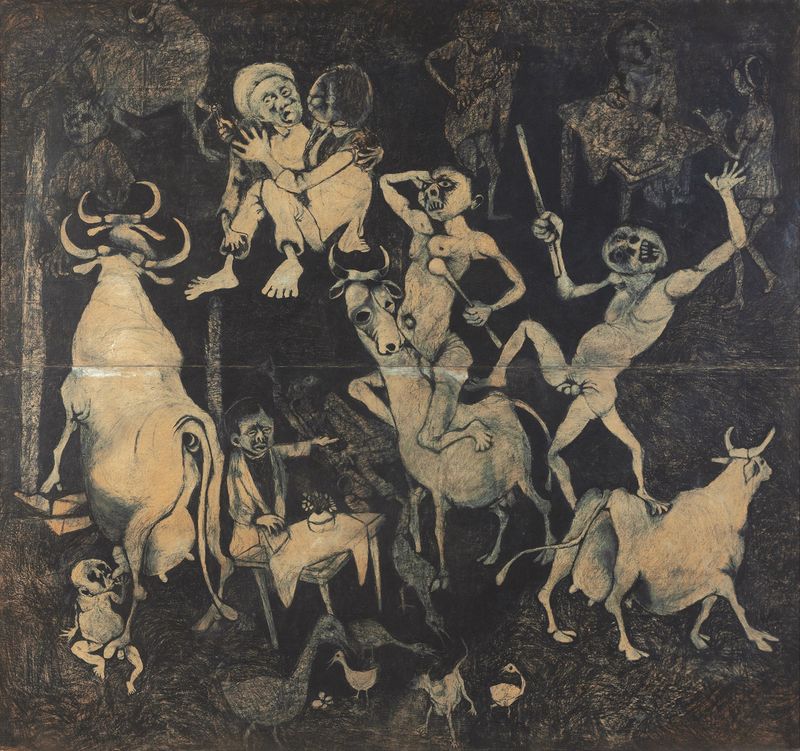
History Doesn’t Repeat Itself, but It Does Rhyme is a new programme at the Museo Reina Sofía that aims to establish a dialogue between Pablo Picasso's Guernica (1937) and other significant works of art that present certain parallels in their modes of representation or thematic concerns, but which come from different historical and cultural contexts.
The series title refers to a phrase which, although traditionally attributed to the writer Mark Twain, is apocryphal and never actually appears in work by the American author.
In this opening show, curated by Tamar Garb, Picasso’s emblematic work is juxtaposed with African Guernica, a work by artist Dumile Feni (Worcester, South Africa, 1942 – New York, 1991), who was a key figure in African modernity. Alongside Feni’s monumental drawing are five other works by this artist which arrive from major South African institutions, including the University of Fort Hare, the Norval Foundation and the Wits Art Museum, in addition to private collections. Furthermore, they are displayed with four of Picasso’s preparatory drawings from Guernica, works which are part of the Museo Reina Sofía Collections.
As Museo Reina Sofía director, Manuel Segade, explained: “African Guernica represents a significant time in the crisis of modernity, the time of Apartheid in South Africa, one of the limits of the modern project”. Meanwhile, the show’s curator, Tamar Garb, was keen to stress how Dumile Feni “is a modern artist who used drawing materials on an almost unprecedented scale worldwide at that time”. “If we observe drawing practices globally in the 1960s, very few artists worked on such an epic, monumental scale as Dumile in that period”, she added.
Main Image: Dumile Feni, African Guernica [Guernica africano], 1967. National Heritage and Cultural Studies Centre, University of Fort Hare. © Estate Dumile Feni and Dumile Feni Family Trust