
Peace Seen Through War: Jean-Baptiste Chantoiseau on the Exhibition The Wings of Peace
Until 1 November, The Wings of Peace exhibition will be presented in Paris, 84 rue de
Turenne.
Organised by Tora and Art Foundation and the cultural platform Bien En Place, the project brings together five artists from different generations and backgrounds: ORLAN, Esther Ferrer, Oleg Kulik, Léa Le Bricomte and Émeric Lhuisset. Working across different mediums such as photography, sculpture and conceptual art, they explore the concept of conflict, power and violence.
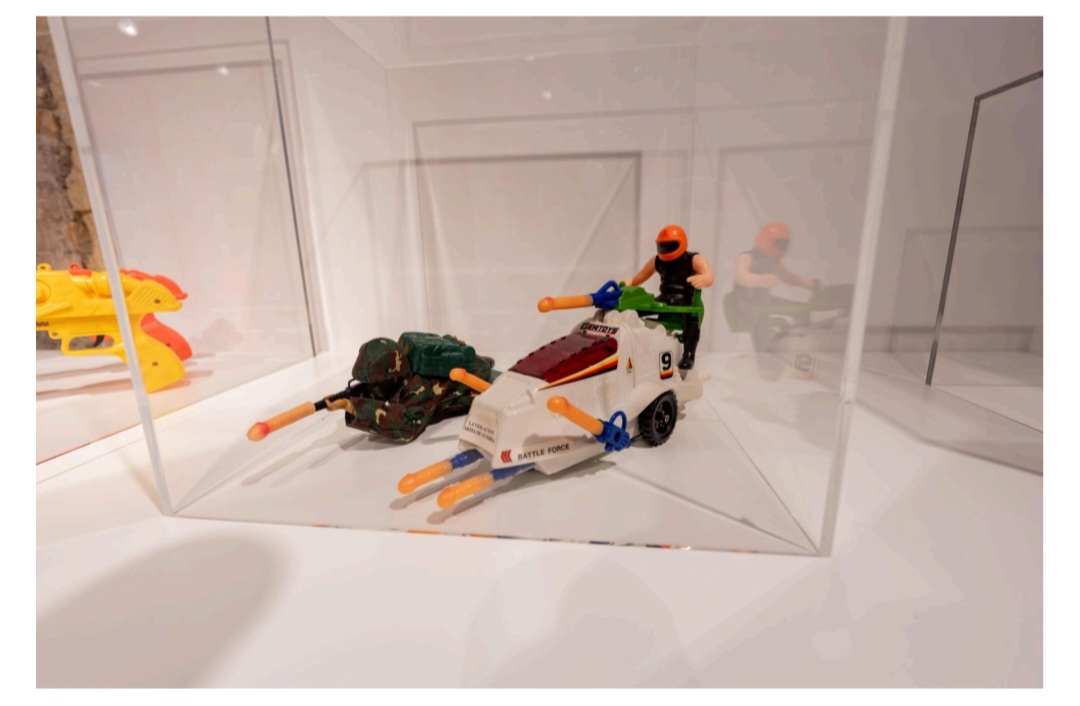
ORLAN’s Vers la paix perpétu-aile(s) opens the show. Léa Le Bricomte’s Dripping Medalsare made from First World War decorations and ribbons, Esther Ferrer’s Educational Toys turn pistols and helicopters into something absurd, and Émeric Lhuisset restages Ilya Repin’s Zaporozhian Cossacks with fighters photographed in the field. Oleg Kulik’s At the Church was made in the 1990s and now looks like a warning.
The exhibition was curated by Jean-Baptiste Chantoiseau, currently Director of Literary
Museums at the Réunion des Musées Métropolitains in Rouen. Previously, he has
contributed to major exhibitions and editorial projects, including Kiefer Rodin at the Musée
Rodin in Paris and Whistler, l’effet papillon at the Musée des Beaux-Arts de Rouen.
We spoke with Jean-Baptiste Chantoiseau about why he approached peace through
violence, and what provocation can still do to an audience that has seen everything.
The exhibition takes its title from an artwork created by ORLAN. What referred you to this particular piece, and how did it shape the broader curatorial narrative of the project?
We are extremely fortunate to be able to present the photography and the statue by ORLAN that occupies the center of the exhibition: it functions like a sun, radiating and spreading its peaceful message all around. Like an absolute deity clad entirely in white, ORLAN evokes both sacred statuary and modern cybernetic art, bringing together the past, the present, and the future in an artistic gesture of amplified power.
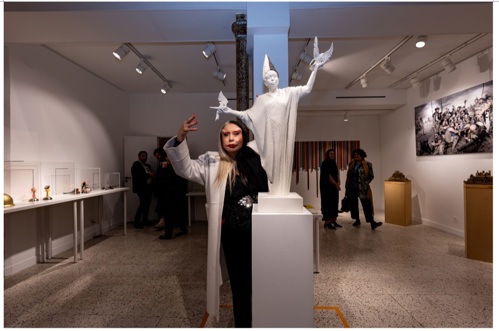
ORLAN with her sculpture Vers la paix perpétu-aile(s) at the opening of The Wings of
Peace. In the background: Esther Ferrer’s Juguetes educativos (Educational Toys), Léa Le Bricomte’s Dripping Medals. Photo: Ankou
The exhibition explores the idea of peace through artworks that primarily address violence, conflict and power. Why did you choose to approach peace through these
contrasting themes?
In a world where war is omnipresent, talking about peace without confronting the reality of
war, its violence and the threats it poses, would, to me, be an unrealistic approach. Far from any mawkishness, their images awaken the conscience. By using military-inspired toys (pistols, submachine guns, helicopters), Esther Ferrer takes on the subject of war... by turning war against itself! The phallic forms incorporated into these weapons expose, more effectively than any formal treatise, the infantilism and irresponsibility inherent in acts of violence; acts which, in truth, can never be justified when they result in the death of another human being. In this way, memory, painting, and art become authentic, universal forms of resistance, which explains why Émeric Lhuisset’s photographs have travelled the globe. All the artists we exhibit demonstrate that one cannot truly speak of light without having experienced darkness.
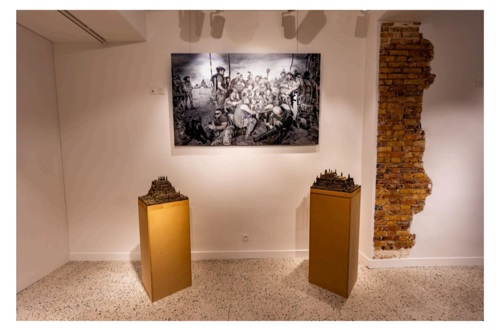
Émeric Lhuisset, J’entends au loin la réponse des cosaques (From far away, I hear the Cossacks’ reply), 2023; in the foreground Léa Le Bricomte, Spirit Houses. Photo: Ankou
The exhibition brings together five artists from different generations, backgrounds and artistic mediums. What exactly guided your selection, and what connections did you discover between their artistic practices?
Peace must, or should, be a concern for all of humanity, regardless of age, country, gender, or religion. It was therefore very clear to me that we needed to bring together artists from different generations and countries, each contributing their own sensibility and perspective based on a common theme: war - and, above all, peace. A sense of commitment, boldness, and the coherence of the artistic approach were at the heart of the selection process. The art of assemblage and appropriation, employed as a means to defuse war, is the primary common thread among these artists; bringing them together in a single exhibition certainly makes this easier to grasp. Temples, ancient statuary, paintings by Courbet or Repin - art is subtly reworked through a new form of hybridisation that conveys a powerful message, often with a touch of humour and irony. These reappropriations, combined with a shared sense of poetry among the artists, create a strong sense of coherence that transcends differences in medium.
Oleg Kulik’s artistic biography spans several cultural and political contexts, from his Ukrainian origins and career in Moscow to his longstanding relationship with the Parisian art scene. In today’s geopolitical climate, does presenting his work in an exhibition about peace carry a particular significance?
Naturally, a Ukrainian artist living in Russia who calls for peace, like Oleg Kulik, resonates
profoundly in the current climate. His presence, therefore, struck us as essential. What I find very moving about his approach is his fidelity to the themes he holds dear, most notably animality, and his subtle way of depicting reality and conveying messages, all while avoiding easy clichés or obvious symbols. At a time when everything tends toward uniformity, he expresses himself in his own way, one that may well be baffling to many, but to me, his very strangeness is remarkably effective.
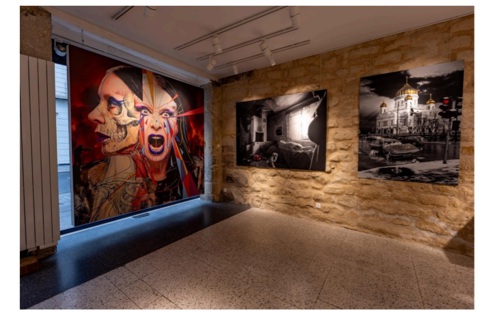
Installation view. On the left: ORLAN, from the series Nous sommes inconsolables; On the right: Oleg Kulik, At Home, from The Russian series. Photo: Ankou
The exhibition features artists whose practices have often challenged social conventions and political structures. Do you think provocative art still has the same power to challenge audiences today, or has our relationship with artistic provocation changed?
It is true that in recent decades, we have witnessed an escalation of provocative, disturbing imagery. As these images multiply, they lose their power; it is often said that today’s public has become desensitised to such visuals - that nothing, anymore, is capable of shocking them. This is why I felt it was essential, through this exhibition, to present works that are in no way gratuitous - works that do not seek to provoke merely for the sake of provocation or to join in the race for sensationalism, but whose primary intention is the pursuit of profound meaning through aesthetics. I remain convinced that what can spark joy, a sensation, or an idea today is the feeling of encountering a work that holds meaning within an artistic trajectory: a work that is the fruit of a slow process of maturation on the part of the artist who created it. In my view, it is only under these conditions that art can still stir something within us.
Léa Le Bricomte, Spirit Houses. Photo: Ankou
The exhibition encourages visitors to form their own interpretations rather than offering a single message. How do you balance this openness with the urgency and sensitivity of the subjects being addressed?
The urgency of a planetary peace speaks for itself: there is no need to belabour the point.
Quite the contrary. Heaviness and redundancy have never served any cause. The more
freedom the public has to reflect and engage with a work and its subject matter, the more
profound their encounter with art - and, consequently, the greater its impact - will be. This is why, in my view, there is no contradiction between freedom. That is to say, an open dialogue among artists, works, and spectators, and the effectiveness of a message.
Main Image: Esther Ferrer, from the series Juguetes educativos (Educational Toys). Photo: Ankou
This article was authored by Sofiia Barysheva