
In contrast to his contemporaries, Van Gogh signed surprisingly few paintings. In his ten years as an artist, he only added his name to 133 of the 840 known paintings: approximately 15 per cent. Remarkably, the frequency with which Van Gogh signed his work appears to correspond with his artistic ambitions, mental well-being and self-confidence.
Researcher Julia Engelmayer collated all known authentic signatures on paintings in a comprehensive dataset. She published her findings in the Van Gogh Museum Article Simply 'Vincent': An Overview of Van Gogh's Signed Paintings. The title refers to the fact that Van Gogh nearly always signed with his first name. Outside the Netherlands, people had difficulty pronouncing and remembering his surname.
The most important information about why Van Gogh only signed a portion of his works can be found in his letters. His reflections on his painting practice reveal his highly critical nature. During his career, Van Gogh considered the majority of his work to be practice or preparation. This explains why he never signed any paintings before 1884, although he had begun painting in oils in 1881. He had started signing his drawings earlier. Once in Paris, his commercial ambitions grew, as did the number of signed works. Shortly after arriving in Arles, with the Parisian art market still fresh in his mind, Van Gogh regularly added his signature to his paintings. As his mental health deteriorated, the number of signatures decreased significantly.
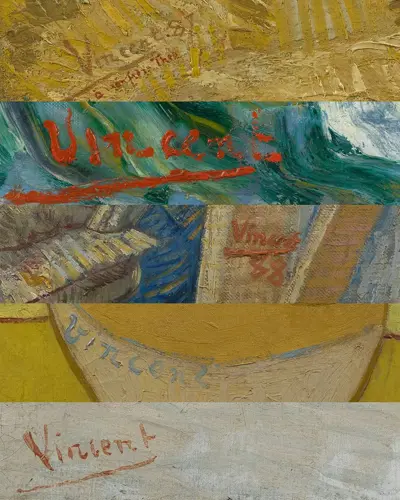
Detail of works signed by Vincent van Gogh
Van Gogh’s letters reveal that he signed paintings that he was particularly proud of, such as The Potato Eaters (1885, Van Gogh Museum) and Sunflowers (1889, Van Gogh Museum). He considered The Potato Eaters his first masterwork and spent weeks working on it. He signed the back of the chair on the left, although the signature has since become almost invisible.
Van Gogh also often signed paintings that he gave to family and friends. He usually did not sign the paintings he made after prints by Millet, Rembrandt and Delacroix. An exception is Pietà (after Delacroix) (1889, Vatican Museums), which was a present for his sister Willemien.
Van Gogh also often signed works that formed part of exchanges with artist friends. The still life Three Pairs of Shoes (1886, Harvard Art Museums/Fogg Museum, Cambridge, US), which Van Gogh exchanged with the Australian artist John Peter Russell, is a striking example: the work features not one, but two signatures. One is small and barely visibly, scratched into the paint in Van Gogh’s customary style. The second appears in the upper right in large block letters, in handwriting that closely resembles Russell’s. Why Russell may have added this signature himself remains unknown. Perhaps he was unable to decipher Van Gogh’s signature, or thought it was too modest, and decided to give his friend’s name a more prominent place – just as he did in the portrait he painted of Van Gogh that same year (1886, Van Gogh Museum).
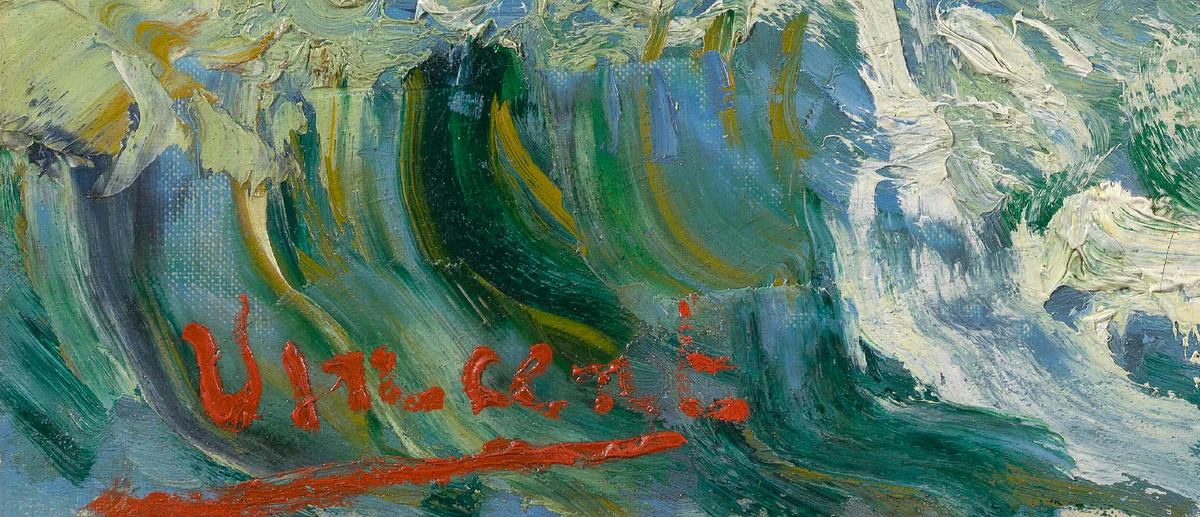
On rare occasions Van Gogh used his signature to enhance a painting, as in Seascape near Les Saintes-Maries-de-la-Mer (1888, Van Gogh Museum). He was not fully satisfied with the colour scheme and, as he wrote to his brother, placed in the lower left ‘a very outrageous red signature, because I wanted a red note in the green.’ (letter 660).
Van Gogh’s signatures add an extra dimension to his works, but their absence is also significant. Many late masterpieces remained unsigned. After his admission to the institution in Saint-Rémy in 1889, his self-confidence gradually diminished. During this period, he signed hardly any of his paintings. In Auvers, he added ‘Vincent’ to a painting only once – on a portrait that he gave to his sitter, Adeline Ravoux (Adeline Ravoux, 1890, private collection).
Main Image: Detail from Vincent van Gogh, Seascape near Les Saintes-Maries-de-la-Mer from 1888, oil on canvas, Van Gogh Museum, Amsterdam (Vincent van Gogh Foundation)