
New Discoveries emerge from Restoration of Van Gogh’s Parsonage Garden at Nuenen in Spring
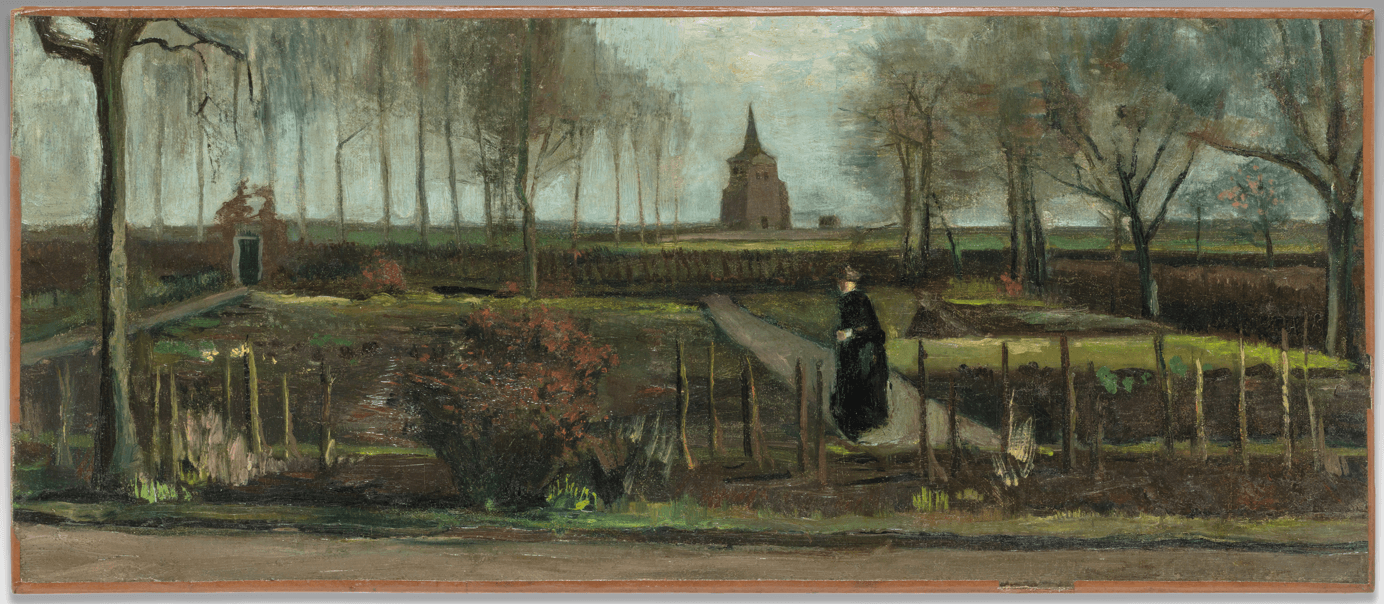
Since Van Gogh painted The Parsonage Garden at Nuenen in Spring in 1884 on the grounds of his parents’ parsonage in the Dutch town of Nuenen, the work has moved around.
It accompanied the artist from house to house and was eventually sold. It was bequeathed to the Groninger Museum’s collection in 1962.
The Parsonage Garden at Nuenen in Spring was on loan to the Singer Laren museum when it was stolen on 30 March 2020. Thanks to the efforts of the art detective Arthur Brand, the painting resurfaced in 2023. Unfortunately, it had suffered damage, so De Visser was commissioned to restore it.
In earlier research, De Visser determined Van Gogh had initially titled the painting Wintertuin (Winter Garden) in 1883 but changed its name to Lentetuin (Spring Garden) in spring 1884.
More recent research yielded another discovery: the face of the woman in the image contained details Van Gogh had not put in in 1884. They may have been added in 1903 by an amateur painter before a sales exhibition at the Oldenzeel gallery in Rotterdam, to make the work more attractive to potential buyers. At the time, restoration often involved painting over parts of a work. De Visser removed the extra details, and the woman’s face now looks as it did when Van Gogh painted it in 1884.
De Visser restored Van Gogh’s painting with great precision and care, in accordance with contemporary practice. First, she researched materials and tested techniques, as the painting is fragile and different methods produce different results. During examination and restoration of the work, De Visser found that large areas of the original painting contained a layer of degraded varnish and oil paint and a layer of zinc soap. The latter is produced in a chemical reaction that occurs with the ageing of paint containing zinc pigments.
Differentiating Van Gogh’s original work from the later additions posed a challenge for De Visser. Some changes were so similar to the original paint as to be scarcely detectable. Signs of overpainting include thick layering, paint applied over a crack, brown pigments, and dark purple patches that show up under UV light. De Visser was able to identify the overpainting in The Parsonage Garden at Nuenen in Spring by using various types of material analysis, studying Van Gogh’s letters and consulting specialist publications.
Main Image: Vincent van Gogh Parsonage Garden at Nuenen in Spring Groninger Museum after restoration