
Nayla Maalouf Guillemin - The Artist With a Permeable Soul
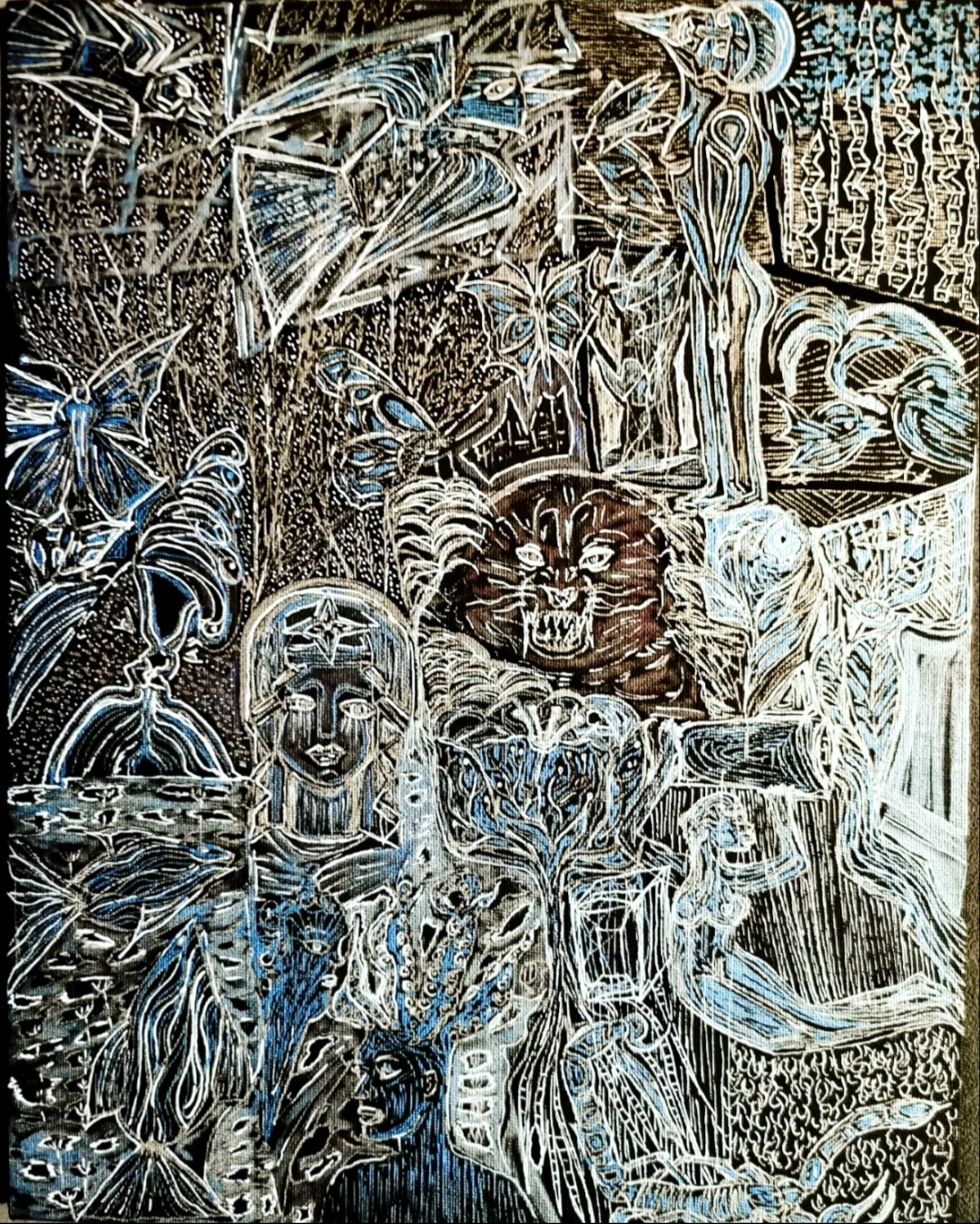
Sharp-pointed triangles suggest trajectories, setting the rhythm of the space, framed within rectangles in which, always against a black background, an epiphany of blue and white lines evokes the wanderings of a melody diverted by dissonances and counterpoints, much like American jazz, in the country where she lived for several years.
In 2007, in memory of a loved one, Nayla created her first ink works on canvas. Etcetera would become a foundational work, marking the beginning of a new creative chapter. In this piece, the lines are strongly emphasized. Geometric segments seem to collide, evoking the metallic clatter of machinery, as though the Eiffel Tower had collapsed with a tremendous crash. Certain cyclone-like motifs recall the famous The Scream by Norwegian painter Edvard Munch. Other motifs, which would reappear much later in her work, are more aquatic in nature, softening the overall composition of this symbolic canvas.
Nayla explores everything, experimenting with a wide variety of materials and formats: mixed media, acrylic, compressions, wood sculptures, Plexiglas, and, more recently, the enlargement of her subjects. She fears nothing. In 2017, Totem X emerged: a hollow, painted tree trunk, a vertical form firmly anchored to its pedestal, radiating a soothing presence.
Nayla Maalouf Guillemin has adopted Gaston Bachelard’s thought, “Matter is the unconscious of form,” as her guiding principle.
“My statements are not expressed through writing a book, but through an instinctive, narrative artistic practice.”
And these statements reflect her concerns. In this respect, her 2007 exhibition entitled New World Order remains emblematic. It featured three-dimensional and metal works, including the daring and much-noticed Baby-Making Machine.
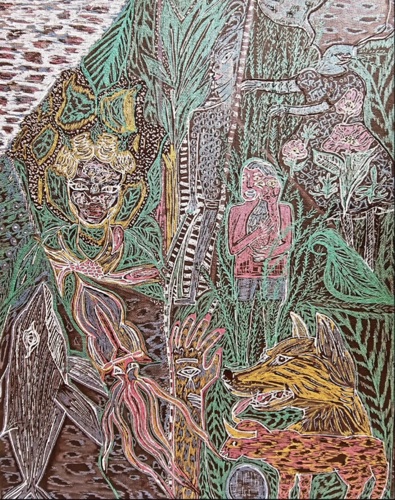
Nayla Maalouf Guillemin, Harmonie sauvage, Ink on canvas 2024
Her piece Cometa intercitdat (2007) denounces consumer society. Ideas flow freely. Her series Les Bulles (The Bubbles, 2018) consists of panels made from 3,000 compressed beverage cans, placing these works within the tradition of the Nouveaux Réalistes (New Realists).
Much like Jacques Villeglé with his torn posters, Nayla brings out the graphic designs of brands such as Fanta and Orangina, bearing witness, whether we like it or not, to the tastes and colors of an era. Through this ecological gesture, Nayla also seems to preserve traces of what Italian historian Carlo Ginzburg calls the “microhistory of everyday practices.”
Just think of all those soda consumers, all those mouths whose lips once brushed against these fragments of aluminum. Is this not a truly realistic kind of poetry?
Works such as Secrets and Jtm mon bb (Love You, My Baby) unmistakably recall Arman’s accumulations of the 1960s, yet the Lebanese artist’s motivation is different. She speaks of rubble, of a frozen and painful memory. An underlying coherence connects each of Nayla’s works, as they echo one another through recurring themes of life, the environment, destruction, verticality, and hope.
A Longing That Creates
Over the past three years, her artistic language has become more concentrated. Every detail matters. The poetic dialectic of her imagination follows the perfection of a checkerboard. A strange checkerboard indeed: from one work to another, the world appears to her sometimes cold and celestial, sometimes warm and earthly, sometimes dreamlike, as though told by moonlight and unfolding, as it once did, in broad daylight.
These checkerboard compositions create a sensation of achieving balance through the delicate meeting of opposites.
“My starting point is always a black background, and then my hand simply cannot stop,” she says.
The artist seems to carve into the black surface, allowing light to enter through white openings, much like an engraving. Within this chiaroscuro, the filament-like lines, seemingly crocheted, beautiful and light as lace, preserve the mystery of the image through exquisite transparencies. The artist reveals a miniature world that must be examined closely.
A giant scorpion attempts to conceal its frightening tail among the vegetation. This jungle undoubtedly reminds her of the equatorial forests of Gabon. There is an octopus-man, a masked man, and the undulating body of a woman reminiscent of a mermaid.
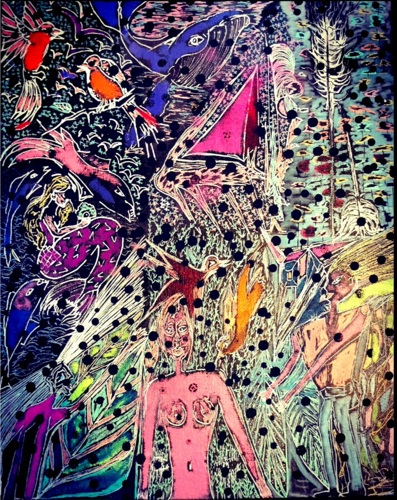
Nayla Maalouf Guillemin, After the war, Ink on canvas 2024
The snout of a lion-maned beast, with almond-shaped eyes and threatening teeth, appears alongside the bust of a queen wearing a star upon her forehead. Her characters coexist without harming one another, because here nature meets fable, and fable tells the story of nature.
“Gabon is a tough country, make no mistake about it.”
Nayla adored this country, where she lived for ten years. There, the sun rises and sets at the same time every day. It is a country where those considered mad are treated with respect. Within the close-knit community of the Pygmies, she learned to carve driftwood alongside the sculptor Boris, of whom she speaks with admiration and affection.
In her own jungle, the wind gently caresses the vines, and happy butterflies flutter and play. Here too, as in a real wild forest, one must pay close attention to what is happening, for then birds and fish may also appear. Here too, just as in nature itself, animals prefer to hide.
An Intimate Perception
Nayla enlarges and multiplies her panels. Through this gesture, she brings us closer to her artistic language, inviting a form of intimate, close-up perception. Her lines seem tactile, like the threads of a weaving loom.
Nayla has developed a highly personal figurative calligraphy, revealing the permeability of all living things, a quality that has deeply permeated her artistic soul. She seems to describe a better world, one in which all living beings would form a magnificent hymn to life!
As in the early works of Dubuffet, Nayla fills the entire surface, with breathing space emerging only from the depths of the black background. At times, she draws with the subtle forcefulness of a sculptor practicing direct carving. (Harmonie Sauvage — Wild Harmony)
Her filament-like lines, dots, and strokes connect her work to Persian miniature painting, as do the delicacy and finesse of her execution. Ingeniously arranged on a magnetic panel, these rectangles are interchangeable. As in quantum physics, one never knows exactly where one stands in space or time. The eye is thus invited to play a game of checkers or chess.
Her work has been featured in La Gazette Drouot, and she has sold several pieces both at auction and through galleries, much to the delight of our collectors!
This article is authored by Ileana Cornea
Main Image: Nayla Maalouf Guillemin, Bestiaire intime, Ink on canvas, 106x81cm, 2024