
Mondrian's Masterpiece Composition III to be auctionned in Christie's 20/21 Evening Sale in London
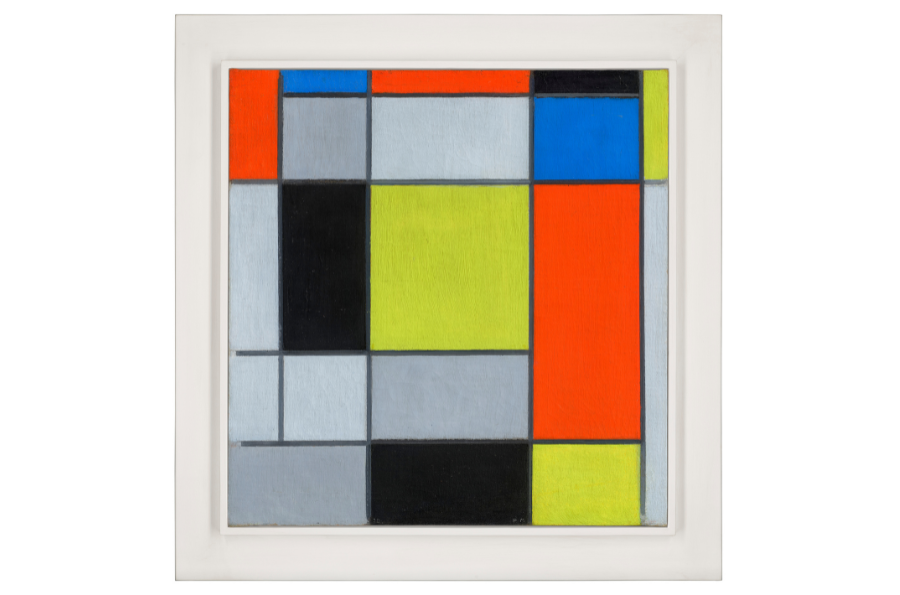
Christie's announces that Piet Mondrian's Composition III will be one of the key highlights of its 20th/21st Century: London Evening Sale on 14 October 2026 during Frieze Week.
Carrying an estimate of £20,000,000-30,000,000, this masterwork is the most important Mondrian offered at auction in Europe since 2009, when Composition avec bleu, rouge, jaune et noir (1922) and Composition I (1920) were sold at Christie's Paris from the Collection of Yves Saint Laurent and Pierre Bergé.
Composition III comes to auction for the first time, with past custodians including the legendary architect and collector of Modernism Armand P. Bartos and his wife Celeste.
Painted in 1920, Composition III dates to a pivotal moment in the artist's career, as he achieved the first breakthrough examples of his visionary Neo-Plastic style. That year, Mondrian completed just eight landmark paintings, five of which are now held in internationally renowned museum collections: Tate, London; The Museum of Modern Art, New York; the Stedelijk Museum, Amsterdam; the Galleria Nazionale d'Arte Moderna e Contemporanea, Rome; and the Wilhelm-Hack Museum, Ludwigshafen.
Composition III stands as a clear expression of intent, and embodies Mondrian's newly crystallised artistic vision. After returning to Paris in late 1919 having spent the First World War in the Netherlands, Mondrian once again engaged with the city's avant-garde scene. This period marked a crucial turning point in his practice, in which he embraced a completely new aesthetic. Throughout 1920, he systematically established the principles of his pioneering abstract language – known as Neo-Plasticism – and achieved a powerful and coherent formulation of his ideas. At the same time, he was working on his seminal essay 'Le Néo-Plasticisme: Principe général de l'équivalence plastique,' which was published the following year as a pamphlet by Léonce Rosenberg, marking the first time Mondrian's influential theories were available in French.
The paintings produced in 1920 present the dynamic development of Mondrian's ideas, as he distilled his works down to their most essential components: he focused on the interaction of a series of strictly linear, geometric forms on the canvas, the boundaries of the shapes marked by graphic lines, and his palette consisting only of a few essential colours. This sense of visual simplicity was the result of a wider philosophical belief: Mondrian thought that by reducing painting to its basic elements - such as pure areas of carefully calibrated colours and lines - he could convey a sense of universal harmony and explore the fundamental laws that govern the universe.
Mondrian's works from this defining year reflect a painstaking creation process in which theory and intuition progressed together. He would work on one composition over a number of months, letting the paint dry between each stage, and at various points stepping back to think over the alterations he had made. Instead of using an easel, he painted with the canvas spread out on a table, which he positioned close to a window for the best light, and kept the easel for when he was reviewing the work, so that he could look at the composition from a distance.
Composition III gives tangible expression to all this. The work only employs the colours allowed by Mondrian's Neo-Plastic system: namely the three primary colours, red, yellow and blue, together with black, white and grey - arranged in a dynamic grid made up of lines whose tone subtly changes as they cross the surface of the canvas. The bold passages of red and blue are counterbalanced by planes of bright, almost acidic yellow and delicately gradated greys, each panel showing several layers of pigment and clear traces of brushwork, revealing the artist's hand. Mondrian added a layer of varnish to only the black panels within the work, which enhanced the saturation and luminosity of the pigment and produced a captivating contrast against the other colour planes. At the centre, a yellow square aligned on the axis of symmetry creates an outward-moving energy, bringing rhythm and balance to the whole composition.
Main Image: Piet Mondrian, Composition III, 1920; estimate: £20,000,000-30,000,000