
Mercedes-Benz to Auction Historic C 111 Prototype to Fund "Museum 2.0" Project
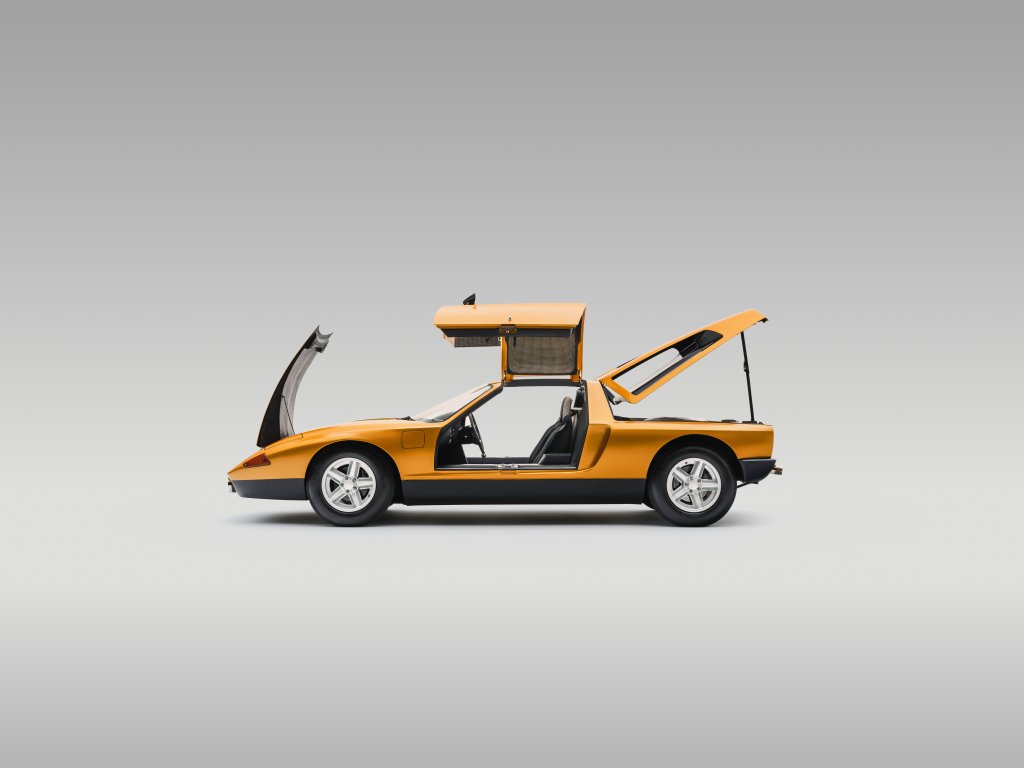
Mercedes-Benz AG is putting a unique C 111-II, fitted with an original 2.4-liter four-rotor Wankel engine, up for auction through the auction house RM Sotheby’s at the Palais du Louvre in Paris on February 3, 2027.
For the first time in its history, Mercedes-Benz is offering a C 111 for sale – a car that was previously out of reach. For at least 25 years, this will remain the only opportunity: Mercedes-Benz has contractually committed not to sell any further C 111s during this period. The proceeds from the auction will go towards the “Mercedes-Benz Museum 2.0” project.
The C 111 is one of the most fascinating vehicles in the brand’s history. When it was unveiled at the 1969 International Motor Show (IAA) in Frankfurt am Main, it embodied the vision of taking the design and technical innovations of the legendary 300 SL (W 198) into a new era. However, it never went into series production. In total, only 17 prototypes of the iconic super sports car were made.
Marcus Breitschwerdt, CEO of Mercedes-Benz Heritage GmbH: “It is reported that prospective buyers even sent blank checks to Stuttgart, yet Mercedes-Benz never sold a single C 111. The desire to own one of these extraordinary vehicles has resurfaced time and time again ever since. To this day, the fascination of the C 111 remains undiminished and it continues to inspire us, as the Vision One-Eleven demonstrates. We are now turning a new page and, for the first time, passing one of these vehicles from our collection into new hands. In doing so, we are emphasizing the unique value of our brand heritage and investing the proceeds in the future of the Mercedes-Benz Museum.”
The aim of “Mercedes-Benz Museum 2.0” is to bring the brand’s unique heritage to life for future generations and make it accessible worldwide. To this end, Mercedes-Benz is continuously developing both the Museum in Stuttgart and its virtual offerings. A key component is the Museum’s digital twin. This makes the Museum experience accessible regardless of physical location, thereby extending its reach far beyond Stuttgart. It will give people all over the world greater access to the Mercedes-Benz brand heritage. The virtual twin is being developed in collaboration with The Classic Car Trust (TCCT) and its digital platform, Roarington.
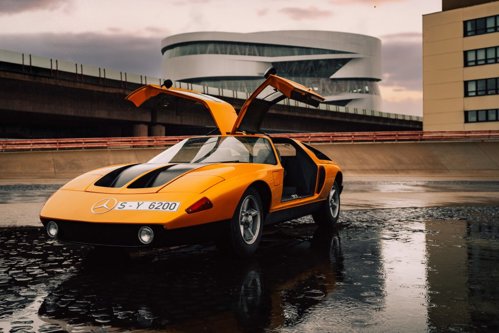
Mercedes-Benz C 111-II Car 33 Photo: Offline.Studios
Bettina Haussmann, Director of the Mercedes-Benz Museum: “With ‘Mercedes-Benz Museum 2.0’, we are consistently taking our Museum to the next level. We are continuing to write our company and brand history right up to the present day, creating new exhibition experiences and providing space for topics that are of particular interest to our visitors – from more recent classic cars to the latest innovations. With a digital twin, we are also opening up the Museum to people all over the world. Visitors can also experience the exhibits interactively here. The first results will be visible as early as 2027.”
The third C 111-II ever produced, listed in the Mercedes-Benz Collection as “Car 33,” is to be auctioned. The number 33 is only of internal significance. It was built from March 1970 onwards, painted in the color “Weißherbst” and fitted inside with sports seats featuring a grey-and-white houndstooth pattern, a four-spoke safety steering wheel and a vertically mounted “Becker Europa” radio. Contact with the road is ensured by contemporary 8×15-inch light-alloy wheels; on the racetrack in the 1970s, wide 10×15-inch and 13×15-inch magnesium wheels were used. Both sets of wheels are included in the auction. However, given their age and condition, the magnesium wheels are now only suitable for display purposes.
In August 1970, a 345 hp (257 kW) 2.4-liter four-rotor Wankel engine of the M 950 W 48 type was installed in the center of the vehicle. It propels the supercar, which weighs just 2,734 lbs (1,240 kg), to speeds of up to 186 mph (300 km/h). With the number plate S-Y 6200, this C 111-II became part of the test fleet. Among other things, it was used to test a fluidic component designed to ensure even emptying of the two side fuel tanks, which have a combined capacity of 30.6 gallons (116 liters), to carry out temperature measurements in the rear trunk, and to conduct test drives at the Hockenheimring. The rear trunk tub is removable and fitted. The anti-lock braking system (ABS) was also tested back then. However, this function is no longer active today.
From an early stage, the vehicle became a prominent ambassador of the C 111 project: Car 33 took center stage in the first issue of the German edition of Playboy, published in 1972. A year earlier, on the test track in Stuttgart, the renowned conductor Herbert von Karajan had been shown the C 111 project, based on this vehicle. In 1975, it was transferred to the company’s own vehicle collection. Since the Mercedes-Benz Museum opened in 2006, Car 33 has been on display in the “Fascination Design” section.
In 2024, Car 33 was restored to running order with great care at the Mercedes-Benz Classic Center in Fellbach. The original patina of the exterior and interior was deliberately preserved, while the powertrain was thoroughly overhauled and a fire-extinguishing system was also fitted in the engine compartment. Later that same year, Car 33 was showcased on the famous lawn at the Pebble Beach Concours d’Elegance as part of the “Wedge-Shaped Concept Cars and Prototypes” special exhibition. When the photographs were taken in October 2026, the odometer read just 24,766 kilometers.
Mercedes-Benz has entrusted the sale to the renowned auction house RM Sotheby’s, building on a long-standing and successful partnership: in 2022, the 300 SLR Uhlenhaut Coupe was sold for a record €135 million, followed in 2025 by the W 196 R Streamliner from the collection of the Indianapolis Motor Speedway Museum for €51,155,000. Both auctions took place at the Mercedes-Benz Museum in Stuttgart.
The auction is scheduled to take place on February 3, 2027 in the “Salles du Carrousel” at the Palais du Louvre in Paris, in parallel with the leading international trade fair Retromobile Paris. Bids can be placed at the auction, either by telephone or in person following prior registration.
The futuristic C 111 super sports car was unveiled at the IAA in September 1969. Its iconic gullwing doors are reminiscent of the legendary 300 SL Coupe (W 198), which had itself set new standards in automotive engineering as far back as 1954. Its story is that of a super sports car with the potential for series production, which at the same time served as an experimental vehicle for testing new technologies.
With its mid-engine, glass-fiber-reinforced plastic body and Wankel engine technology – which was regarded as cutting-edge at the time – even the first generation of the C 111 was far ahead of its time. Compared with conventional reciprocating piston engines, the rotary engine promised high power output combined with a compact design, low weight and exceptionally smooth operation.
This was followed in 1970 by the presentation at the Geneva Motor Show of the radically redesigned C 111-II, featuring a more powerful 2.4-liter four-rotor Wankel engine producing 345 hp (257 kW). Weighing just 2,734 lbs (1,240 kg), the C 111-II delivered breathtaking performance for its time: a maximum speed of up to 186 mph (300 km/h) and acceleration from 0–62 mph (0–100 km/h) in just 4.8 seconds were among the most spectacular performance figures in automotive engineering at the time.
Its futuristic wedge shape, “Weißherbst” paint finish and extraordinary technology made the C 111 an icon of the brand. Despite enormous public interest, the C 111 never went into series production due to new emissions standards, high production costs and the 1973 oil crisis. As a result, the C 111 has remained one of the great unfulfilled dreams of automotive history to this day.
Even after the decision not to begin series production, Mercedes-Benz continued to make history with the C111: in 1976, the C 111-II D, fitted with a five-cylinder OM 617 A turbodiesel engine, set a total of 16 records, including three world records. Over a distance of 10,000 miles, it achieved an average speed of 156.46 mph (251.798 km/h). The successful C 111-III from 1978 was also powered by a turbodiesel engine.
In 1979, the C 111-IV, in its final version with a 494 hp (368 kW) twin-turbo V8, was even faster: on the high-speed track in Nardò, Italy, it set another circuit world record of 251.02 mph (403.978 km/h).
A total of 17 Mercedes-Benz C 111 vehicles were built. One vehicle was used for crash tests; three others were dismantled in the 1970s. The Mercedes-Benz vehicle collection still includes 13 examples of the various C 111 variants. No vehicle has left the possession of Mercedes-Benz to date.
Main Image: Mercedes-Benz C 111-II Car 33 Photo: Kamil Kozlarek