
Major Transformation of Buckingham Palace’s Picture Gallery unveiled
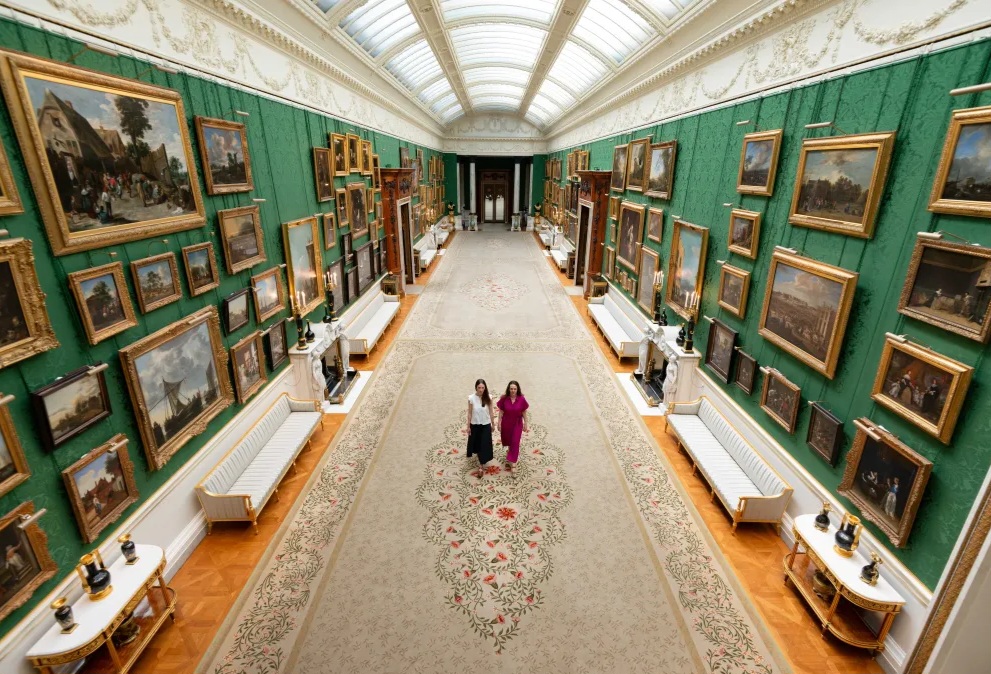
Paintings by Rubens, Caravaggio and Zoffany are among 120 masterpieces from the Royal Collection going on display for visitors to Buckingham Palace from Thursday, 9 July, as part of a major re-display in one of the Palace’s most important reception rooms.
The Picture Gallery, one of the State Rooms that open to visitors each summer, has undergone a once-in-a-generation re-display, almost doubling the number of paintings on show from 63 to 120.
The new presentation puts more works by some of the world’s greatest artists on show, bringing together paintings in inspiring and new ways.
Curators have drawn on historic watercolours, photographs, inventories and architectural schemes to devise the new display, which took 875 hours to hang and brings the room closer to its historic appearance. New emerald-green silk wall hangings and updated lighting, together with the increased number of paintings, create a striking visual transformation.
Anna Reynolds, Surveyor of The King’s Pictures, said: ‘This re-hang is an exciting and rare opportunity to significantly increase the number of world-class paintings on display for visitors, in line with our charitable aim to share as much of the Royal Collection as possible. It continues the longstanding tradition of renovations and re-hangs in the Picture Gallery that have commonly taken place following a change of reign, and we are delighted to be able to share it with as many people as possible this summer.’
Designed to showcase George IV’s magnificent paintings collection, the Picture Gallery was part of the architect John Nash’s transformation of Buckingham House into Buckingham Palace. George IV died before seeing the project completed; the first arrangement was hung by the time Queen Victoria acceded to the throne in 1837 and has evolved with new ideas about displaying art. Today, the Picture Gallery is used by the Royal Family to host guests, including Heads of State, and to hold receptions celebrating members of the public, and is seen by more than half a million visitors each year.
A highlight of the re-display is The Tribuna of the Uffizi by Johan Zoffany, a German artist active in Britain, which depicts the famed Florentine gallery filled with masterpieces and animated by visitors studying, discussing and enjoying works of art. Pictures by Holbein, Rubens and Raphael are all identifiable within the scene. Although commissioned by Queen Charlotte, the painting was never hung in her apartments, reportedly displeasing its royal patron with its crowded and unconventional composition. It was later recorded in the Picture Gallery in 1841, making its inclusion in the new display particularly fitting.
The painting forms part of a major new addition to the room: a display illustrating the flourishing of British art in the 18th century, reflecting Queen Victoria’s hang in the 1840s. Visitors will also see A Rough Dog by George Stubbs, believed to show George IV's pet dog, and Thomas Gainsborough’s elegant portrait of Johann Christian Fischer, not thought to have hung in the Picture Gallery before.
Five paintings by Rembrandt and one attributed to his studio are now hung together and demonstrate the breadth of the artist’s work. The re-display also unites seven works by Rubens. A standout pairing is Rubens’s Self Portrait, shown alongside his newly added portrait of Anthony Van Dyck. Displayed facing one another, the hang reflects their friendship in real life (Van Dyck joined Rubens’s studio as a teenager) and recreates history – the two portraits were known to hang together at Whitehall Palace in the 1660s.
George IV’s painting collection was one of the finest holdings of 17th-century Dutch paintings in the world. Vermeer’s Lady at the Virginals with a Gentleman, acquired by his father George III, remains in the 47-metre-long gallery and is now joined by lesser-known artists who were just as celebrated in their time. A striking work in the new display is The Letter by Vermeer’s contemporary Gerard ter Borch. This intimate scene of a woman with a letter draws the eye to the sumptuous textures of her silk satin dress, while inviting speculation about whether the message has just been written or received.
The paintings have been broadly grouped according to shared geography, period or subject matter, but the display also highlights affinities and connections between artists in the Collection. Within displays of Italian, French and Flemish masterpieces, visitors will find the influence of Caravaggio. His newly added painting The Calling of Saints Peter and Andrew, with characteristically dramatic lighting, is joined by Christ Healing the Paralysed Man by Van Dyck while nearby is The Young Cardplayers by the Le Nain brothers, who were inspired by the Italian master’s sense of narrative and naturalism.
The new additions to the room join remaining highlight works including 12 scenes of Venice by Canaletto, Frans Hals’s charismatic Portrait of a Man and a scene of a Madonna and Christ Child by Titian.
While the Picture Gallery has always displayed great paintings from the Royal Collection, the colour of the walls has changed numerous times, due to shifting tastes and the natural deterioration of fabric. The room has been golden yellow, lilac (fashionable in the Victorian period), crimson red and olive green, which it remained for much of the 20th century before coral pink velvet wall coverings were installed in 1976. After 50 years, this fabric had deteriorated, prompting its replacement with new emerald-green silk damask (patterned fabric) that will be fit for the next generation.
Main Image: Photographer: Ben Fitzpatrick