
Leonardo da Vinci Never Handed Over the Mona Lisa. Start There.
Around 1503 a Florentine silk merchant named Francesco del Giocondo paid Leonardo da Vinci to paint his wife, Lisa. An ordinary job. The painter takes the fee, paints the wife, delivers the panel, and it hangs in the client's house.
Leonardo never handed it over. He carried the portrait with him for the rest of his life, from Florence to Milan to Rome to France, still working the surface, until he died in 1519. The most famous painting on earth is a commission that was never delivered. Lisa del Giocondo never got her painting.
I start here because it explains him better than any speech about genius. He could not let go of a thing, and he could not finish it on anyone else's schedule. Those are not two habits. They are one habit, and it shaped everything he touched.
Look at the numbers. In about fifty years of work he left roughly fifteen paintings, and specialists still fight over several of the attributions. The list nobody disputes is shorter than that. Titian, working across the same century, signed hundreds. A busy Florentine studio could finish a dozen altarpieces while Leonardo circled one.
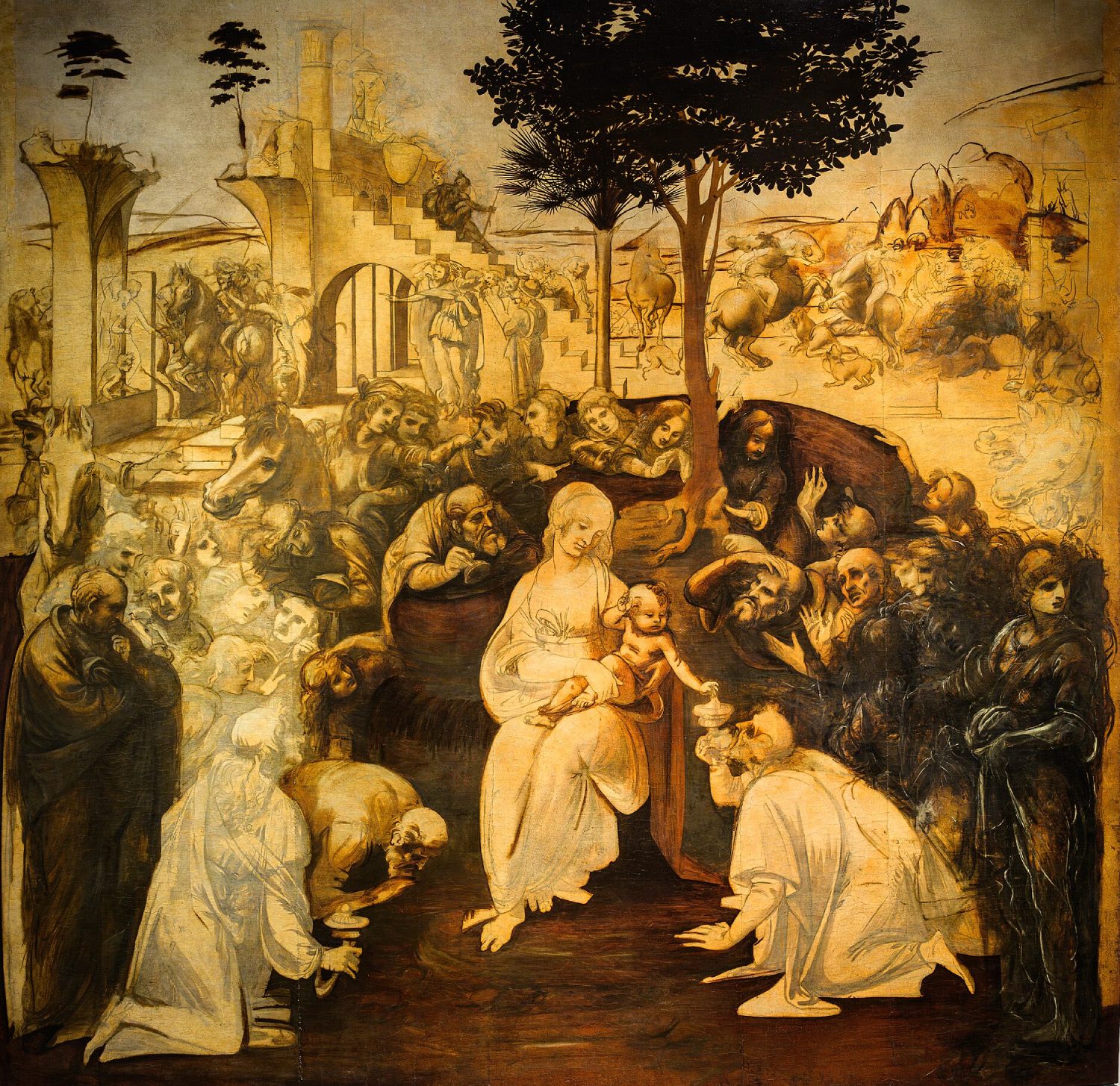
The abandoned works are well known. The Adoration of the Magi, commissioned in 1481, left as bare brown underpaint the day he moved to Milan. Saint Jerome, never resolved. The bronze horse for Ludovico Sforza, a clay model seven meters tall, used by French archers for target practice when Milan fell in 1499 and lost to the rain soon after.
Museums sell you the noble version of this. Restless genius, too visionary for mere commissions. I do not fully buy it. A good part of it was a man blowing deadlines and letting down the people who paid him. But there is a better reason underneath, and it is technical.
Leonardo's method ran on slowness. Sfumato, the smoke-soft blending that makes Lisa's mouth impossible to fix in place, is not a single move. It is dozens of near invisible glazes built up over weeks, each layer left to dry before the next goes down. A technique like that cannot share a room with a deadline. And it cannot survive fresco at all.
That is the collision at the center of the Last Supper. Between 1495 and 1498 he painted it for the monks of Santa Maria delle Grazie in Milan, and he threw out the fresco rulebook, which demands fast work into wet plaster with no corrections. He wanted his slow glazes, so he painted onto a dry wall with an oil and tempera mix the surface could not grip. It started shedding almost at once. By 1517, while he was still alive, a visitor wrote that it was already ruined. And inside that failing wall he still buried a detail people fight about to this day, which I took apart on its own in the secret of the Last Supper.
So here is my actual position, and it is not the gift shop one. Leonardo was, by the standards of his own trade, unreliable. He broke contracts, missed deadlines, and left clients empty handed. The same trait that made him a nightmare to employ is the only reason the Mona Lisa exists. He never delivered it because he was never done, and he was never done because he always found one more thing to change.
The panel he refused to hand to a silk merchant now sits behind bulletproof glass in the Louvre, the most visited museum on earth. The merchant's wife is still waiting.
This article is authored by By Julien, founder of the art newsletter Cool Stories About Art
Main Image: The Adoration of the Magi is an unfinished early painting by the Italian Renaissance artist Leonardo da Vinci.