
Interview with Elena Cologni: An Ecology of Affinities and Contamination(s)
Elena Cologni (Italy/UK) gained a BA in Fine Art from Accademia di Belle Arti Brera in Milan, an MA in Sculpture from Bretton Hall College, Leeds University and a PhD in Fine Art and Philosophy from University of the Arts London, Central Saint Martins College (CSM).
Her work combines her academic research and artistic studio and site/ communities/discourse responsive practice in a ‘research as art practice as research’ approach. In her projects she often collaborates with academics and professionals from other disciplines with open formats. These result in workshops, drawings, sculptures, video and text. In her work she has been interested in sharing experiences of the unstable nature of perception and memorisation of place through time (eg. the Mnemonic Present, Un-Folding series of video live installations 2005-2006 was developed as part of my post-doctoral project at CSM supported by Arts and Humanities Research Council). Since 2006, her work became distinctively situated and participatory interrogating on the nature of memory, the archive, remoteness, heritage, personal histories, the city.
Cologni has exhibited at Venice Biennale of Architecture, GAMeC Bergamo, Tate Modern London, National Portrait Gallery London, New Hall Art Collection Cambridge, Q2 Museums Quartier Vienna, to name a few.
Kisito Assangni KA): Many contemporary artists see the aesthetic as a social and artistic construct where the shapes represent an emotion in innovative ways. What is aesthetic to you?
Elena Cologni (EC): Aesthetic is a loaded term alluding to a philosophical construct.
Even though we are used to think that this is shaped by abstract ideas that intertwine
with art, and therefore might be quite removed from reality, it actually impacts society
and politics in the everyday. And the everyday in turn is where art happens.
In my studio practice I conceive shapes, forms, patterns, colours, through rhythm,
compositions and juxtapositions, and a process of sequencing and reduction through
drawing, cutting and folding. The results are spatialized actions in public space,
dialogic sculptures, (un)monuments, diagrams, scores, formations, propositions. In
these, geometries are distorted and skewed in different ways, while quietly
subverting the dominant cartesian grid. I defined them as attempts to (un)spatialize
while drawing geographies of difference. A strong influence from systems of
representation through geometry studies in my traditional art education background
in Italy, and also lived and breathed as I have been brought up in a country where
renaissance perspective and the baroque were all around me.
I studied at Brera in Milan, then lived in NY for a while and then came to the UK for
an MA in sculpture. But to push the limits of this controlled ‘visual construct’ at the
core of the western system of thought, in 1999 I got a scholarship for a PhD at
Central Sain Martins (UAL) in London, focused on resisting our ocular centred
culture. As part of this I was implicitly also critiquing the modernist subject therein.
Drawing on Donna Haraway’s take on this, I am interested in processes of
(un)spatialization through alternative mapping exercises and tactics of temporary
appropriations of space (Lara-Hernandez, JA, et al. 2019) allowing inexact
‘measuring’ instruments and personal stories to punctuate places as other kinds of
coordinates, that though are never fixed.
Conceptual ideas and abstract notions intertwine with my practical process, as tools
within it. Praxis and theory are one within a research art practice.
My work evolves through affinities and contamination(s). I find affinities with ideas,
processes and other artists I work with, or directly refer to, and most of these happy
‘collisions’ are directed by instinct, chance and ultimately urge. So, I adopt
participatory approaches or collaborative ways of working because I would hope this
to be a mutually beneficial opportunity. I always learn as aspects coming from this
ecology stay with and in me. These affinities highlight an interdependence with those
I work with, where vulnerability is exposed, to allow mutual contamination(s),
ultimately pointing to a feminist care aesthetics (Cologni 2024). I have referred to the
artist, myself as wound, blessure, ferita, which for care ethicist Elena Pulcini is what
allows subjects to be exposed to contagion with otherness, contesting every illusion
of separateness or self-sufficiency of the Self.
In my work this is understood in different coinciding ways and based on a disposition
towards others, to be available, to be in between, a bridge, to be a filter, a tool, to be
the artwork.
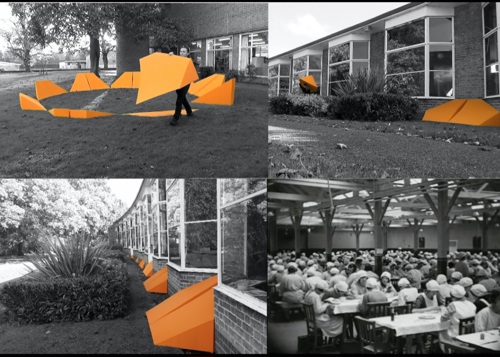
Gropius’ Offcuts, Elena Cologni, 2015
I had been working in seemingly different directions for years, but all start from the
percipience quality of the body - its porosity – that of the work or the artist, in relation
to the audience, participant, spectator. This implies a process in continuous
development, within which it is impossible to keep things out, resulting in an ongoing
negotiation for me between the need to close the world off in the studio and then the
need to be out there again and expose my own vulnerability to activate the dialogic
exchange, the contagion.
Shapes, feelings, untold stories and words popping up in my head are all indications
of a system of rebounds, something somewhat coherent, but not consciously
formalised or – I should say - addressed. On a personal as well as on a more
intellectual level. I learnt to listen to this dialogic self.
This appeared in my sketchbook which got drenched on a cold a late spring evening
in 2021 in Venice. Covid19 rules were still in place when it came to restaurants, so
curator Gabi Scardi and I sat outside, and I placed my rucksack on the ground…it
contained my sketchbook, pens, cello tape, strings, and various other things I would
use to install my then imminent solo show, Elena Cologni. Practices of Care. On
Finding the cur(v)e.
The note in the picture has been guiding much of my thinking and doing since,
including the series of city interventions The Body of/at Work which premiered at the
Italian Pavilion of the 17a Mostra di Architettura, La Biennale di Venezia (2021), but it
also refers to a lot of what I had done before. And there is so much more I still need
to unpack about it.
I have recently gone back to my sketchbooks and found clues in something I wrote in
1991 (!), and then in other more recent ones, where it became apparent how where I
was then is still relevant to where am now. When I work in the studio, words pop up,
they get mixed up with words I write down as I wake up, perhaps coming from
dreams, or as clues about connecting sensations, fears and experiences, or again
indicating future directions.
Art is a way to get to understand life, one’s own life within the wider ecology of
relations, including others, places, plants, animals. To relate is also to care and art
practice is a complex, at times a messy form of care. The feminist care aesthetics
framework is a testing ground for this and a context that gave me strength, solace
and purpose after a period of personal struggle. All of a sudden, the full-blown reality
of what turned out to be a quite dysfunctional family recently finally came to the fore.
Instances of uncare, which I can now see for what they are, and recognise: they
have a taste, a smell, names, faces, colours and shapes – which I miss and hate all
at the same time.
KA: Given your extensive exhibition history, what processes have to be carried out for viewers to understand that an art object represents a feeling, a phenomenon or a concept?
EC: I do write and talk about my process, but I also like to think that one does not
necessarily have to have that information to access the work in its complexity –
access through beauty is still so powerful and seductive. And access is important. I
present my work and research in exhibitions, performances and workshop-based
work I also like to call experiential exercises. These are based on an untidy, messy
and not rehearsed, and are the most rewarding contexts for me, because it is where
as we, as a group share experiences, we make new memories which then become
embodied. We all go away with something that will forever stay with us. We get
‘contaminated’ with one another while we care with.
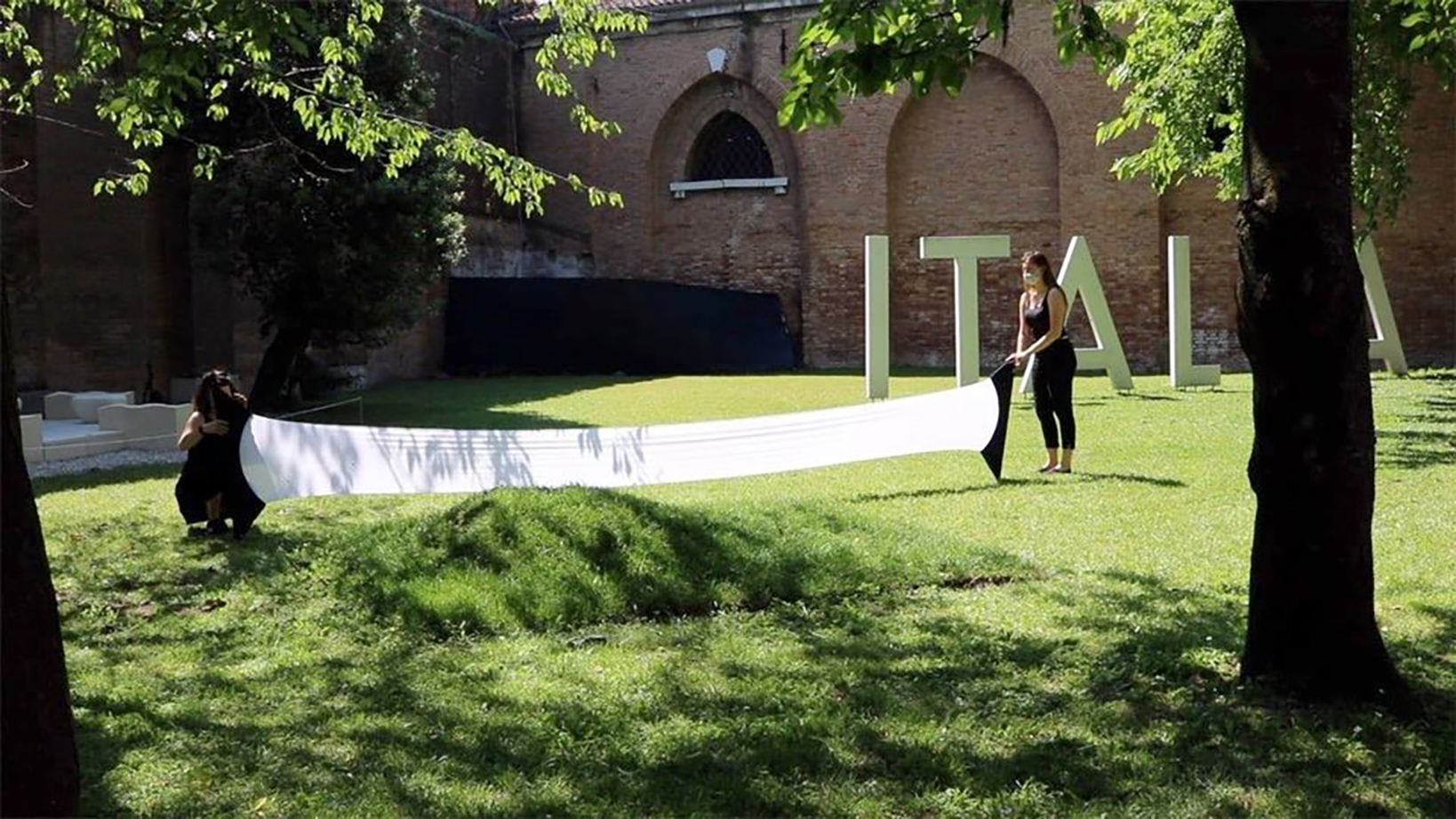
At the core of the ‘The Body of/at Work’ series are dialogic sculptures I developed.
These alternate, between moments of rest, and moments of activation, and are also
repositories of those experiences in some ways. The experiences offered are
primary, and of our bodies first.
The series has been presented in Venice, Milan, and Crespi, where these
interventions aimed at punctuating public space to reactivate invisible or forgotten
stories and memories (will also take place in the UK). The sculptures comprise
shapes used as ‘handles’ which are connected through a long sheet of stretchy
fabric. Participants work in pairs to reactivate the past through the sculptures, and
keep the sheet stretched out to navigate the space. Their movement consists of
attempts to draw curves around the pivotal body of each person. The body is an
instrument through which one gets to know the place with its memories and in the
present of the experience. The body is hot, cold, tired, feels the weight and lightness,
struggles, is at work, reacts to obstacles, stumbles, responds, stops, moves slowly.
The action is, as a participant said, “a rediscovery of the place through bodies in
motion”. The body thus is part of the meaning making creation, I do not have to explain how it does it, on the contrary those who take part tell about the experiences they went
through.
KA: Is there an artwork of yours that stands out in this moment as being particularly meaningful to you? Relating to the above, what does it mean to you to be authentic as an artist?
EC: All my works develop in relation and response to one another, and since I left my
country of origin, a condition of transition is central in my work. So, particularly since
the series Mnemonic Present, Un-Folding (various venues, 2004-2006), but also Re-
Moved (Centre for Contemporary Art, Glasgow internation 2008) I have addressed
issues of memory, presentness, and amnesia in relation to home and more generally
place. More specially, Seeds of Attachment (Women’s Art Collection, Cambridge
University, 2016/18) was a project I developed soon after the British people voted to
leave the EU.
I moved to the UK in 1996; my two sons were born here. I recall very
clearly how, worried, the youngest asked me if we then, because of the result, had to
leave. The project developed from a previous one Lived dialectics, movement and
rest, outcome of a residency at the Museums Quartier in Vienna that summer
(curated by Gülsen Bal and Walter Seidl), where I went with my son and I started
thinking about how one gets attached to a place to make it one’s own, and what that
might mean.
But also, how damaging it is for individuals to get taken away from it when having to
leave to survive – and the devastating social impact of this.
Seeds of Attachment was for me a way to invite other mothers/cares to create a safe
space together using a foldable sculpture to understand these transitory moments
experienced by everybody, not only those we tend to identify as migrant. For
example, when one goes from the family home to another village, region or country
to study or work; the effects these changes have on our children. Participants
indicated where to meet at a chosen spot on their daily school run and opened up
about what home might mean to them: a place or a condition.
These are still central issues in my work and remain unresolved in my own life. I felt
welcome in the UK since I have moved here from the US and Italy, and I am
supported in my work. However, even if I feel settled here, it is difficult to accept how
things have turned out in my family of origin after my parents passed away. These
are still unresolved. Even though I made a conscious decision to get a way years
ago and focus on what I can do to promote small but real change, the psychological
abuse I suffered recently reopened old wounds and reminded me why I left then.
Being authentic means not to shy away from facing what life throughs at you, but
also make it visible, turn it into something else, and not only for you. This transformation process at the core of art is sometimes a survival mechanism, the
roots of which might go unnoticed for a long time.
KA: From your perspective, what is the importance of art collecting?
EC: Huge. It is to do with opening up conversations with other artists, and other
facilitators within the system. Providing an artist with the support to be able to
succeed thus actively contributing to their sustainability, and that of their wider
community. But also of course, providing others with access to the artist’s language, while supporting the process of historicization of their practice. And with all this comes huge responsibility from part of collectors on who they provide these to, and who they eventually exclude in the process.
KA: What are you currently interested in and how does it feed into your creative thinking?
EC: Interconnected concepts of work, body (our own body and the body of society), care (as kinship) and skin (surface of the body), these have been all addressed in my practice in parallel, at times intersecting one another, or opening up more conceptual/theoretical investigations. More specifically, some experiments using materials resembling skin or membranes started in 2020, never really left the studio.
I am now ready to discover where I can go with them. This journey is also inspired by Marxist scholar Silvia Federici who imagines the "periphery of the skin" not as that which "encloses" the body, but that which enables us to establish newer ways of relating to the world around us and being affected by it. For me also a membrane functioning within relationality, and again contamination(s), and also kinship, perceptual dynamics. Navigating these
concepts not only helps when working with others, it is also useful in life.
KA: In recent times, conjunctural artistic manifestations are everywhere: there is activist art to combat climate change, collective art to solve social problems, political art to reflect on the discomforts of society. What is your position around these examples? Do you have any moral or ethical responsibilities in your works?
EC: I make art because I need to, I make sense of life through it, and I am lucky that
it is also my job. But art does not solve problems, however it plays an important part
in what it is to be human. Humanity needs it to express happiness and joy, while it
has become evident also how in catastrophic times (like during Covid), and in
everyday moments of discomfort, it can have a beneficial even transformational
effect. So, access to art is important and should be protected and guaranteed for
everyone, as it is intrinsically connected to self-care and wellbeing whether we are
aware of it or not.
Art has been for me also an instrument to fight abuse, control and prevarication.
Mother Art Collective I have been collaborating with since 2021, in discussing their experience as women artists in the 70’s they said to me when we were in their studio in LA in 2023 of their work that it “came out of oppression, which is a motivation for everybody to fight something. It is when it's oppressive to you that you see it's how
oppressive it is for others”.
Oppression can manifest in many different ways and perpetrators can be more or
less visible, so it is sometimes difficult to direct the fight because though invisible the
target is all around you, and it becomes more of a continuous struggle.
If as artists we go through a tough personal experience informing or becoming the
work, or we work with others who bring their lived experience in the work, this comes
with a responsibility for those involved in the work itself or those who will be affected
by it. Being aware of this is central to create long-term trustworthy relationships. Art
can open conversations, and at times this can be painful, but it is through these
processes that small changes happen for those individuals, contributing to the bigger
picture.
KA: The influence of artificial intelligence (AI) on creativity and productivity is a controversial topic in the art world. Have you experimented with AI art? How do you see AI impacting the life of artists and the creative process?
EC: I have not experimented with it, I will do. At the moment though, I still need to
focus on touch and materiality and feel gravity through my body and my feet on the ground. A conscious decision I made in 2001 after 9/11, a pivotal moment for the world and for me, when from mediatised live installations I started engaging with the here and now of the experience of place more consistently.
So, the more we are pushed to engage with AI, the more I feel the urge to go back to where I started: pencil and paper, to make sure that we ‘define our bodies in ways that are nondependent on our capacity to function as labour power’ (Federici, 84) within the digital economy.
KA: French thinker Jacques Rancière wrote “ When artists adopt other guises or disciplines, are there alternative models of criticism or classification to which we should turn? “ How does this resonate with you? Any future projects?
EC: I am not sure. My artistic research is underpinned by a confluence of perceptual
dynamics, philosophy and environmental psychology, through a feminist care
aesthetics lens. Artistic research was discussed by Clare Bishop in 2023 as a genre,
outside the academic context, so a more engaged critical discussion around this
would be interesting.
I am now working on two large exhibition projects. The first represents next step of
"The body of/at Work" focusing on women’s places of work, this time more specially
informed by Silvia Federici's research on reproductive labour and issues of place in
South America.
The second project is developing from a Getty Research Institute Grant I was
awarded in 2023. One of the outcomes is the exhibition ‘From the Home to the
Planet. A dialogue between Elena Cologni and Mother Art Collective’, curated with
Raffaella Perna, presented in Rome in October-November 2025 at the MLAC
museum of the Sapienza Universita’ di Roma, with the support of the director Ilaria
Schiaffini. This included a new collaborative piece and previous projects.
I am also hoping to soon bring to completion a monograph on 30 years of my work
(!). This will be published by the Milan based Postmedia Books and I am so thankful
of being able to include conversations with collaborators over the years. It is a very
exciting time.
References:
Publications.
Bishop, C. (2023) INFORMATION OVERLOAD Claire Bishop on the superabundance of research-based art. Artforum, Features, April. https://www.artforum.com/features/claire-bishop-on-the-superabundance-of-researchbased-art-252571/ [accessed 07/10/2024]
Cologni, Elena (2004) The artist's performative practice within the anti-ocularcentric discourse. PhD thesis, University of the Arts London.
Cologni, E. (2020). Caring-With Dialogic Sculptures. A Post-Disciplinary Investigation into Forms of Attachment. PsicoArt – Rivista Di Arte E Psicologia, 10(10), 19–64. https://doi.org/10.6092/issn.2038-6184/11444
Cologni, E. (2024). Percipience, embodiment, contamination(s). The artist as wound. Practicing a feminist care aesthetics. International Journal of Education & the Arts, 25(si1.25). http://doi.org/10.26209/ijea25si1.25
Cologni, E. (2024). Mother(ings): From the home to the planet. A dialogue between Mother Art Collective and Elena Cologni. International Journal of Education & the Arts, 25(si1.6). http://doi.org/10.26209/ijea25si1.6
Federici, S (2020) Beyond the Periphery of the Skin: Rethinking, Remaking, and Reclaiming the Body in Contemporary Capitalism. PM Press/Kairos
Haraway, D. “Feminism and Technoscience”. Journal of the History of Biology 30 (3) 1997: 494-497.
Lara-Hernandez, JA, et al. 2019. Temporary Appropriation of Public Space as an Emergence Assemblage for the Future Urban Landscape: The Case of Mexico City. Future Cities and Environment, 5(1): 5, 1–22. DOI: https://doi.org/10.5334/fce.53
Projects
Cologni, E. (2004/06). Mnemonic un-folding series. Galleria Arte Moderna e Contemporanea di Bergamo; Galleria di Arte Moderna, Bologna; Whitechapel Gallery, London; Brown University, US, (among other venues).
Cologni, E. (2008). Re-moved. Centre of Contemporary Art, Glasgow International 08, Scotland, curator Francis McKee.
Cologni, E. (2009). Geomemos. Yorkshire Sculpture Park, UK
Cologni, E. (2015). Gropius’ Offcuts. Impington Village College, Cambridgeshire, UK
Cologni, E. (2016/18). Seeds of Attachment. Women’s Art Collection and Centre for Family Research, University of Cambridge; Freud Museum, curator Eliza Gluckman.
Cologni, E. (2021/). The Body of/at Work, 17a Mostra di Architecttura, La Biennale di Venezia, curator Alessando Melis ; London Festival of Architecture; Crespi (UNESCO) Festival della letteratura e del lavoro, curator Gabi Scardi.
Cologni, E. (2021). Elena Cologni. Practices of Care. On Finding the cur(v)e, curator Gabi Scardi. Fondazione Bevilacqua La Masa, Venice, Italy
Cologni, E. (2023). 416_SR1938, Universita’ di Pisa, Italy
Main Image: ‘The Body of/at Work’, Elena Cologni, Padiglione Italia, ‘Resilient Communities’ program, Biennale di Venezia 17a Mostra di Architettura, 2021. Discussion with participants.