
Interview with David Blandy: How we can enter Into Different Worlds and Lives through Collective Imaginative Practices
David Blandy (1976, Lives & works in Brighton) is an artist examining global structures of control and networks of resistance, in areas that range from ecology, history and science to arenas of play.
David Blandy makes videos, games, sound and ephemera, deconstructing forms to put them back together again. He searches for meaning in cultural life, an expanded form for auto-anthropology, sifting through multiple forms of archive, from historic texts to academic archives, archaeology and ecological theory, twitch streams and film archives; he weaves poetic works that explore the complexities of the contemporary subject. He builds complex stories that sketch out a future of interdependence, through visual poetry and immersive play.
Nominated for the Film London Jarman award with Larry Achiampong in 2018. He has exhibited and performed at venues nationally and worldwide, with solo shows at John Hansard Gallery, Southampton; Towner Gallery, Eastbourne; Focal Point Gallery, Southend-on-Sea; The Baltic, Gateshead; Turner Contemporary, Margate; Spike Island, Bristol; The Exchange, Newlyn; Künstlerhaus Stuttgart, Germany. Blandy has also exhibited in museums internationally including at Art Tower Mito, Tokyo; Kiasma Contemporary Art Museum, Helsinki; Tate Modern, London; and MoMA PS1, New York.
Kisito Assangi (KA): Many contemporary artists see the aesthetic as a social and artistic construct where the shapes represent an emotion in innovative ways. What is aesthetic to you?
David Blandy (DB): For me the aesthetic is a lure, a way of attracting and holding attention, in order to communicate both ideas and emotions. I’m always interested in new aesthetic forms, where those forms come from and what they might mean in different contexts. Those forms originate from disparate places, from the world of popular culture to new forms of “folk art”, such as twitch streams, YouTube How To videos, video games and tabletop roleplay.
KA: Given your extensive exhibition history, what processes have to be carried out for viewers to understand that an art object represents a feeling, a phenomenon or a concept?
DB: I always think of, and strive for, my work to be largely self-explanatory, that the work should be able to speak for itself, and contain everything that is needed to read or understand the work on a certain level.
The work often has layers of meanings and allusions that fall outside the work itself, but I aim for the work to speak in its own right, to be open to the viewer, not closed off and hidden behind veils of theory or necessary prior knowledge.
I think that viewers always come open to the work, hoping to find a meaning or feeling in it. Otherwise they’d stay away from the gallery space. This is the main function of the gallery space, to say that you are entering a space where you are ready to consider things as art. I fin it interesting to try to move that space into other realms, in an image, online video, book, role-play game or piece of sound outside the gallery, where the status of the object is more uncertain, and yet still be able to transport the viewer into the contemplative and associative space of art.
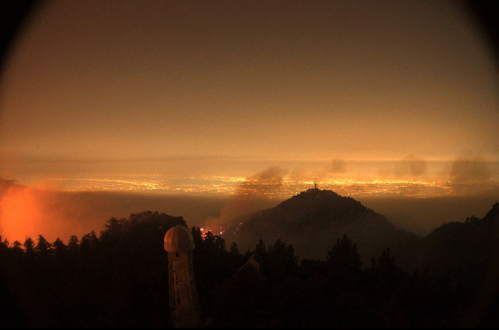
Still from Sunspot, David Blandy, 2023; Commissioned by John Hansard Gallery,
Southampton, UK
KA: Is there an artwork of yours that stands out in this moment as being particularly meaningful to you? Relating to the above, what does it mean to you to be authentic as an artist?
I’ve been working on a new project, Alien Pastoral: The Strain, which brings together a lot of disparate strands in my work. Initially inspired by my grandfather’s experience working in an agricultural research station, it is a game that places the player in a complex position, with a role and a potentially contradictory secret, such as a research scientist who is secretly trying to undermine the experiments. It’s a game about being trapped in a certain mode of acting and thinking, that posits that acceptance of radical change is necessary to build a new society.
It uses the form of a bodyhorror tabletop roleplay game, but undermines the genre through the ultimate horror perhaps being the longed-for solution, suggesting that we need to abandon old hierarchies if we’re going to survive.
Authenticity for me is about being true to the cultures that you are investigating, to be a part of them. Of course that necessitates an auto-anthropology, to make honest work about the life you live. Taking gaming as an example, I grew up obsessed with gaming, both videogames and tabletop games, and much of my work has come from my analysis of my own thought processes a fan, as a subject of these cultures. Virtual bodies, group imaginative play, cultures of control and pathways to emancipatory ideas, are all there inside the cultures I participated in without self-awareness.
What can I know, as an artist, when so much is mediated? I can be sure of my own visceral and lived experiences, not necessarily that they are true, but that they were felt,
and that feeling had meaning, the feeling itself was true. Relating that understanding, helping others feel and think about what those feelings mean, are core to my practice.
KA: From your perspective, what is the importance of art collecting? Is contemporary art open to the masses?
DB: I understand the base desire to collect, it’s something everyone does to a greater or lesser extent, a gathering of stuff to mark our place in the world. But there are also hidden hierarchies within this system, who has access, who has the funds, who benefits the most? Art collecting is unregulated, but very much part of the art ecosystem; artists need collectors, particularly now the arts are so underfunded by government.
One of the reasons I am interested in making art within the realm of videogames or tabletop roleplay games is that it takes art outside the gallery space. There are elements of my artwork that can be downloaded and adapted for free. I love that there might be someone in their bedroom creating their own new world using my templates.
KA: What are you currently interested in and how does it feed into your creative thinking?
DB: I’m currently interested in the cathartic and emancipatory potential of tabletop roleplay, how we can enter into different worlds and lives through collective imaginative practices. As Ursula Le Guin said, “Before we can change the way we organize ourselves, we first have to imagine it.”
The form is also a complex tool for investigating systems and how they function. So I’ve been using this form, entering into the online and offline discourse around this space, seeking out the possibilities offered, that I see as a continuation of various Fluxus games, the logic of the seance, and the history of oral storytelling.
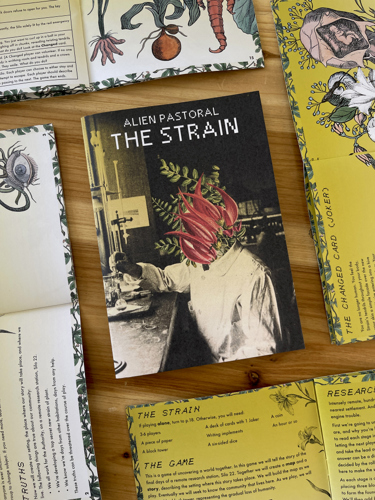
Alien Pastoral- The Strain, David Blandy, 2024; Commissioned by Serpentine Gallery,
London, presented as part of the Infinite Ecologies Marathon.
KA: In recent times, conjunctural artistic manifestations are everywhere: there is activist art to combat climate change, collective art to solve social problems, political art to reflect on the discomforts of society. What is your position around these examples? Do you have any moral or ethical responsibilities in your works?
DB: I think that we all have a responsibility to think about how to make a better world. I would say that my practice acts in all these fields to varying extents in different works, many directly dealing with ideas around climate change (like my films The Edge of Forever & Sunspot, or my game The Strain), collective work (like The World After and Lost Eons) and societal structures and racism (through collaborative work with Larry Achiampong and works like Gathering Storm).
My work reflects what I’m thinking about, and I find myself returning again and again to these issues. They they feel urgent because they are urgent. We’re entering into a new unpredictable stage for the planet, and we have to think through both how to respond and how to change our lives to survive.
KA: The influence of artificial intelligence (AI) on creativity and productivity is a controversial topic in the art world. Have you experimented with AI art? How do you see AI impacting the life of artists and the creative process?
DA: What concerns me is environmental inequity and how the use of AI exacerbates this. The environmental load can be disproportionate depending on which country is hosting data centres, placing inequitable burdens on local people. I’m already a part of this problem from being an image-based creator using video and computer games, running renders on computers, living a digital life.
I think there is some interesting AI work being made, but I’d like to know more about
what impacts advancements in the technology will have on creators, on privacy and its
appropriative nature. Who will govern this, monitor it and enforce guidelines? Who is in charge of building these frameworks: corporations, governments or rogue innovators, and who benefits from it?
KA: French thinker Jacques Rancière wrote " When artists adopt other guises or
disciplines, are there alternative models of criticism or classification to which we should turn? " How does this resonate with you? Any future projects?
DB: Every discipline has its own mode of criticism, and I think an artist has to accept that when working within other disciplines (as I often do for graphic novels, videogames, tabletop games) you have to accept that the primary mode of criticism will be from the discipline you are adopting for the piece.
As an artist working in another creative space you are entering into a conversation with a parallel culture, so I think to do so authentically you have to enter into that culture at the same time as making the work, become immersed in the culture’s understanding of its own medium. Then the work functions as a part of both a creative culture and as an object to be considered in a gallery space. The hardest thing for work like this to achieve is to function well under both forms of critique. But I keep trying.
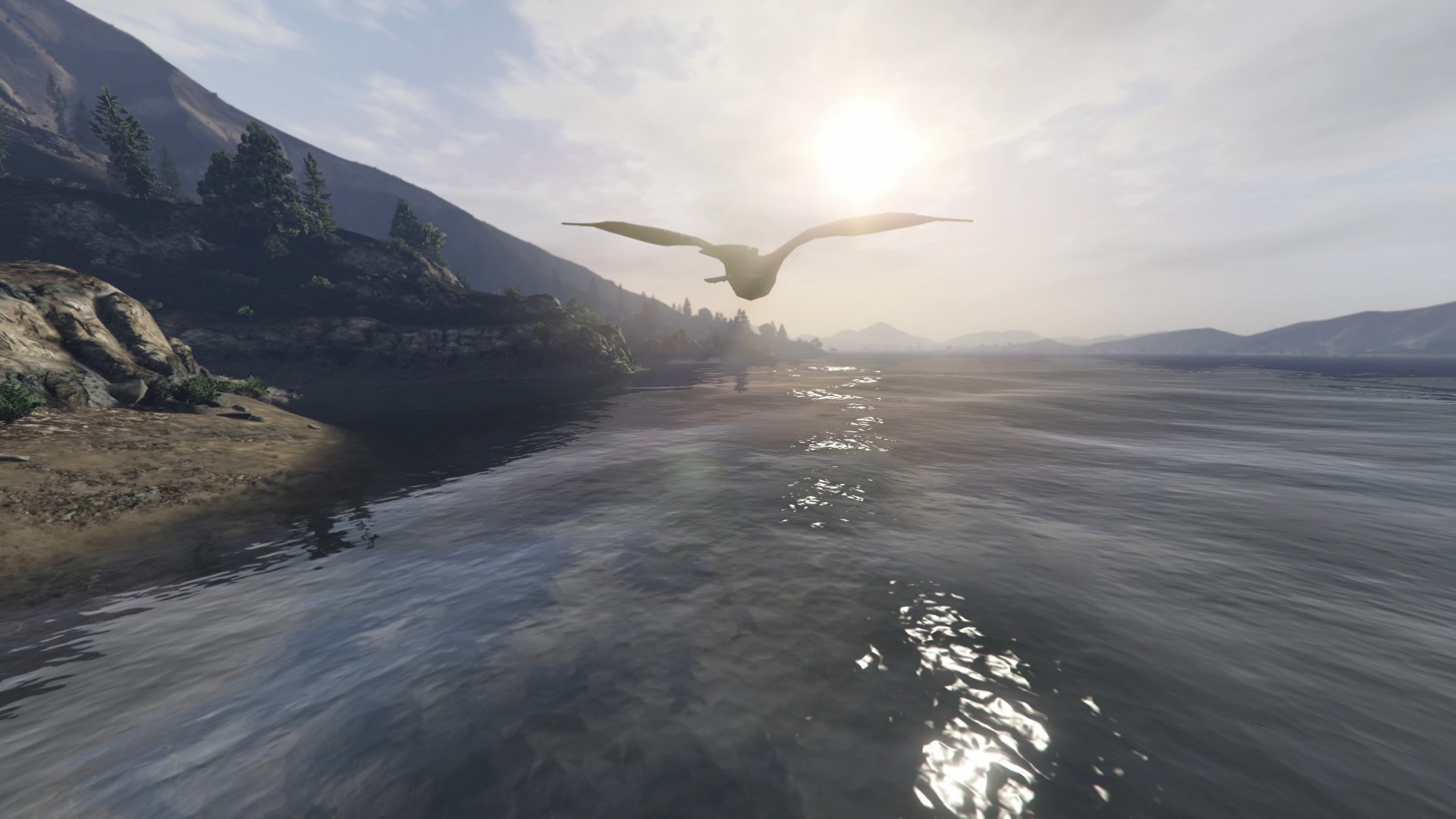
Main Image:Still from How to Fly, David Blandy, 2020; Commissioned by John Hansard Gallery, Southampton, UK
David Blandy is represented by Seventeen Gallery, London. His films are distributed by LUX, London.