
Hundreds of Ice Age Rock Art Engravings Discovered Hidden in Plain Sight
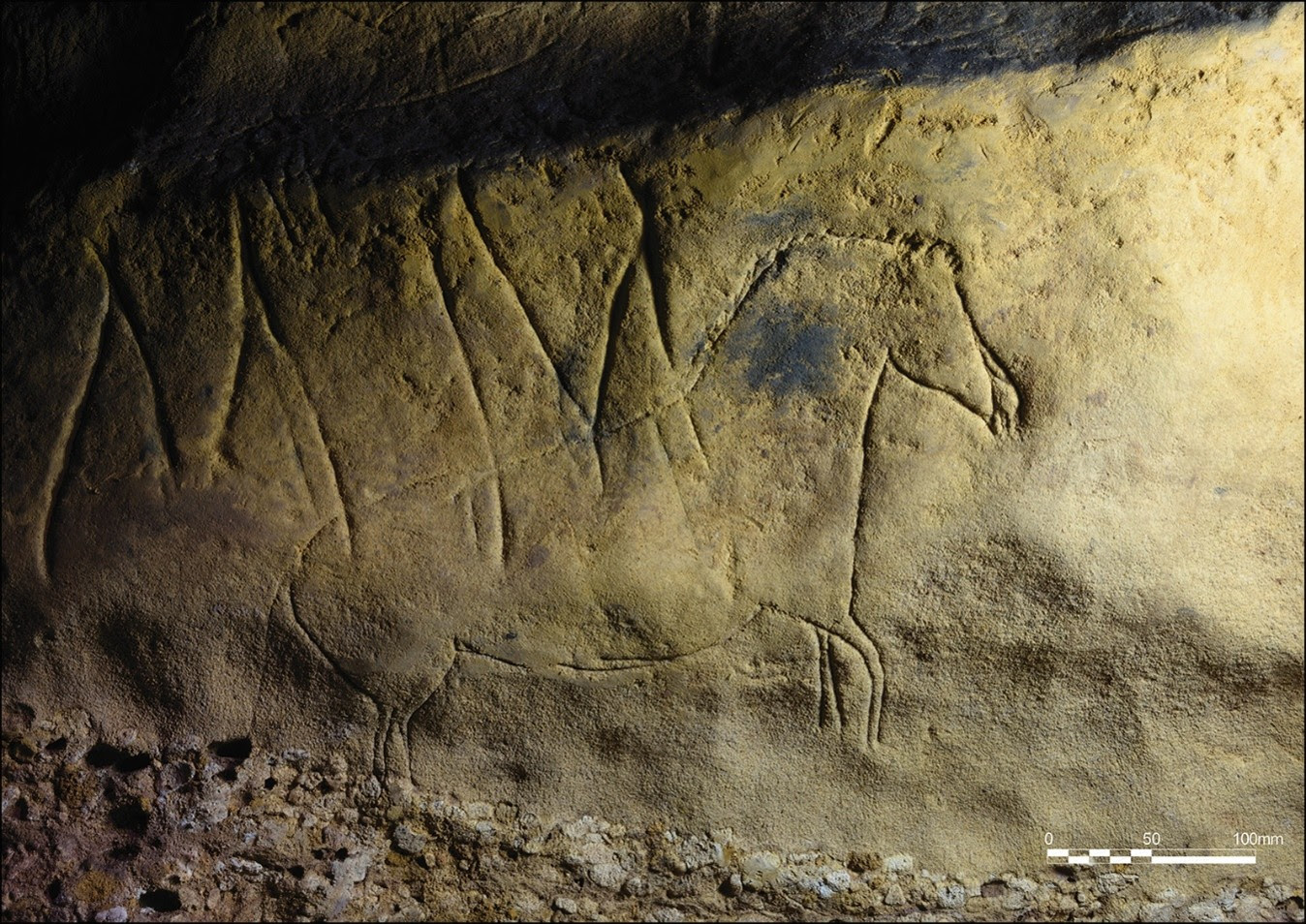
Archaeologists have discovered the third-largest assemblage of Ice Age cave art ever found in Mediterranean Iberia in a region thought devoid of cave art, transforming our knowledge of Paleolithic European art.
Since the 12th century AD, people have been visiting the Cova de la Font Major in Catalonia. From 1957 onwards it was widely frequented by visitors, speleologists and treasure hunters and it was even converted into a tourist attraction in 1993.
Despite this, no art from the Ice Age had ever been discovered there and it was believed that the cave walls were unsuitable for the engraving of Palaeolithic art.
The Iberian Peninsula contains over 50% of all cave art documented in Upper Palaeolithic Europe, but its distribution is incredibly uneven, with a high concentration found in the Franco-Cantabrian region (located between modern France and Spain) but only two representations found in the entirety of Catalonia.
“Until now, the Palaeolithic rock art identified in north-eastern Iberia has been very scarce compared with the abundant record of the neighbouring Franco-Cantabrian region”, states co-author of the research, Josep Maria Vergès from the Catalan Institute of Human Paleoecology and Social Evolution (IPHES-CERCA).
This all changed when archaeologists identified 280 Palaeolithic motifs in the cave, located right under our noses the entire time. This is the highest concentration of Palaeolithic parietal representations currently known in Catalonia.
“For more than six decades, thousands of visitors passed directly in front of the engraved surfaces, and in some cases inscribed names and dates over them, without the Palaeolithic origin of the figures being recognised”, says Vergès.
This discovery means that Cova de la Font Major in fact contains the third-largest Palaeolithic cave art assemblage on the Mediterranean side of the Iberian Peninsula.
“Along the Iberian Mediterranean façade, from the Pyrenees to Gibraltar, around 75% of known assemblages contain no more than five zoomorphic figures, and over 90% contain no more than 20”, adds co-author Míriam Salas-Altès from the Catalan Institute of Human Paleoecology and Social Evolution (IPHES-CERCA). “The sheer quantity of art discovered at the Cova de la Font Major is therefore particularly exceptional.”
The authors analysed the rock art and determined that the motifs are different from the art of the neighbouring Franco-Cantabrian region, leading them to conclude that this represents a distinct Palaeolithic artistic tradition. Their results are published in the journal Antiquity.
These findings therefore demonstrate, for the first time, that north-eastern Iberia was home to its own particular artistic customs.
Importantly, the quantity of art could indicate that the region, previously seen as marginal, was in fact densely occupied, completely transforming our understanding of the Palaeolithic in the Western Mediterranean.
“Contrary to what was previously thought, north-eastern Iberia holds first-rate Palaeolithic rock art sites”, concludes Salas-Altès. “The Mediterranean art of western Europe is now enriched by a new body of rock art, which allows us to characterise in greater depth a Mediterranean graphic tradition with an identity of its own, distinct from that of the Franco-Cantabrian region.”
Main Image: An engraving depicting a horse. “Filling Gaps: The Palaeolithic Rock Art of the Cova de la Font Major on the North-east Iberian Peninsula,” by Josep Maria Vergès Bosch and Míriam Salas-Altès, in Antiquity Publications Ltd,