
Humanity’s Oldest known Cave Art has been discovered in Sulawesi
When we think of the world’s oldest art, Europe usually comes to mind, with famous cave paintings in France and Spain often seen as evidence this was the birthplace of symbolic human culture. But new evidence from Indonesia dramatically reshapes this picture.
Research, published in the journal Nature, reveals people living in what is now eastern Indonesia were producing rock art significantly earlier than previously demonstrated.
These artists were not only among the world’s first image-makers, they were also likely part of the population that would eventually give rise to the ancestors of Indigenous Australians and Papuans.
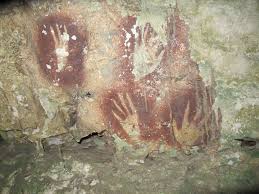
The discovery comes from limestone caves on the island of Sulawesi. Here, faint red hand stencils, created by blowing pigment over a hand pressed against the rock, are visible on cave walls beneath layers of mineral deposits.
By analysing very small amounts of uranium in the mineral layers, we could work out when those layers formed. Because the minerals formed on top of the paintings, they tell us the youngest possible age of the art underneath.
In some cases, when paintings were made on top of mineral layers, these can also show the oldest possible age of the images.
One hand stencil was dated to at least 67,800 years ago, making it the oldest securely dated cave art ever found anywhere in the world. This is at least 15,000 years older than the rock art previously dated in this region, and more than 30,000 years older than the oldest cave art found in France. It shows humans were making cave art images much earlier than once believed.
This hand stencil is also special because it belongs to a style only found in Sulawesi. The tips of the fingers were carefully reshaped to make them look pointed, as though they were animal claws.
Altering images of human hands in this manner may have had a symbolic meaning, possibly connected to this ancient society’s understanding of human-animal relations.
In earlier research in Sulawesi, images of human figures with bird heads and other animal features were found, dated at least 48.000 years ago. Together, these discoveries suggest that early peoples in this region had complex ideas about humans, animals and identity far back in time.
The dating shows these caves were used for painting over an extraordinarily long period. Paintings were produced repeatedly, continuing until around the Last Glacial Maximum about 20,000 years ago – the peak of the most recent ice age.
After a long gap, the caves were painted again by Indonesia’s first farmers, the Austronesian-speaking peoples, who arrived in the region about 4,000 years ago and added new imagery over the much older ice age paintings.
This long sequence shows that symbolic expression was not a brief or isolated innovation. Instead, it was a durable cultural tradition maintained by generations of people living in Wallacea, the island zone separating mainland Asia from Australia and New Guinea.
The findings add to a growing body of evidence showing that early human creativity did not emerge in a single place, nor was it confined to ice age Europe.
Instead, symbolic behaviour, including art, storytelling, and the marking of place and identity, was already well established in Southeast Asia as humans spread across the world.
Main Image: Narrowed finger hand stencils in Leang Jarie, Maros, Sulawesi. Adhi Agus Oktaviana