
How Do We Decide Whether Something New Has Real Value, and What Signals Do We Learn to Read ?

Nadezhda Gribkova is an art historian who studies modern and contemporary art, the
European avant-garde, and art created outside official institutions and markets.
Her dissertation looks at unofficial culture of the late Soviet period, where artists worked without museums, collectors or public recognition. Small circles of artists and viewers defined the value of their work long before institutions accepted it.
She is a PhD candidate in the Department of Slavic Languages and Literatures at the University of Chicago (expected 2031). She holds an M.A. in Art History from the University of Illinois at Chicago and a B.A. cum laude in Art History and English from the University of Rochester, with a Certificate in Literary Translation. Nadezhda Gribkova has designed and taught undergraduate Art History courses and served as a teaching assistant for courses on Russian literature.
Kisito Assangi: Soviet unofficial art developed beyond state-sanctioned cultural institutions, formalised markets, and official recognition. How did artists and their audiences establish artistic value and legitimacy within these alternative networks? What does this history show about how artistic value forms independently of institutional endorsement?
Nadezhda Gribkova: Trust in the Soviet Union was a weighted question. Faithfulness to state ideology—or its visibility—was paramount to social standing. Many led official lives as party and union members while living, on the ground, far from the state's high ideological aspirations.
Leading up to glasnost (Gorbachev's mid-1980s policy of openness), widespread mistrust of the state's emptied symbolic machine pushed artists toward alternative art-making and thinking. Unofficial art grew in tight-knit circles through apartment exhibitions and private readings. In that atmosphere of familiarity, friendship, and occasional good-faith rivalries, legitimacy was not the focus. Artworks were made in real time, often before the audience's eyes.
Many artists lived double lives. They held official posts as illustrators or decorators, receiving studio space and materials from the state cultural apparatus, and worked on unofficial projects in their free time. Before leaving the Soviet Union in 1987, Ilya Kabakov was a prolific children's book illustrator; much of his unofficial work borrows formally from official art while infusing it with an eerie, uncanny quality.
Away from official power, trust became personal and almost existential: were artists true to themselves and to the process of art-making? That question ran through subjectivity, citizenship, identity, and professional specialization. It became commercial only once works entered the global market.
The West discovered Soviet contemporary art incrementally. Two decisive events stand out: the 1974 Bulldozer Exhibition—an open-air show on Moscow's outskirts destroyed by authorities with bulldozers and water cannons before foreign journalists—and Sotheby's 1988 Moscow auction, the first international art auction in the USSR. Entering the global market gave trust an economic dimension, forcing artists to prevent fakes and verify authenticity.
Kisito Assangi: Without established institutions, critics, or commercial infrastructure, trust often becomes central to validating new practices. What mechanisms of trust operated in the Soviet unofficial scene, and how do they compare with contemporary digital art communities, including crypto-art and digital collectibles?
Nadezhda Gribkova: The comparison is fruitful, if not immediately intuitive. Both crypto art and Soviet unofficial art sat on the periphery of established legitimization, relied on collectives sharing faith in art's autonomy, and developed in isolation.
Soviet art was peripheral to both domestic official institutions and the global market. The NFT boom arrived during the early COVID pandemic, when online life and institutional fragility became lived realities in quarantine. Yet Soviet artists stood on the periphery by circumstance, while NFTs and digital collectibles positioned themselves there by choice.
Among unofficial Soviet artists, trust was personal and embedded—built through collegiality, comradeship, disagreements, and conversation. Art-making itself signaled authentic human experience during what many felt was an inhumane era. Personal connection formed an organic support structure, and artists built their own informal institutions, including thorough documentation of their work.
Blockchain entered the art world with a subversive model of trust. The defining moment for me was Christie's 2021 sale of Beeple's EVERYDAYS: The First 5000 Days for roughly $69 million—the first NFT sold by a major auction house. I have compared this to moving from a modern fiat economy grounded in trust-backed social contracts to a postmodern one substituting computing consensus: "in code we trust." As Ruth Catlow writes, trust in people and institutions gives way to trust in market forces and cryptography.
Blockchain pioneers promised frictionless, trustless transactions by attaching uniqueness to a non-fungible token. Yet at the point of sale, trust returned through Christie's as guarantor and authenticator. Even the lot entry's claim that the work is "unique" blurs artistic significance with token non-fungibility.
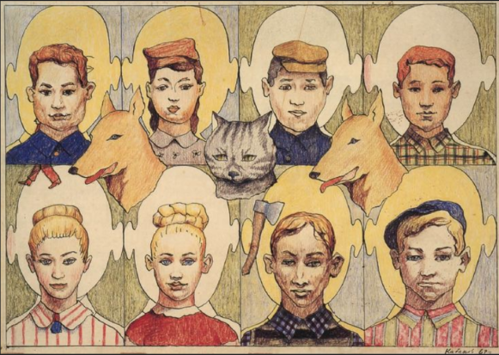
© IIya Kabakov, Heads, 1967, Courtesy of Ilya and Emilia Kabakov Art Foundation.
Kisito Assangi: When encountering an unfamiliar artistic medium or practice, what signals do audiences learn to read as evidence of legitimacy?
Nadezhda Gribkova: It starts with meeting the unfamiliar with curiosity and openness rather than dismissal or hostility—a capacity art invites us to practice regardless of medium or date.
Historical context also matters. Much contemporary art deliberately questions uniqueness and skill; conceptual art and readymades have a fraught relationship to both by design. Knowing that helps frame the encounter around how a piece relates to art you already know. Visual literacy, art-historical awareness, and trust in your own aesthetic intuition help separate authentic creativity from mere pretense.
Kisito Assangi: Digital collectibles and crypto-art raise questions about cultural significance versus market price. How can we distinguish artistic value, social recognition, and economic value?
Nadezhda Gribkova: Healthy skepticism toward mass-culture hype and agiotage (speculative fever) helps across life—especially today, when not everything demanding attention deserves it.
Artistic value builds over time, verified through institutions and professionals. Translating artistic value into economic value runs alongside art-historical context and personal connection to a work. Sometimes a sale—attaching a dollar figure—acts as a legitimation gesture whose narrative overshadows artistic value.
The Beeple sale illustrates this clearly. Buyer Anand Venkateswaran noted that the work's artistic importance or potential status as a masterpiece never entered their calculation; what mattered was the combined narrative of what Beeple represented. Price was a bet on a crypto story, not a verdict on artistic quality.
Talk of the "end of art" or a radical new creative era faded as hype cooled. Blockchain still serves specific corners of the art world, but it has not replaced long-standing ways of recognizing artistic mastery, which collectors and connoisseurs continue to value most.
Kisito Assangi: Like the literary and intellectual circles of Dostoevsky's Petersburg, which shaped moral authority outside official institutions, can contemporary digital art communities build autonomous systems of artistic legitimation, or do they reproduce traditional art-world hierarchies?
Nadezhda Gribkova: Every system of legitimation involves hierarchies and power. Alternative systems often operate alongside established ones at first, proposing their own criteria and structures. Much of the NFT space began with an anti-institutional pitch to bypass big banks, yet sought validation from the very institutions it aimed to sidestep. Beeple's sale at Christie's pairs an anti-institutional technology with a premier traditional auction house. Blockchain offers alternative exchange mechanisms without necessarily replacing the wider system.
The ethos behind those structures matters too. Late-Soviet artists were cut off from much of Western art history, yet took it seriously and saw themselves as participating from the periphery. NFT art emerged largely from gamer and coder circles marked by boyishness, anarchic musings, and libertarian economic instincts. Even so, it captured a real cultural moment in early-21st-century history.
Kisito Assangi: When marginalized works enter museums, collections, and academic discourse, what happens to their meaning and perceived value?
Nadezhda Gribkova: Institutional recognition expands reach and audience, but it is a double-edged sword. Entering global art history secures cultural standing while often diminishing urgency and countercultural edge.
In the Soviet case, Sotheby's July 1988 Moscow auction formally introduced nonconformist art to the international market, drawing artists into an ambivalent relationship with fame and money previously absent from their practice.
Framing also shaped reception. Seen through a stark ideological lens, early dealers' focus on politics over aesthetics often obscured artistic quality for Western buyers and slowed market traction. As Sotheby's later noted, the auction also coincided with a wave of emigration in the early glasnost years. The artworks stayed the same, while interpretation, consumption, and context shifted.
Art history advances through ruptures and conflicts—through "bad behavior." Yet the era of Impressionists challenging the Academy or Surrealists shocking polite taste is behind us. Marginal critiques are absorbed faster today, complicating rather than erasing their edge.
Kisito Assangi: Looking at Soviet unofficial art alongside today's digital art economy, what shapes long-term recognition for practices born outside established systems—and how can we separate lasting artistic innovation from speculation, novelty, or hype?
Nadezhda Gribkova: Art history shows that lasting recognition develops slowly and often outside the market. Commercialization is nothing new, yet works that endure across centuries rarely owe their status to a high price tag.
Hype travels far faster. In 2021, NFTs quickly became the "next cool thing," drawing swift institutional attention and celebrity tie-ins—from Pete Davidson's NFT series to Gucci's virtual sneaker—making a permanent shift seem inevitable.
For a museum or gallery visitor, it is often more productive to engage aesthetic feeling than get stuck worrying about fraud. Art-historical training encourages starting with how a work feels, then considering its historical moment: what it reveals about being human in general, and at that specific point in history. For me, as a viewer, that remains the best place to begin.
Main Image: Nadezhda Gribkova