
Germany agrees to speed up Return of Polish Art looted in WWII
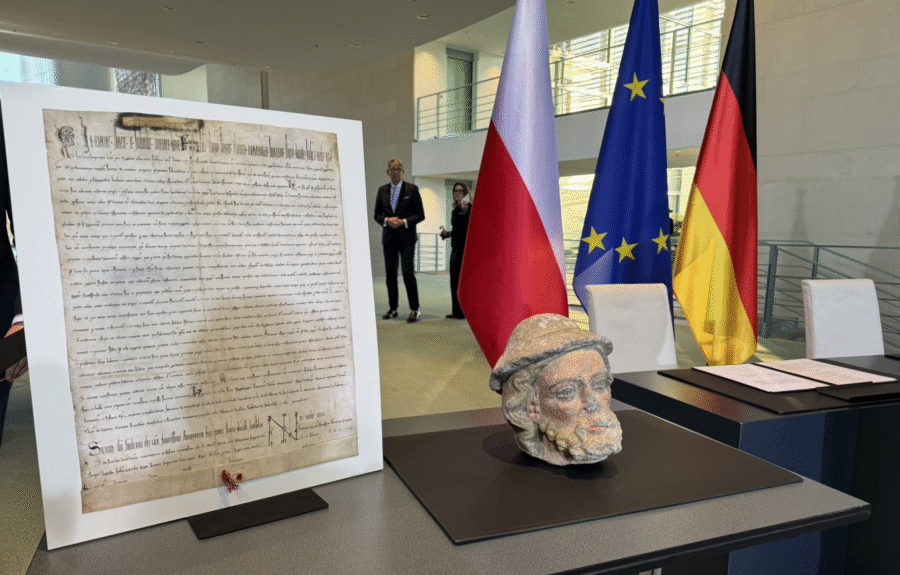
Germany has agreed to speed up the return of looted Polish cultural property, the two countries' leaders, Merz and Tusk, said after talks in Berlin on Monday.
German Chancellor Friedrich Merz announced that the Federal Foreign Office would create a special working group to prepare further returns of Polish cultural goods.
He confirmed the return of a precious medieval archive of 73 documents from the 13th to 15th centuries, as well as a carved head of Saint James the Greater, a fragment of a Gothic sculpture from around 1340, Polish state news agency PAP reported.
Polish Prime Minister Donald Tusk welcomed the move, calling it a very important gesture. He said he knew it had been the chancellor’s personal decision. Tusk added that seeing the wax seals of medieval Polish rulers such as King Władysław Jagiełło and King Casimir the Great made his heart swell, because these documents are coming back to Poland after many years of efforts.
The documents form part of a key archive on relations between the Kingdom of Poland and the Teutonic Order, a powerful German Catholic military order that controlled large parts of what is now northern Poland and the Baltic region in the Middle Ages.
According to Polish officials, the papers include land grants, royal privileges and treaties, as well as papal and imperial letters that defined the political map of the region.
Poland’s Culture Minister Marta Cienkowska called it a historic day. She said Poland is regaining from Germany priceless Polish–Teutonic archives that were looted during World War II.
During the talks in Berlin, which took the form of Polish-German intergovernmental consultations, Cienkowska also handed the German side nine new restitution requests, covering 35 cultural objects lost from Polish collections.
The new Polish claims include a fragment of a medieval manuscript with the hymn Gaude Mater Polonia, once held by the seminary library in the city of Płock, as well as manuscripts and letters from the former Zamoyski family library.
Poland is also seeking the return of three handwritten diaries by the writer Stefan Żeromski, a 12th-century Limoges medallion from the Czartoryski collection at Gołuchów Castle, railway exhibits, and a 15th-century church bell.