
Fossilized Elephant Bone may be First Physical Evidence of Hannibal's Army
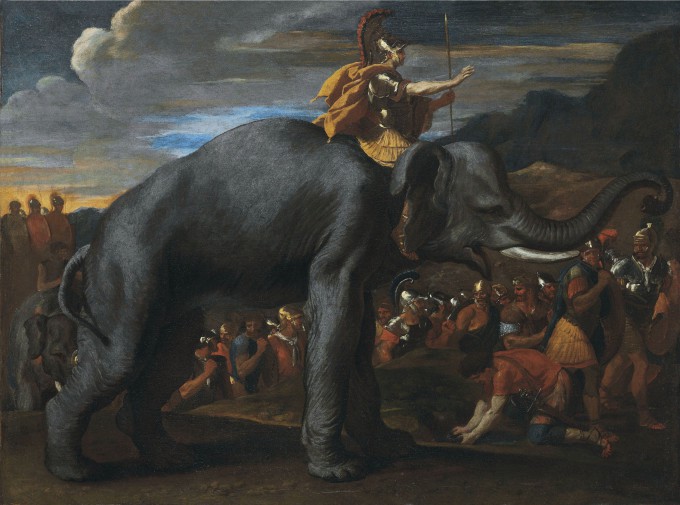
The Carthaginian Empire, which once rivaled ancient Rome, is known for pushing Rome to the brink of collapse with its daring strategies.
During the Second Punic War, which began in 218 BCE, the great Carthaginian general Hannibal Barca famously led dozens of elephants through modern-day Spain and France, crossing the Alps to launch a surprise attack on the Italian Peninsula, home to Rome.
A joint research team from the University of Córdoba and the University of Madrid in Spain, and Leiden University in the Netherlands, has presented the first fossil evidence for Hannibal's elephant tactics, previously known only through literature and artwork. The findings were published on January 14 (local time) in the international academic journal 'Journal of Archaeological Science: Reports'. The elephant fossil, discovered in Spain, is believed to belong to an animal that died before reaching the Alps.
Carthage, which vied with Rome for supremacy over the Mediterranean, was an empire located in North Africa, in what is now Tunisia. While Hannibal is said to have crossed the Alps with 37 elephants during the Second Punic War, no direct scientific evidence had ever been presented.
The research team, which discovered a 10-cm-long right front ankle bone of an elephant at the 'Colina de los Quemados' archaeological site in southern Spain, determined its age using radiocarbon dating of the carbon (C) isotopes within it. This method calculates the age of fossils or artifacts by taking advantage of the constant rate of decay (half-life) of radioactive isotopes.
The results dated the elephant bone to the period of the Second Punic War. The discovery of siege equipment and pottery near the elephant bone supports the theory that the site was used for military purposes. Researchers also concluded that it is highly unlikely the short and unremarkable ankle bone, unlike ivory, was used for decoration or crafts.
Written records of humans capturing and taming elephants date back to before 1000 BCE. Hannibal is said to have utilized over 50 African elephants in the 'Battle of Agrigentum' on the island of Sicily during the Second Punic War, from 264 to 241 BCE.
"The elephants, being the largest land animals in existence, would have been transported by boat," the research team stated. "The discovered bone could be the first artifact to support the fact that elephants were used in the Punic Wars."
Main Image: Nicolas Poussin, Hannibal traversant les Alpes à dos d'éléphant