
Faderera Wahab: The Materiality of Belonging
What remains of a place once we leave it behind? The practice of Faderera Wahab, an artist born and raised in Lagos and now based in the United Kingdom, explores this question through painting, photography, textiles and sculpture.
The home is one of the central concerns of her work, understood as a space where personal experience, emotional attachments and cultural references contribute to the formation of identity. Domestic environments become repositories of lived experience, preserving stories that can be reactivated in the present.
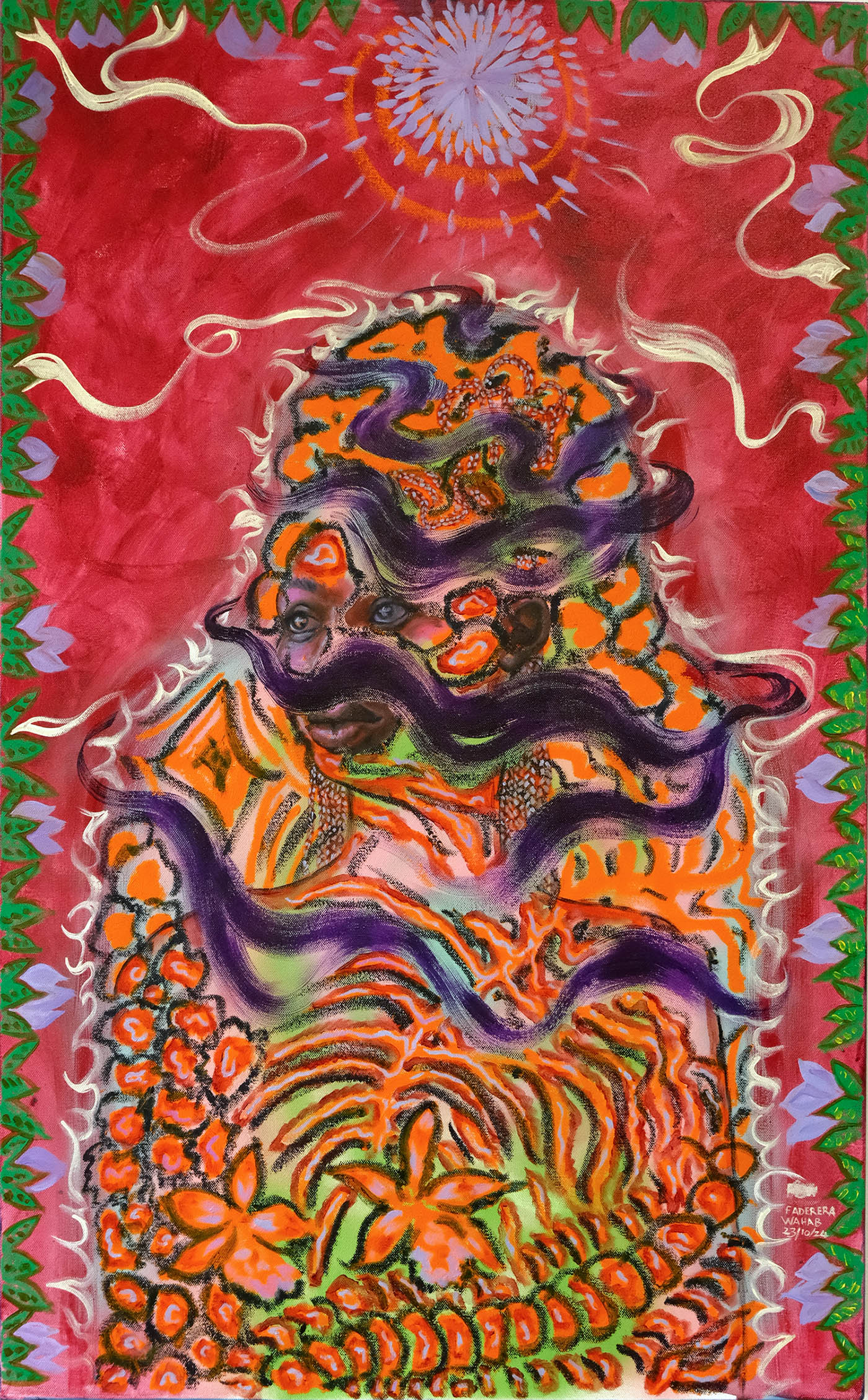
In the painting process described by the artist, the background precedes the introduction of the figure. Colours, textures and objects establish the context in which the subject acquires meaning, giving the surrounding environment an active role in representation. Identity emerges through the relationships that connect individuals to the world around them. In Disappearance Into the Night (2024), executed in oil and acrylic on canvas, the title evokes a tension between presence and disappearance, opening up questions about visibility and the ways in which a subject is perceived.
The photograph I Hide From Myself Within Myself extends this inquiry into the realm of introspection. Its title suggests an inner fracture, in which self-recognition becomes difficult to sustain. Photography preserves a trace of experience, fixing a moment already subject to change. Alongside painting’s construction of space, this medium offers a distinct mode of observation grounded in the recording of fleeting moments.
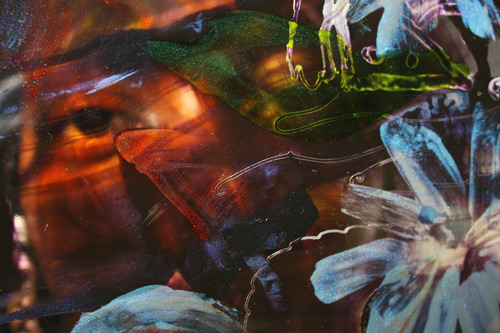
Faderera Wahab, Hide From Myself Within Myself
In The Poetics of Space (1957), Gaston Bachelard considers the home fundamental to the formation of the imagination and intimate memory. This perspective provides a framework for approaching In My Mothers Garden (2022), a mixed-media work on paper connected to the memory of the artist’s mother’s garden in Lagos. Wahab has linked the recurring floral motifs in her practice to this experience. The garden persists as an emotional reference, reshaped by geographical distance and the circumstances of the present.
Materiality plays a decisive role in works incorporating reclaimed textiles, embroidery, beads, ceramics and inks. In Atunbi (Rebirth), acrylic, reused fabrics, embroidery, linocut, wood, glass beads and batik combine in a composition that extends beyond the conventional boundaries of painting. Lace curtains partially screen the work, establishing a threshold between visibility and protection. Associated with domestic intimacy, the textile becomes a device that regulates access to the image and intensifies its private dimension.
Spirituality further expands the scope of Wahab’s practice. In her artist statement, she identifies her relationship with Jesus as one of the reference points informing her work. In Radiance II, according to Artmag’s interpretation, light evokes the divine presence within the human being. This spiritual dimension connects individual experience to broader questions of interiority and the meaning of existence, extending the work beyond autobiography.
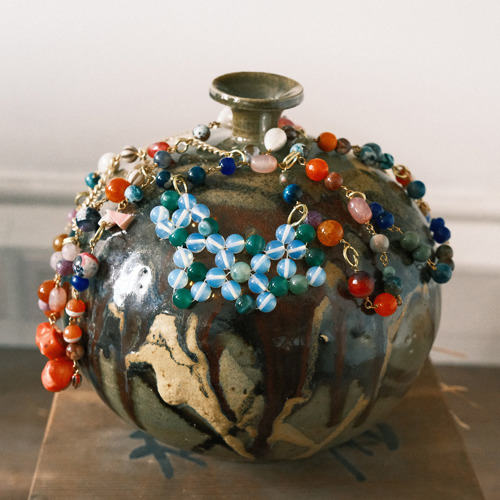
Faderera Wahab, Beaded Vase
In Beaded Vase, Wahab reinterprets the Ṣẹ̀kẹ̀rẹ̀, a Yoruba percussion instrument traditionally made from a dried gourd encased in a net of beads. The combination of natural stones and antique Japanese vases, as described by Artmag, brings different materials and traditions into dialogue. The work occupies a space between domestic object, sculpture and ritual memory. Its transformation of a cultural reference demonstrates how tradition can move across contexts and acquire new expressive possibilities.
In For Space (2005), Doreen Massey understands space as a configuration produced through multiple relationships and trajectories. This perspective makes it possible to approach Wahab’s experience between Lagos and the United Kingdom as an evolving geography in which memories, cultural references and everyday experiences intersect. Belonging takes shape through these encounters, while the home becomes an inner point of orientation accompanying the individual across different places.
Wahab’s practice brings experience, materiality and spirituality into dialogue through visual languages that allow objects and images to bear witness. Textiles, ceramics and recurring motifs convey personal and cultural histories, while the use of different media articulates distinct modes of perception. Dwelling emerges as a process through which individuals continually renegotiate their emotional and cultural coordinates, shaping a sense of belonging that remains open to change.
Main Image: Fadérera Wahab, Disappearance Into the Night