
Export Bar to save Flint Handaxes crafted by some of Britain’s First Human Settlers
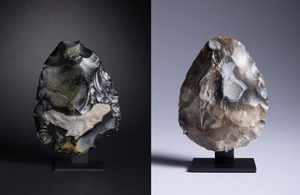
A temporary export bar has been placed on two prehistoric handaxes representing some of the oldest human settlements in Britain.
Both flint handaxes were discovered on the Happisburgh shoreline in Norfolk. Their discoveries followed the unexpected consequences of storms in the East of England, which cleared away clay on the beach shore and exposed ancient land surfaces underneath.
Created using a stone or antler hammer to knock off flakes from both sides of a larger piece of flint, these handaxes have strong, skilfully shaped edges suitable for cutting and scraping. They were used without handles.
One of the handaxes has an asymmetrical appearance, with small patches of orange-brown staining from the sediments in which it was deposited. This handaxe is 13cm long and weighs 465 grams.
The other handaxe is distinguishable by its mottled light brown and grey colouration. One side of the flint also retains a small patch of chalky outer cortex. This piece is just over 10cm long and weighs 308 grams.
Found on the Happisburgh shoreline, the handaxes belong with a series of finds connected to some of the first human occupation of northern Europe. They provide internationally significant insights into the type of technologies that first enabled humans to survive in northern environments.
Britain’s environment was different from today when hunter-gatherers made these handaxes around 500,000 years ago. What became the River Thames then ran a northeastern course through Norfolk, entering the North Sea near the find site at Happisburgh. Subsequently, a cold period caused ice sheets to cover the North Sea, East Anglia and the Midlands, churning up and moving the ground beneath. As the climate warmed again, the ice sheets melted, dumping dirt and rock across the landscape covering the Happisburgh area. Recent rising sea levels and storms exposed the hunter-gatherers’ campsites sealed underneath.
The decision on the export licence application for the handaxes will be deferred for a period ending on 2 September 2026 inclusive. At the end of the first deferral period owners will have a consideration period of 15 Business Days to consider any offer(s) to purchase either handaxe at the recommended price of £15,000 (plus VAT of £3,000, which could be reclaimed by an eligible institution). The second deferral period will commence following the signing of an Option Agreement and will last for three months.