
British Artist David Hockney dies aged 88
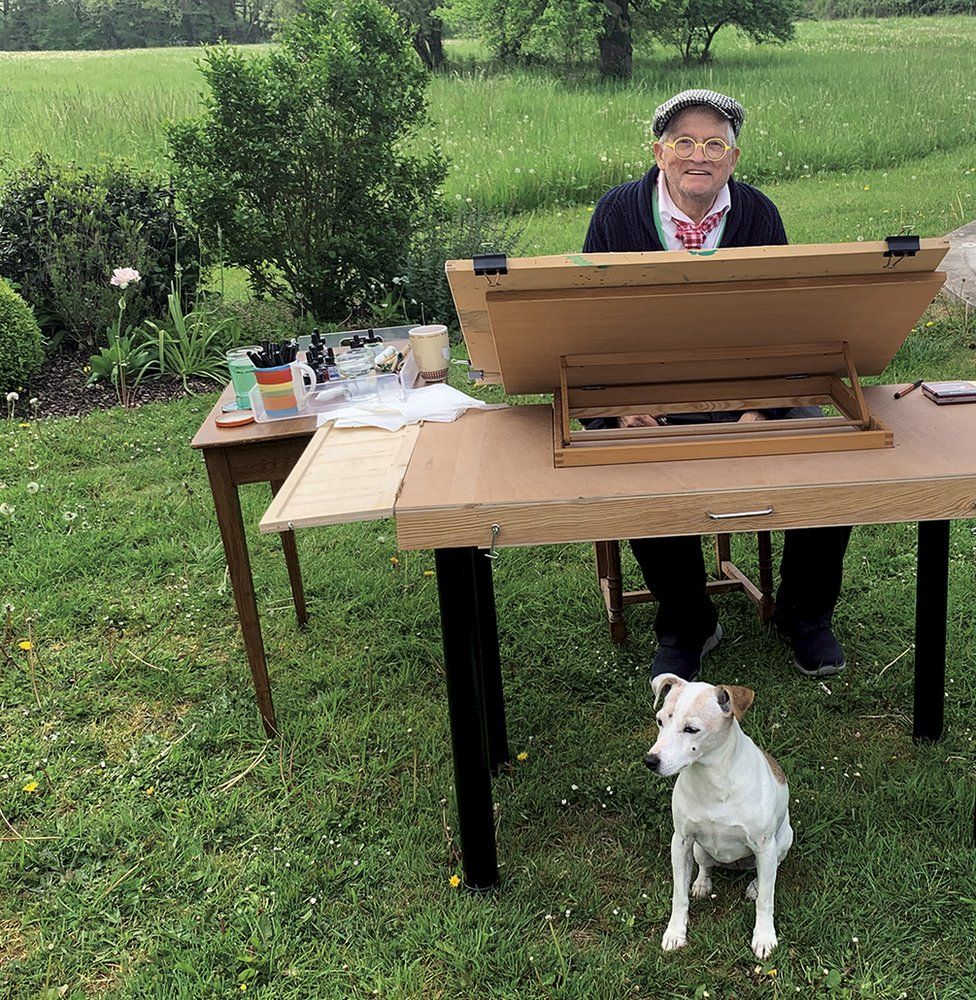
British artist David Hockney has died at 88, his PR agent said on Friday. Hockney was one of the most influential artists of the 20th and 21st centuries known for his vivid use of colour in paintings depicting scenes from California, Normandy and the UK.
Hockney was born on 9 July 1937 in Bradford, Yorkshire, the fourth of five children in what he describes a ‘radical working-class family.’ In 1948 he won a scholarship to Bradford Grammar School where he was awarded prizes for art. In 1953 he enrolled at Bradford College of Art, studying there until 1957. Here he painted in a naturalistic style in oils – his medium of choice for much of his life – and gained a National Diploma in Design. From 1959 to 1962 Hockney attended the Royal College of Art, London. In 1961, Hockney exhibited at the seminal Young Contemporaries student show that brought Pop Art to prominence in Britain.
In 1963 he had his first solo exhibition, David Hockney: Pictures with People In at the Kasmin Gallery in London. In 1963 he travelled to the United States, visiting New York where he met Andy Warhol, and then Los Angeles. Hockney was taken with the lifestyle and culture of California and decided to move there in January 1964. It was here that Hockney discovered his great subject - the swimming pool, which would become the setting for many of his major paintings of the 1960s and 1970s.
In 1970, Whitechapel Gallery, London, held his first retrospective, David Hockney: Paintings, Prints and Drawings 1960-1970. Following the death of Picasso in 1973, Hockney moved to Paris to produce a suite of etchings in his honour. After 15 years divided between Europe and America, he decided in 1978 to settle permanently in Los Angeles.
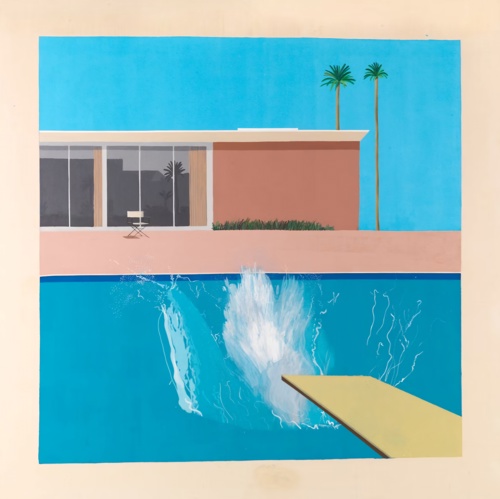
A Bigger Splash, David Hockney, 1967
Energetic and experimental, Hockney was always eager to try new media and techniques, and in 1978 master printer Ken Tyler introduced him to a method of adding dye to wet paper pulp. In just 45 days Hockney produced a series of 29 richly coloured Paper Pools. During the 1980s he continued to assemble photo collages, creating hundreds of montages reminiscent of Cubist paintings. Hockney’s interests extended to new technology, beginning with graphics on the computer program Quantel Paintbox, home-made prints on photocopiers which layered colour or manipulated selected details, and faxes.
Hockney’s ‘home-made’ Xerox prints were developed in the Spring of 1986 as a means of restoring spontaneity and autonomy to his printmaking. Having worked exclusively with collaborators for several years, he sought a form of making that would allow him to create and reproduce art without restriction. Keen to test the limits of the medium, his experimentations with the photocopier mark this attempt. Hockney’s journey into printmaking began in Bradford College where he studied lithography. This marked the beginning of one of the longest and most diverse artistic careers in modern printmaking. From lithography, etching and screen-printing, to more radical experimentations of the medium, Hockney’s life-long curiosity and testing of printmaking techniques has placed him among the finest printmakers of the last century.
Hockney continued to paint prolifically during the 1990s, and in 2003, after four decades abroad, returned to Yorkshire where he began working en plein air. During this period, Hockney created the Arrival of Spring (2011) comprising of iPad drawings. This body of work resulted in the Royal Academy, London, to commission a blockbuster exhibition, David Hockney: A Bigger Picture (2012)featuring large scale East Yorkshire landscapes and iPad drawings.
Prompted by the tragic death of his studio assistant, Hockney moved to Normandy in 2019. In the 2020 Covid-19 lockdown, Hockney produced over 100 iPad images capturing the changes of light and climate over the course of a few weeks. This work continued for the rest of the year culminating in a show at Musée de l'Orangerie titled A Year in Normandy (2021-2022).
At the age of 87, the Fondation Louis Vuitton in Paris staged the largest exhibition yet of his art, with more than 450 works – the majority from the preceding 25 years – filling the entire museum, much to his obvious pleasure.