
Bidding Battle for a Rare Kossoff Painting sets New World Record
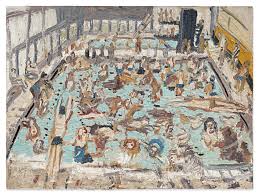
Ten bidders battled it out over Leon Kossoff’s rare swimming pool painting, which made sold for £5 million at Sotheby's London on Wednesday.
Children’s Swimming Pool, 11 o’clock Saturday Morning, August is one of the defining works of Leon Kossoff's oeuvre, standing as the first and most accomplished work in his celebrated series of five large-scale paintings devoted to Willesden’s public swimming pool, executed between 1969 and 1972, with three such works in institutional collections across the U.K.
Four works from this sequence were in fact first exhibited at the Whitechapel Gallery in 1972, a landmark exhibition that signaled a decisive expansion in Kossoff’s engagement with contemporary London life.
The present painting captures the charged vitality of a Saturday morning at the height of summer. Through tall panes of glass, the verdant fringe of King Edward VII Park frames a dense constellation of more than forty bathers, splashing, bobbing and diving beneath the surface. The pool itself becomes the true subject: a living medium animated by light, reflection and the dissolution of form.
As Kossoff later explained, “it is more about the pool than the others. It brings light and time into the studio… David and Peggy are both in the painting, which sharpens the focus” (Andrea Rose, Leon Kossoff: Catalogue Raisonné of the Oil Paintings, London 2021, p. 176). At the right edge, a woman – Peggy – stands waist-deep in water, while on the left a young boy, the artist’s son David, prepares to dive.
This intimate anchoring of lived experience within a grand, public scene lends the work its distinctive emotional resonance. Its provenance further underscores its importance, having passed through the collection of renowned collector Rosemary Peto – a frequent sitter for Kossoff at the time — before its entry into the Saatchi Collection. At once psychologically intimate and atmospherically expansive, the painting exemplifies Kossoff’s ability to elevate the everyday into the realm of epic modern painting. The present painting is one of his most iconic works, which is underscored by its vast literature and exhibition history, and crucially one of two of the series left in private hands.
Viewed from the elevated vantage point of the pool’s observation deck, the composition presents a rectangular field of incessant vitality: plunging bodies, frantic dog-paddling, flashes of limbs and bursts of reflected light; they have an almost staccato-like quality to their movements. Men and women – customary protagonists of Kossoff’s urban vision – are subsumed into a collective choreography, their movements orchestrated into rhythm rather than chaos.
The municipal pool is transformed into a theatre of human energy, where sound, motion and light seem almost audible and tactile. This work belongs to a crucial phase in Kossoff’s late 1960s and early 1970s practice, when his vision of London shifted away from the grave monumentality of bomb sites and building excavations toward the fragile beauty of lived, everyday scenes.
“I have painted in bomb sites… railways and recently a children’s swimming pool in Willesden,” he recalled, tracing a trajectory from ruin to renewal (the artist quoted in Robert Hughes, Frank Auerbach, London 1990, p. 85). Jewel-like passages of colour shimmer against darker enclosing fields of paint, while the water’s surface fractures bodies into dissolving planes.
Main Image: Children’s Swimming Pool, 11 o’clock Saturday Morning, August. Image courtesy of Sotheby's