
Between the Tangible and the Intangible: The Ether of Sayali Goyal
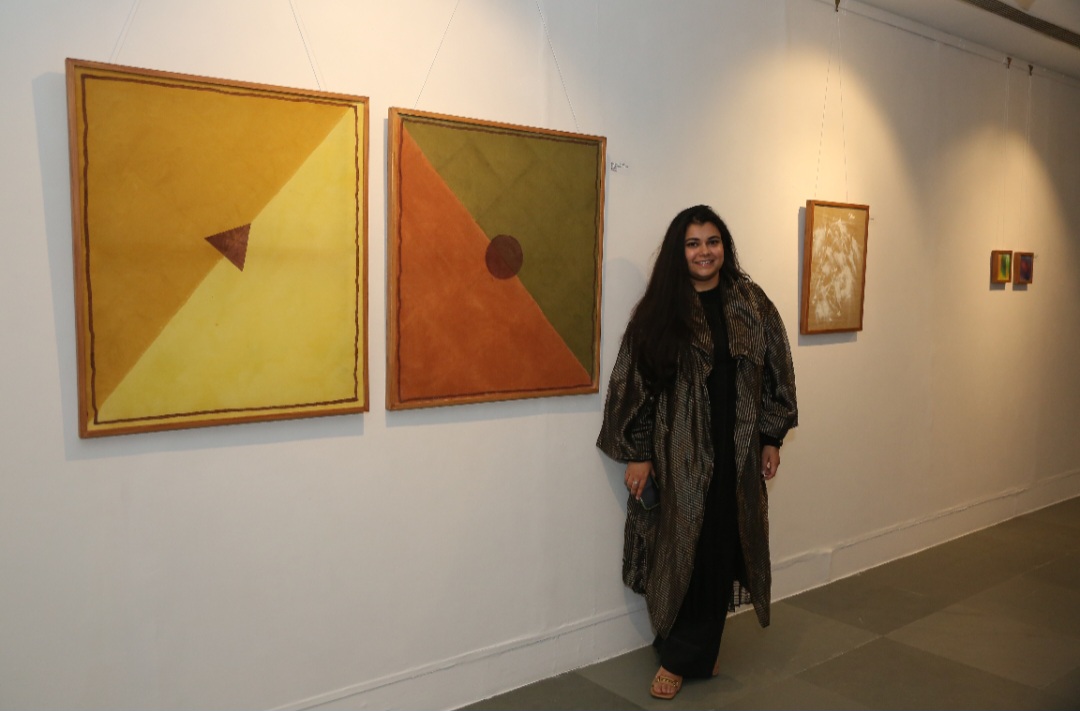
Textile based visual artist Sayali Goyal approaches abstraction as a form of inquiry into material, memory, nature, and the invisible forces that connect them.
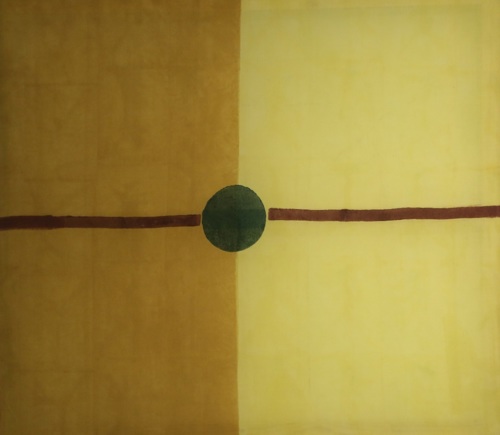
In her recent body of work, she turns to Ether, or space, the fifth element in several Indic philosophical traditions, not simply as a subject but as a conceptual and visual framework. Space becomes both absence and presence: a field in which energies meet, forms emerge, and the worldly and divine become momentarily inseparable.
At the centre of Goyal’s practice is an interest in relationships the tangible and intangible, the material and metaphysical, the masculine and feminine, structure and intuition. Her works do not seek to resolve these oppositions. Instead, they inhabit the space between them. The resulting compositions are contemplative fields in which colour, texture and form appear to be in a state of quiet negotiation. Creation, in this sense, becomes an act of finding balance rather than imposing order.
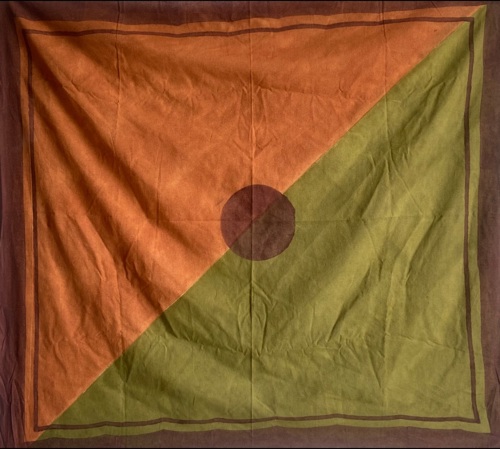
This understanding of Ether is particularly significant within Goyal’s material practice. Space is not treated as a blank surface or emptiness; it is understood as an active, generative force. It is the interval between things, the space through which energy moves, and the condition that allows relationships to exist. Her paintings consequently feel less like representations of an external world and more like attempts to give material form to something that cannot ordinarily be seen.
The works emerged from Goyal’s time in Jaipur’s old city, where her engagement with colour became inseparable from a broader ethnographic investigation. Rather than approaching the city merely as a visual archive, she spent time observing its material cultures, communities and systems of making. Her research led her towards the tantric school of art, particularly its use of pared-down forms, geometric structures and concentrated symbolism. Tantric painting offered an alternative visual vocabulary in which a minimal mark could hold an expansive metaphysical proposition.
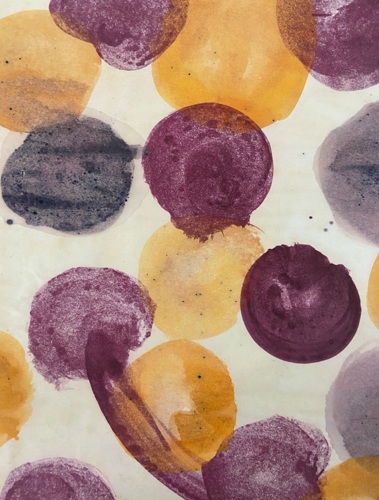
This encounter with tantric abstraction is not reproduced literally in Goyal’s work. Instead, it operates as a conceptual point of departure. She translates the principle of symbolic economy into an intuitive language of her own, allowing forms to hover between recognisable structures and abstraction. Her compositions suggest diagrams without becoming diagrams, symbols without settling into fixed meanings. This ambiguity is central to their force: the viewer is invited to experience the work before attempting to decode it.
Equally important is Goyal’s engagement with the communities and technologies of making that surround her research. Her interest in textiles has always extended beyond the finished surface to the processes, tools and knowledge embedded within it. During her time in Jaipur, she collaborated with the local block-printing community, experimenting with pigments and incorporating block-printing tools into the production of her works. The tools, ordinarily associated with repetition and pattern, are repositioned within an abstract and intuitive process.
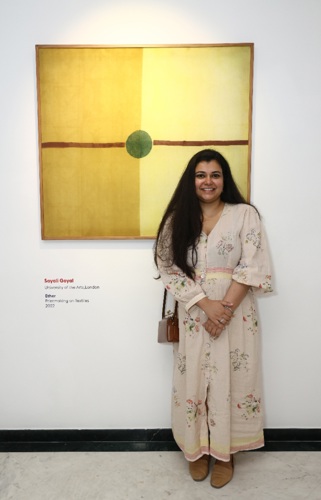
This movement between established craft practice and contemporary abstraction reveals something fundamental about Goyal’s approach. She does not treat craft as a repository of aesthetic motifs to be borrowed. Instead, she is interested in its material intelligence: how knowledge is held in a tool, how a surface records pressure and gesture, how pigment behaves, how repetition can generate variation, and how processes are transmitted between people and generations. Her practice emerges from this encounter between embodied knowledge and individual intuition.
The textile is therefore more than a medium in Goyal’s work. It becomes a way of thinking.
Textiles have historically occupied a curious position between the functional and the symbolic. They clothe bodies, furnish spaces and mark rituals, while simultaneously carrying stories, identities, cosmologies and systems of belief. Their surfaces can operate as archives—recording movement, labour, geography, memory and exchange. Goyal’s work extends this potential into abstraction. Rather than using textile to depict a narrative, she allows the material itself to become a site where meaning is produced.
Her interest in materials, textures and processes also complicates the conventional distinction between painting and textile practice. Pigment, cloth, imprint, pressure, repetition and gesture are brought into a shared visual language. The surface becomes simultaneously tactile and pictorial. What initially appears to be an abstract composition reveals itself through closer attention as a record of actions: something has been pressed, transferred, layered, absorbed or left open. The works retain traces of their making.
This emphasis on process parallels Goyal’s larger interest in the relationship between the real and the abstract. Her forms do not abandon the physical world; they emerge from it. The abstract is not an escape from material reality but another way of perceiving it. A block, a pigment, a textile surface, a colour found in the streets of Jaipur—all become starting points for a movement towards something less definable.
The philosophical dimension of the work extends beyond the idea of Ether itself. The five elements—earth, water, fire, air and space—have appeared across diverse philosophical, religious and scientific traditions as ways of understanding the constitution and organisation of the world. Their meanings have shifted across cultures and historical periods, yet their persistence reveals a shared human impulse: to find structures through which the visible world can be understood in relation to forces that exceed it.
Goyal is interested in this historical and geographic movement of knowledge. Iconographic, oral and written traditions have travelled from ancient texts into architecture, ritual, medicine, design and visual culture. Her work does not attempt to illustrate these histories. Instead, it asks what remains when knowledge moves from text into form, from philosophy into material, and from collective systems of belief into individual artistic experience.
There is also a distinctly contemporary urgency to this enquiry. At a moment when images circulate rapidly and visual culture is increasingly detached from material experience, Goyal’s practice insists on slowness. Her works ask us to consider not only what an image depicts, but how it came into being. The handmade mark becomes a counterpoint to speed; material process becomes a form of attention.
This attention extends to the balance between masculine and feminine energies that underpins the series. Rather than treating these as fixed gender categories, Goyal approaches them as complementary principles—forces of expansion and containment, movement and stillness, structure and intuition. The work locates creation within their encounter. It is in the space between opposing energies, rather than in either one alone, that something new becomes possible.
In this sense, Goyal’s abstraction is ultimately relational. It is concerned less with isolated forms than with the relationships between forms, and less with objects than with the spaces that allow objects, ideas and energies to coexist. Her paintings and textile works ask the viewer to occupy these intervals—to look at what is present while remaining attentive to what is absent.
What emerges is a practice grounded in research but resistant to becoming didactic; rooted in craft but not confined by its conventions; informed by philosophy but ultimately expressed through sensation. Goyal moves between ethnography and intuition, historical knowledge and contemporary experience, inherited visual languages and personal abstraction.
Her engagement with Ether offers an apt metaphor for this practice itself. Like space, the work cannot always be grasped directly. It is encountered through relationships: between colour and surface, mark and material, tradition and experimentation, body and environment. The seemingly empty spaces within her compositions are therefore not voids. They are charged intervals—places where meaning can gather.
Perhaps this is what makes Goyal’s work most compelling: its refusal to draw a firm boundary between the known and the unknowable. Her abstractions do not ask to be solved. They ask to be inhabited. In their restrained forms, layered surfaces and material gestures lies an invitation to slow down and recognise that creation, like nature, is rarely static. It is a continuous negotiation between forces, energies and possibilities.
The work ultimately returns to the simplest proposition of Ether: that space is not nothing. It is what makes everything else possible.
This article is authored by Sudeshna Rana
Main Image: Sayali Goyal