
BEFORE THE IMAGE Conversations on Painting in the Making - Wenhui Hao
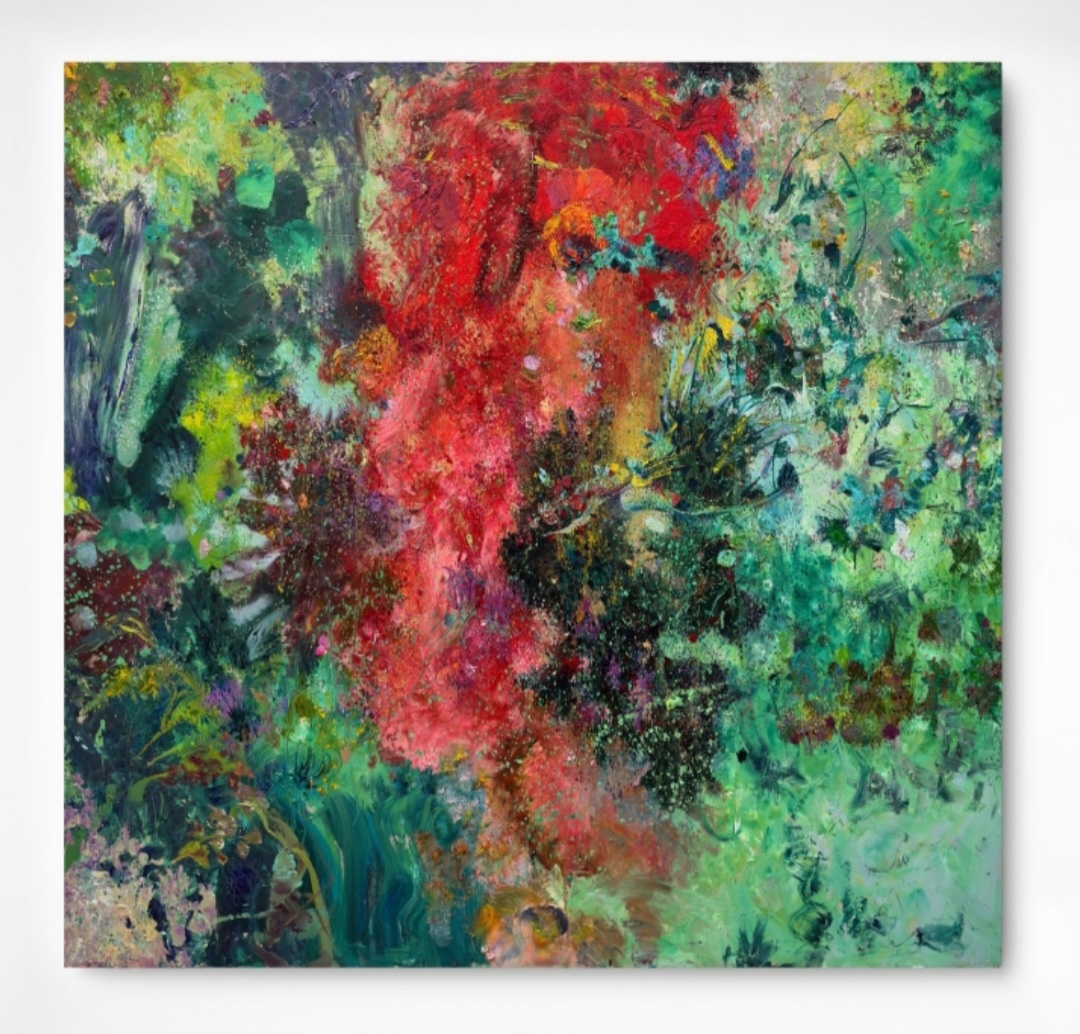
The painterly practice of Wenhui Hao (b. 2000, Taiyuan, China), an artist based in London, explores the relationships between the body, trauma, and materiality, bringing personal experience into dialogue with social and political concerns. Combining figuration and abstraction, her paintings bring fragmented anatomy, organic forms, and imagined landscapes into compositions charged with desire, vulnerability, and transformation.
In her first solo exhibition in London, Forgiveness is a prolonged death, presented by Sim Smith in 2026, Hao explores the complexities of women's lived experience through images in which body and landscape become inseparable. Split-open flowers, ruptured fruit, and fragments of the human figure emerge from densely layered oil paint and saturated fields of colour. Forests, caves, and glacial waterfalls become psychological terrains where bodily forms dissolve and reconstitute themselves. Her experience of abortion provides a point of departure for a broader exploration of bodily autonomy, grief, and renewal, bringing her work into dialogue with artists such as Juanita McNeely and Paula Rego.
For BEFORE THE IMAGE, Margherita Artoni explores Hao's creative process: from the relationship between the body and the imagination to the sensory qualities of paint and the capacity of images to transform individual experience into questions that resonate collectively.
Classical Literature, Sensory Encounters, and Automatic Writing
Margherita Artoni (MA): In your paintings, memories, sensations, and visual associations converge in images suspended between figuration and abstraction. What experiences shape your visual imagination? What sparks the beginning of a painting, and how much room do you leave for unexpected developments?
Wenhui Hao (WH): Classical Chinese literature, poetry, and traditional landscape painting have profoundly shaped my visual imagination. Since childhood, I have been fascinated by natural worlds that hover between reality and fantasy, suffused with vitality and erotic longing:
-
Tang Xianzu's The Peony Pavilion: The lush splendour of a real garden unfolds into a realm of desire and dreams.
-
Qu Yuan's The Mountain Spirit (Nine Songs): The landscape and the female body permeate one another, as though the spirit herself grew out of the forest vegetation.
-
Bai Juyi's The Song of Everlasting Sorrow: An ethereal mountain of immortals rises from the sea, where ocean, drifting clouds, and the female body compose a beautiful yet unattainable realm of desire.
At the same time, I use photography to capture everyday moments that move me on a sensory level: a plant flourishing, animal remains, or a piece of fruit cut open. I often find that through an object's bodily structure, its contours and internal textures awaken another space in my imagination.
When I begin to paint, I rarely use a fully developed sketch. Forms and spaces take shape through the act of painting. I embrace "beautiful accidents" that diverge from my original intentions—fleeting moments brought into being by the paint itself.
As the process unfolds, I become immersed in a state of embodied perception where bodily movement, emotional intensity, and subconscious associations form a continuous flow. Erotic desire, the life drive, the death drive, and passion possess an equivalent intensity of feeling. In this passionate state of immersion, painting becomes a form of automatic writing.
"An accidental trace of paint may awaken a fragment of bodily memory; a single curved line may gradually reveal the contours of a human figure or a landscape."
Anatomy, Landscape, and the Female Narrative
MA: Your paintings present the female body in its physical and emotional complexity, using fragmented forms to evoke vulnerability, resistance, and reclamation. What does reconstructing female narratives through painting mean to you? How does the merging of anatomy and landscape expand how lived experience is represented?
WH: The body carries our desires, memories, and traumas, while being continually shaped by sociocultural forces, history, and power relations. Through painting, I seek to give visible form to feelings that are deeply intimate, contradictory, and almost impossible to articulate in words.
As a feminist artist, reconstructing women's narratives means bringing renewed attention to women's bodily experiences as subjects of their own lives—particularly those long overlooked in social narratives and visual traditions.
My understanding of the female body embraces a sense of contradiction: the body can be soft, fragile, and sensitive, yet filled with desire, violence, and exuberant vitality.
In my work, anatomy and landscape permeate one another. Looking at rivers, valleys, glaciers, or forests, I sense an astonishing visual resemblance to human tissue:
-
Mountain Folds: Evoke layers of skin.
-
Meandering Rivers: Resemble blood flowing through vessels.
-
Caves & Gorges: Mirror internal cavities and plant structures.
In my six-metre-wide painting I Fall at Dawn, the Tide Licking My Burning Bones, a rainforest, stalactite cavern, peeled-open pomelo, and melting glaciers converge while the naked body of a woman appears and disappears within flowing water.
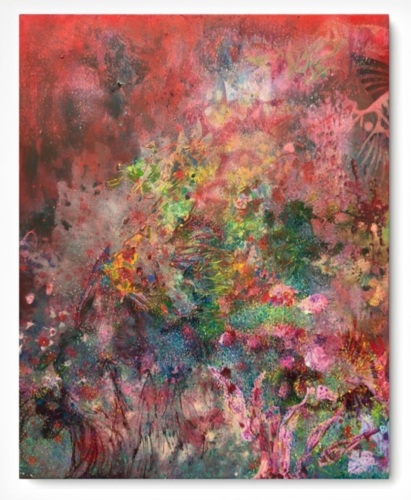
Wenhui Hao, I awoke to find myself underwater, 2025 Courtesy of the artist and F2T Gallery
Food, Erotic Desire, and Visceral Ambiguity
MA: Flowers, fruit, dissected food, and anatomical fragments recur throughout your work, oscillating between attraction and repulsion. How do these associations between botanical forms, food, and human anatomy emerge? How do desire and violence coexist within your images?
WH: My exploration of abstract painting began with fruit and food. Through sustained observation, I became aware of a sensory connection between appetite and erotic desire. Food awakens primal urges, while eating and cooking involve cutting, tearing, destruction, and possession. Satisfying desire alters the object's original form.
The moist seeds of a cut fig remind me of female reproductive organs; the flesh of a sliced papaya assumes a visceral appearance. I once painted a whole chicken that had been cut open, emptied, and stuffed—its swollen abdomen and body pierced by cutlery evoked both ancient depictions of childbirth and the derogatory linguistic connotations of the word ji (鸡) in Chinese.
My paintings contain forms that resist immediate identification. Vivid colours and supple curves exert a sensual attraction, but as viewers discern traces of flesh and violence within these forms, attraction gives way to unease.
I deeply cherish this ambiguity. A single image can evoke beauty and fear, desire and repulsion at once. I hope that as viewers recognize figurative forms within abstraction, they arrive at their own bodily sensations and affects.
"Desire often entails approaching, touching, and possessing its object, while the very act of satisfying that desire also involves altering the object's original form."
The Tactile Corporeality of Oil Paint
MA: The accumulation of oil paint lends your surfaces an almost corporeal presence. How do the tactile pleasure of painting and the emotional intensity of your subjects intersect? What relationship develops between gesture, colour, and texture?
WH: I have an obsessive sensory fascination with oil paint. Its viscosity, thickness, and fluidity—and the resistance of tools against the canvas—directly affect my bodily sensations. Thick, sculptural brushstrokes possess bodies of their own.
My process weaves tactile pleasure with emotional intensity:
-
Early Stages: Swift, forceful gestures using a broad palette knife establish fundamental compositional rhythms.
-
Refinement: Soft goat-hair brushes (from traditional Chinese ink painting) and large flat sheep's-wool brushes render winding lines and subtle variations.
-
Surface Layers: Translucent glazes soften edges, allowing figures to dissolve into surrounding fields of colour.
I often touch the surface of an unfinished painting, letting my fingertips rediscover traces of paint. Hardened brushstrokes preserve emotions and memories of specific moments in time.
I view painting as a recurring process of destruction and repair. Through covering, scraping, and reshaping, images are destroyed while new forms emerge. Paint and erotic desire share a corporeal affinity—the act of painting is a continuous caress of the material, a repeated approach towards the ultimate destination of feeling.
Trauma, Bodily Autonomy, and Collective Memory
MA: The experience of abortion runs through your practice as a point of departure for examining bodily autonomy, grief, and transformation. How did you find in painting a language through which to approach such an intimate experience? How does your work connect individual experience with wider collective concerns?
WH: A specific period of my practice was directly connected to an unplanned pregnancy and subsequent abortion. The pain, prolonged bleeding, and cold medical instruments left my body hyper-sensitive. I vividly recall the oppressive heat, humidity, and a deep crimson memory that hung over me.
In the aftermath, I researched female reproduction, anatomy, and abortion procedures—connecting my experience to the history of China's family-planning policies and social debates on abortion rights in the United States. Bodily autonomy concerns how one perceives their body and whether one has the freedom to make decisions about it.
I recognized a disturbing resemblance between the accumulation, covering, and scraping of paint on canvas and the processes of bodily destruction and repair I underwent during surgery and recovery.
Pain and desire exist simultaneously; vulnerability is bound to an overwhelming force of life. In my paintings, the body may be torn apart or disintegrated, yet it grows anew through colour and form. Through art, private bodily experiences transcend individual boundaries, inviting viewers across different cultures to reflect on their own sensations and lived experiences.
"I recognized a disturbing resemblance between the accumulation, covering, and reshaping of paint on canvas and the processes of destruction and repair that my body had undergone."
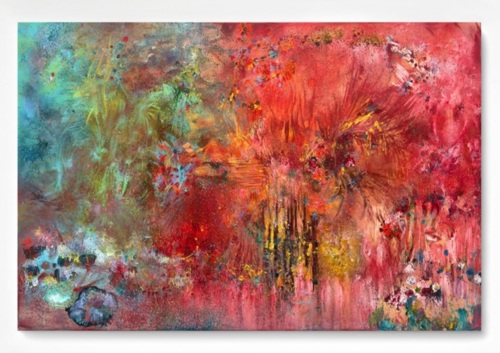
Wenhui Hao, You say, hate lasts longer than love 2025 Courtesy of the artist and F2T Gallery
Artistic Lineage, Influences, and Future Horizons
MA: Your work enters into dialogue with artists such as Juanita McNeely and Paula Rego. How do you relate to this lineage, and what visual territories would you like to explore in your future work?
WH: I admire Juanita McNeely for the powerful corporeality and emotional intensity of her distorted figures, and Paula Rego for her direct narrative focus on reproductive experiences—particularly her Abortion series. Both challenge traditions of idealizing and objectifying the female body. My work shares these concerns, but explores them through the continual metamorphosis of body and natural forms.
My visual language is also informed by a diverse lineage of influences:
-
Traditional Chinese & Early European Art: Classical Chinese landscape space, the spiritual presence of pre-Renaissance egg tempera, and the unadorned materiality of ancient painting.
-
Baroque & Rococo: Twisting bodily gestures, rhythmic curves, and dramatic emotional tension.
-
Marlene Dumas & Francis Bacon: Dumas's intertwining of erotic beauty with morbidity, and Bacon's visceral deconstruction of flesh—what Deleuze termed "pity for meat."
-
Cinema (David Lynch): The interpenetration of reality and dreams, and how familiar scenes gradually become strange through subtle shifts in light, sound, and colour.
Currently, my central question is how painting can bridge immediate sensory experience with an enduring spiritual presence. Moving forward, I am eager to embrace a slower, more contemplative approach—distilling fleeting sensations of vitality into visual forms imbued with spiritual intensity that endure through time.
Main Image: Wenhui Hao, You turn and leap into a burning wild river 2025 Courtesy of the artist and F2T Gallery