
Altenberg Madonna acquired for the Städel Museum Germany
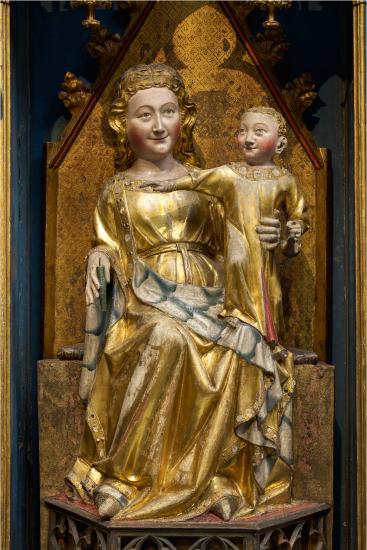
One of the most important sculpture acquisitions in the history of the Städel Museum, Gothic Madonna returns to the Altenberg Altar in the Städel.
For the Städel Museum, it is one of the most significant acquisitions in its history: the Virgin and Child Enthroned (c. 1320/1330) from the Altenberg Altarpiece was purchased for the Städel Museum with the support of the Ernst von Siemens Art Foundation, the Städelscher Museums-Verein and the Cultural Foundation of the German Federal States. Also known as the Altenberg Madonna, the figure is one of the most important works of medieval sculpture in Germany and one of the oldest examples of fourteenth-century Cologne sculpture. It is unique in that its original paintwork is exceptionally well preserved. The Altenberg Madonna is listed in the register of cultural property of national significance and is therefore protected from export.
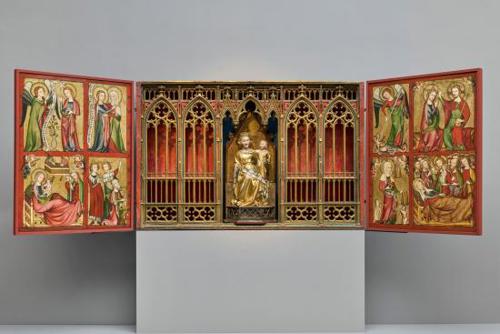
The Virgin and Child Enthroned is part of the altarpiece from the abbey church in Altenberg, Hesse. The Städel Museum has owned the painted wings of this altarpiece for 100 years. Together with the original altar shrine, on permanent loan from the Braunfels castle museum, the Altenberg Altar is a major work in the current collection presentation. The paintings on the altar wings are the oldest examples of German painting in the Städel Museum. The Altenberg Madonna was once enthroned in the altar shrine. The sculpture has been in private ownership in southern Germany since the 1920s and has been kept on permanent loan at the Bayerisches Nationalmuseum in Munich since 1981. With the acquisition of the Altenberg Madonna, all components of the altarpiece are now reunited and can be viewed permanently at the Städel Museum.
Philipp Demandt, Director of the Städel Museum, on the purchase: “After 100 years, the famous Altenberg Madonna has returned to its rightful place on the altar— a momentous occasion in the history of the Städel Museum! We owe the successful acquisition of this exceptional work of art to the foresight of the owners andthe dedication of our sponsors. I would like to express my sincere gratitude to the Ernst von Siemens Art Foundation, the board, and all members of our support association, and the Cultural Foundation of the German Federal States.”
Since the late thirteenth century, pictorially decorated retables have been a permanent feature of churches in Latin Europe. From then on, the task of creating altar retables was to occupy painters and sculptors alike for centuries, becoming one of the main driving forces behind artistic development.
For the main altars of churches north of the Alps, the double “convertible” altarpiece was created—an altarpiece with a folding mechanism that could meet the changing liturgical requirements of church ceremonies on weekdays, Sundays, and holidays. The Altenberg Altar, the high altarpiece of the Premonstratensian abbey church in Altenberg an der Lahn near Wetzlar, was created around 1330 and is thus one of the earliest surviving examples of this development. The weekday side of the altarpiece showed the Passion of Christ against a dark background. The fact that the wings could be folded allowed for a gradual unveiling of the central shrine, in the centre of which the Altenberg Madonna was presented, surrounded by the abbey’s treasure of relics. The partial Sunday opening of the altar retable revealed the Madonna flanked by images from the life of Mary. The abbey had close ties with the Hessian-Thuringian landgrave family ever since Elisabeth of Thuringia (1207–1231) had placed her youngest daughter, Gertrud (1227–1297), in its care following the death of her husband, Ludwig IV, Landgrave of Thuringia (1200–1227). Thanks to Gertrud, who as abbess determined the fate of the abbey for decades, and to the relics of St Elisabeth, Altenberg—alongside Marburg— was a central place for the veneration of St Elisabeth.
The figures of the Virgin and Child Enthroned (c. 1320/1330) in the shrine of the Altenberg Altar belong to a widespread and famous type of enthroned Marian figures with the Christ Child standing, which originated in Cologne and were based on French models. Today, these Madonnas are preserved in numerous museum collections as testimonies to the art of the Christian Middle Ages. For example, the Liebieghaus Skulpturensammlung in Frankfurt has a Cologne Madonna from around 1350, which is similar in form to the Altenberg Madonna, as well as a stone Virgin and Child Enthroned from around 1300–1310, probably made in Paris, which already fully anticipates this type.
The Altenberg Madonna surpasses comparable Cologne sculptures in terms of its artistic quality and excellent state of preservation. As is customary for this type of figure, Mary is depicted as a young woman with an animated smile. She sits on a throne bench with a thin cushion in front of a high back wall that ends in a pointed gable decorated with crabs. Her feet rest on a polygonal pedestal adorned with openwork tracery. With her right hand, the Madonna gracefully holds the remains of a lily stem, the symbol of her virginity and a reference to the sceptre of the Queen of Heaven. With her left hand, she supports the upper body of her son, who stands upright with one foot on her left thigh and the other on the throne bench. He holds his right arm outstretched to the left as though reaching for the (now-missing) lily, and his entire body is turned to the left while Mary’s posture leans slightly to the right. With his left hand, the child grasps the legs of a great tit held upside down, which pecks his finger painfully in return—a reference to Christ’s future Passion.
As patron saint of the church and the Altenberg Abbey, Mary dominated the centre of the high altar shrine as the enthroned Virgin, surrounded by relics. The figure could not be overlooked, as it outshone its surroundings: she and her child are dressed in bright golden robes, the hems of which were studded with “precious stones” made of glass flux, thus emphasising their roles as Queen and King of Heaven. In keeping with this, the sculpture once wore a crown. This also explains the design of the seat as a magnificent throne. Like its high backrest decorated with “leaf crabs”, the throne is gilded and adorned with a rich ornamentation of punched diamonds and flowers. Mary’s golden cloak falls from her right shoulder over her right arm, abdomen, and legs in such a way that its ermine-trimmed lining is clearly visible. This is also a reference to her role as Queen of Heaven.
Altenberg Abbey and, not least, the Altenberg Madonna as part of the sophisticated, representative high altar of the Premonstratensian nuns are ideal examples of a monastic culture practised by women, which the nuns were able to develop in contrast to the male-dominated social hierarchies that were typical of everyday life at that time.
The history of the Altenberg Madonna and the context in which it was originally created can still be traced in detail even after 700 years. Initially acquired and installed by the abbey as a single work, it was soon incorporated into the new high altar retable of the church (c. 1330) and placed in its central niche. This can be deduced from the modifications to the throne and its back wall: the loss of substance on the object reveals crucial information about its history. Following the dissolution of the abbey in 1803, the sculpture came into the possession of the Princes of Solms-Braunfels, who sold it to the Munich art dealer A. S. Drey in 1916. By 1929 at the latest (possibly as early as 1926), the figure had been acquired by the Munich art dealer Julius Böhler, remaining in family ownership until its acquisition by the Städel.
Images: Altenberg Altar, c. 1330 with Virgin and Child Enthroned, Cologne, c. 1320/1330