
All of Jan van Eyck’s Portraits come Together for the First time in Landmark Exhibition
The first-ever exhibition of the portraits of the Netherlandish painter Jan van Eyck (active 1422–1441), will open at the National Gallery London in winter 2026.
The nine painted portraits will be joined by the exceptional loan of van Eyck’s only surviving drawing, the 'Portrait of an Elderly Man' (about 1438, silverpoint and goldpoint on prepared paper, Kupferstich-Kabinett, Staatliche Kunstsammlungen Dresden). This is an astounding drawing, with a dense network of strokes to sculpt the sitter’s face and astonishingly precise colour notations. As the only certain preparatory study for any Netherlandish painting of the period, it provides a unique window into van Eyck’s process of creation. It is also the earliest material record of a formal sitting to survive, opening a new chapter in the history of portraiture. It will be reunited for only the second time ever with the painting it inspired: van Eyck’s 'Portrait of an Elderly Man (A Scholar?)' (1438(?), oil on wood, Kunsthistorisches Museum Vienna, Picture Gallery).
Three other drawings will be included in the exhibition. 'The Portrait of a Young Woman' (about 1435–40, the British Museum) by the artist’s close contemporary Rogier van der Weyden was probably made in response to van Eyck’s work. Two further drawings, made by artists working in van Eyck’s circle or following in the traditions he established, will show the enduring influence he had on the conception and creation of portraits and will allow visitors to compare the technical skills of some of the artists working at the time.
Other exceptional reunions will see the Gallery’s own popular and enigmatic Arnolfini Portrait (1434), the most visited painting page on its website, displayed for the first time ever with a panel showing the same sitter, the 'Portrait of a Man (Giovanni Arnolfini?)' (about 1435–38, Gemäldegalerie, Staatliche Museen zu Berlin). That van Eyck portrayed the same man twice, something unprecedented for the time aside from rulers, suggests a particular bond between artist and subject.
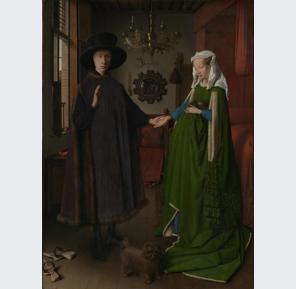
Jan van Eyck, 'The Arnolfini Portrait', 1434
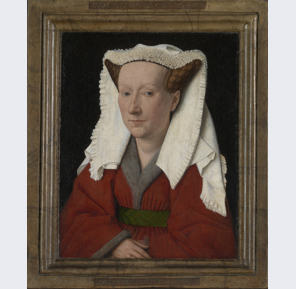
Van Eyck’s newly conserved Portrait of a Man (Self Portrait?) (1433, the National Gallery) will be shown alongside the likeness of the painter’s wife Margaret (1439, Musea Brugge/Musea Bruges). This is the first dated identifiable portrait of a woman who was not a member of the aristocracy. It is a milestone in European portraiture that captures the moment when the genre moved away from dynastic purposes to embrace a wider range of society: successful craftsmen, the artist’s relatives and his friends. One of these friends was probably the goldsmith 'Jan de Leeuw' (1436, Kunsthistorisches Museum, Vienna, Picture Gallery) who makes eye-contact with the viewer – another effect that van Eyck seems to have pioneered.
With the inclusion of 'Jan de Leeuw' and the above-mentioned 'Portrait of an Elderly Man (A Scholar?)', the exhibition marks the first time in its history that Vienna’s Kunsthistorisches Museum allows both of its van Eyck paintings to be lent at the same time.
Considered by many art historians as one of the founders of modern painting, this exhibition will enable visitors to appreciate van Eyck’s extraordinary technique and his ability to create a convincing illusion of reality. While portraits existed before van Eyck, they privileged elegance or the projection of power over individual character and their sitters were too generalised to be recognisable. In contrast, with van Eyck the concept of accurate likeness (the expectation that a portrait should look like the person it depicts) comes into full focus. Disarming in his exactitude and immediacy, van Eyck not only recorded his sitter’s signature traits but also fleeting qualities: bloodshot eyes, growing stubble, untidy hair. No detail, however small, escaped his acute gaze.
In addition, Van Eyck painted the frames and reverses of his panels in imitation of precious metals and stones of various kinds, material illusions compelling enough to fool his viewers. These trompe l’oeil elements offer a playful counterpoint to the truth of van Eyck’s likenesses. Painted on every side, van Eyck’s portraits are three-dimensional objects: they were not meant to hang silently on a wall but to be handheld, closely examined and discussed. The exhibition design will emphasise this by showing several portraits in the round for the first time ever, revealing the marbling that survives on their backs.
While the vast majority of artists working during the late medieval period remain anonymous, van Eyck almost systematically signed his paintings, inscribing his name, the portraits’ date (sometimes to the day), and in cases proudly adding his motto, Als ich kan (As well as I can). These inscriptions are always painted to look as though they are carved in the fictive stone or incised in the mock metal of the frames or parapet where they appear, contributing to the artist’s material illusions. Their exact meaning often remains obscure. Regardless, what these proud assertion of authorship undoubtedly reflect is van Eyck’s bold self-confidence and the rising status of painters from anonymous craftsmen to celebrated figures during the Renaissance.
Van Eyck’s origins and training are shrouded in mystery. In 1425, he was appointed court painter to the Duke of Burgundy, Philip the Good (1396–1467), a king in all but name who was one of the most powerful European rulers of the day. He served as the duke’s painter until his death in Bruges in 1441. Van Eyck was highly valued by the duke and was even sent on diplomatic missions and ‘secret journeys’ on his behalf. In 1428-9, he was sent to Lisbon, as part of the embassy entrusted with negotiating the duke’s marriage to the Portuguese princess Isabella (1397–1473). Van Eyck painted her portrait (now lost) so it could be sent back to Flanders for the duke’s approval. The duke later acted as the godfather to van Eyck's child in 1434. Van Eyck achieved international fame during his lifetime and his paintings are recorded in the collections of leading patrons across Europe throughout the 15th century and beyond.
Foregrounding new research on the artist’s technique, original frames and inscriptions, and addressing lingering controversies over his sitters’ identities, the exhibition’s catalogue will be the first monograph ever published on the subject of van Eyck’s portraits in English – surprising given the vast literature on the artist.
Emma Capron, Curator of Early Netherlandish and German Paintings at the National Gallery, says: ‘Some stories do not have a beginning. Portraiture is one of them. It bursts onto the scene fully formed in the 1430s under the brush of Jan van Eyck. None of the stylised likenesses that preceded his work would pass as a portrait today: you would not recognise their sitters if you walked by them on the street. This changes with van Eyck. Pushing the possibilities of oil painting to convey a convincing illusion of reality, suddenly we are faced with individuals pulsating with life, every single detail of their appearance captured, sitters who look back at us and who speak to us through elaborate and multilingual inscriptions. These portraits’ ability to baffle by their precision and liveliness is intact today. Yet, just as van Eyck defined the fledgling genre of portraiture, he also subverted it with his cryptic inscriptions and the play of materials of his frames and reverses. These images do not divulge their meaning easily, and they are all the more rewarding for it. We are really proud and grateful to our lenders to be able to show van Eyck’s pioneering contribution to the rise of portraiture in this once-in-a-lifetime exhibition.’
National Gallery Director, Sir Gabriele Finaldi, says ‘Van Eyck is one of the pillars of the National Gallery’s collection and a foundational figure in the European history of art. The portraits reflect a remarkable sensitivity to his sitters and an astounding technical virtuosity in their execution. This will be an extraordinary opportunity to see them all gathered together in one place.'
Main Image: Jan van Eyck, 'Margaret, the Artist's Wife', 1439. Municipal Museums Bruges, Groeningemuseum © Municipal Museums Bruges, Groeningemuseum. Photo: The National Gallery, London